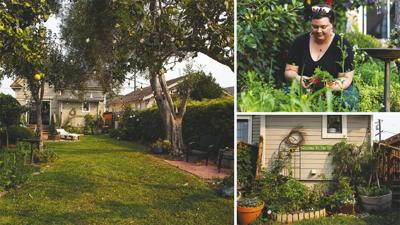

GARDENING IS BUILT INTO YANI AZEVEDO’S HERITAGE. “I’ve probably been gardening as long as I could carry rocks,” she says. She describes her grandfather as a master gardener, and her mother as a lover of English gardens, a tradition that emphasizes colorful flowers and adds structure with lawns and hedges.
Azevedo describes her own garden as “English style,” narrow with flower beds on each side, with a long promenade of grass that leads up to an Italian stone fountain and big red barn-like shed where she workshops tinctures and herbal remedies for her business, Adara Wellness.
When she moved to the Victorian house in Salinas from Monterey six years ago and saw the backyard, she got to work right away installing flower beds and an herb garden. But since the pandemic, she’s been increasingly working on cultivating her garden. “I have been spending a lot more time in my garden,” she says.
The National Gardening Association plugs pandemic-era gardens as the Victory Gardens of our day, referencing the World War II-era movement of growing your own food. “Gardening also gets you out in the fresh air (while respecting social distancing), adds positive energy into your life, gives you something fun to do, and gives a new activity that the whole family can participate in,” per its introductory gardening guidance.
Though Azevedo claims she hasn’t reached the heights of mastery – “I am experienced but I still have much to learn,” she says – she has some ideas for everyone to be able to add a little more green to their lives, even if you don’t have a yard.
“That’s how I started. I was living in a studio before I had a yard,” Azevedo says. “I think you can be more creative with limitations.”
Observe your space.
Whether you have acres of fertile fields or a small balcony, there’s always room for greenery. Azevedo suggests before you start buying up half of the nursery that you identify the places in your yard or house that get the most sun, or where are the patches in your yard that have soil ready to plant in. “Where you plant something will make or break it,” she says. “Really meditate on where things can go and from there, you can go wild with your creativity.”
Food as medicine.
An herb garden on the windowsill is a great starter project for anybody and it can be medicinal and have culinary benefits too. Azevedo recommends starting with easy-to-grow herbs like sage, which she says “grows like a weed.” (As a bonus, it smells good and is full of antioxidants.)
Then add Greek or Italian oregano, which can make a tea that helps with respiratory problems. For those who want flowers, she recommends chamomile which has relaxing properties, and feverfew, which can help soothe migraines. Then of course there is basil, a fan favorite and a good pollinator plant – “so you’ll get butterflies and pesto.”
Three sisters:
Azevedo has two tips for growing food: most vegetables that can grow on the Central Coast need full sunlight, and if you’re just beginning, try planting the three sisters. “Corn, beans and squash – they’re companion plants,” she says, referring to the Native American planting technique in which beans help fix the nitrogen in the soil, squash helps protect the soil, and corn stalks provide a ladder for the beans to climb. “There is a science to it,” she says.
Planting, watering and harvesting food are also a great way to get kids into gardening. In addition to gaining an understanding of where food comes from they’ll have to water their crop regularly, adding a sense of responsibility.
Form and function.
For those who plan on entertaining in their yard, Azevedo recommends natural wood structures. Again referencing indigenous planting traditions, she recommends simple tripod structures in garden beds that can show off climbing vines. And of course, adding a hint of sparkle, like fairy lights, can infuse the space with some atmosphere that can be lost when the sun goes down. As far as finding the right pieces, she says just forage for them. “It could even be a piece of wood you find on the side of the road,” she says.
Start small.
A potted herb on a windowsill or a single barrel on your front porch is still gardening. “It all begins with one planter,” Azevedo says. “Wine barrels or wood planters work great, because they have good drainage.”
And for those who don’t know where to start, there is always help at your local nursery. “Don’t pretend to be an expert, just be honest at the nursery and ask for help,” she says. Whether you’re wondering what to plant in your soil type that’s easy or need help making your rose garden bloom, she recommends asking for guidance.


(0) comments
Welcome to the discussion.
Log In
Keep it Clean. Please avoid obscene, vulgar, lewd, racist or sexually-oriented language.
PLEASE TURN OFF YOUR CAPS LOCK.
Don't Threaten. Threats of harming another person will not be tolerated.
Be Truthful. Don't knowingly lie about anyone or anything.
Be Nice. No racism, sexism or any sort of -ism that is degrading to another person.
Be Proactive. Use the 'Report' link on each comment to let us know of abusive posts.
Share with Us. We'd love to hear eyewitness accounts, the history behind an article.