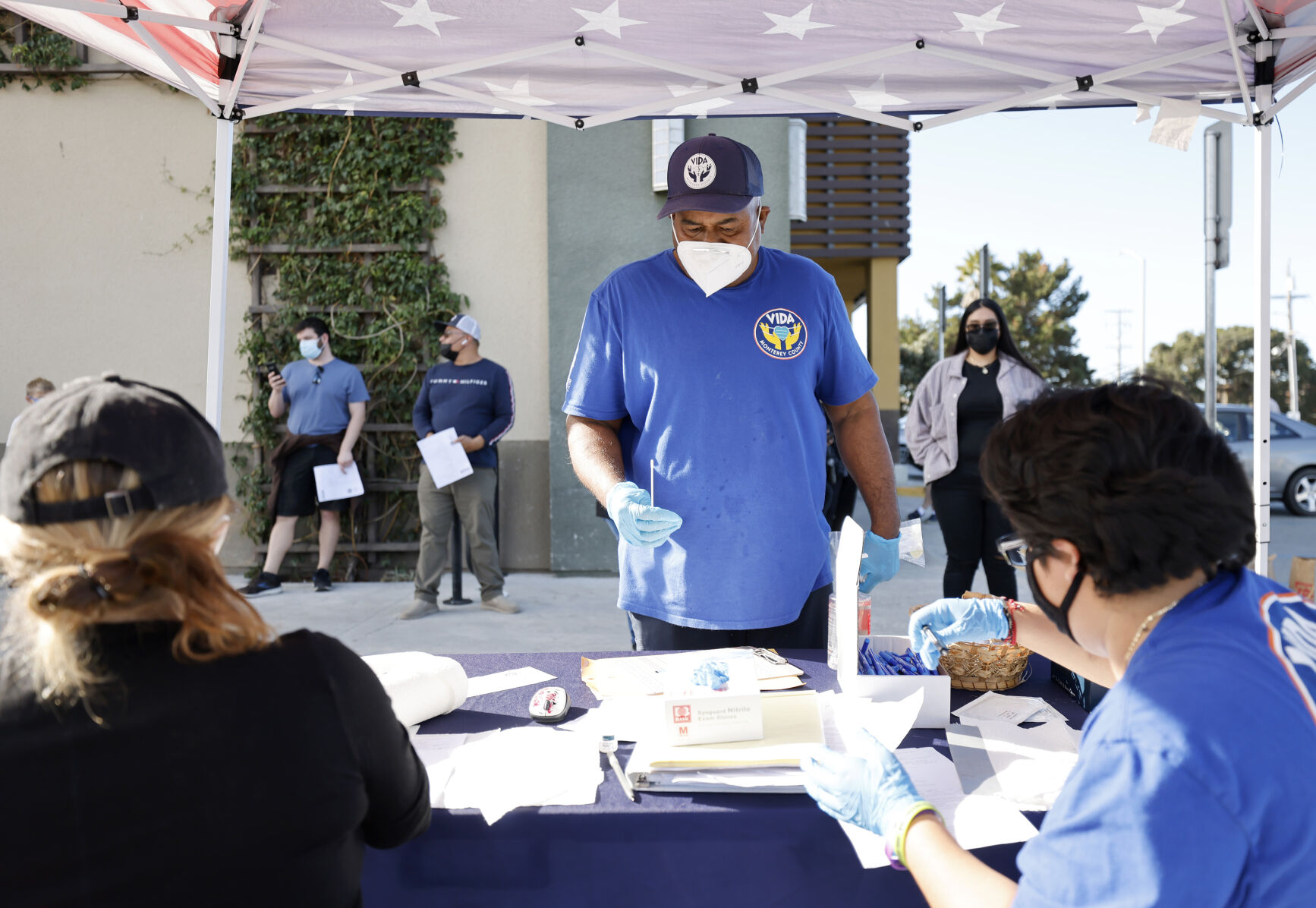
ON A WEDNESDAY AFTERNOON IN JANUARY, DOZENS OF PEOPLE ARE LINED UP OUTSIDE GROCERY OUTLET IN SEASIDE WAITING TO GET A RAPID COVID-19 TEST. It’s a line that ranges from 20 deep to wrapping around the building. The day before, a line wrapped around the block at a rapid testing site at La Chiquita, a market just up Fremont Boulevard.
A group of community health workers from the VIDA Project are working under a small tent, geared up with masks, gloves and wearing matching blue T-shirts. They’re helping people sign up for tests, swab and then producing results in a matter of minutes, to the hundreds of people showing up at each testing site each day during the omicron surge.
VIDA was a program launched to combat the impacts of Covid-19, specifically among the most vulnerable population in the county. It’s a collaborative program, integrating workers from different local organizations including Lideres Campesinas, The Village Project, Building Healthy Communities and others.
The program has evolved since it started in January of 2021, adapting to the needs of the ever-evolving pandemic. VIDA was initially funded by the county of Monterey with $4.9 million, plus another $300,000 from Together Toward Health and $125,000 from the Community Foundation for Monterey County, which administers the program. Another $3.9 million federal health literacy grant will keep the initiative going for another two years, after the original funding is set to end on March 31.
VIDA was originally based on Fresno County’s Covid-19 Equity Project, a collaborative effort that includes over a dozen community-based organizations, Fresno State and UCSF Fresno, that similarly offers outreach and support on communities that are disproportionately impacted by Covid-19. “It was initially modeled after that, and then we kind of took it in our own direction,” says Michael Castro, community initiatives manager at the Community Foundation.
Community health workers have joined the health care ecosystem at a time when the system is under strain. While they are not medical professionals, they are trained to educate and inform people about resources – including about the safety and efficacy of vaccinations, and availability of testing sites – and other community resources, like rental and utilities assistance, or alternative housing sites for isolation for those who test positive. VIDA workers have registered more than 4,600 vaccination appointments and administered over 13,000 rapid tests.
The VIDA program started with over 100 community health workers, and has since downsized to about 50. But they’ve again been hit with soaring demand for their services during the omicron surge: In the first 10 days of January, the VIDA Project tested 3,160 people – 56-percent more than they tested in the entire month of December.
Unlike doctors or clinicians who you see by appointment, community health workers are out and about, walking door-to-door or tabling at popular grocery stores. Many workers are bilingual, and some VIDA staff speak Mexican Indigenous language such as Mixteco, Zapoteco and Triqui.
The community health workers are regular people – farmworkers, students, church members and so on. They are people who live in the area and understand the challenges and needs of their communities, those who “know how to best serve the community,” Castro says, because they are in the community themselves.
One VIDA community health worker is Hufemia Ruiz Perez, a Seaside resident and a student at Monterey Peninsula College. She has worked in different cities such as Salinas, Seaside and Gonzales providing resources and free rapid tests. “What I love is being able to help the community out,” Ruiz Perez says. “And it’s letting them know that they’re not alone, and that they have our support.”
She works for VIDA through The Village Project, one of nine VIDA nonprofit partners, this one with a focus on reaching the Black community. “The Village Project has been doing a lot to make sure everybody’s treated equally with the VIDA Project,” Ruiz Perez adds.
Cecilia Rodriguez, a VIDA coordinator and recent CSU Monterey Bay graduate, knows firsthand how difficult is to navigate the system when you don’t know how to get the resources you need: Her dad broke his leg and then ended up with a $70,000 bill. He eventually got help with filing for disability and enrolling in a payment system to pay off his medical bills.
“That really inspired me,” Rodriguez says, “because sometimes you get stuck in these obstacles and you don’t know what to do.”


(0) comments
Welcome to the discussion.
Log In
Keep it Clean. Please avoid obscene, vulgar, lewd, racist or sexually-oriented language.
PLEASE TURN OFF YOUR CAPS LOCK.
Don't Threaten. Threats of harming another person will not be tolerated.
Be Truthful. Don't knowingly lie about anyone or anything.
Be Nice. No racism, sexism or any sort of -ism that is degrading to another person.
Be Proactive. Use the 'Report' link on each comment to let us know of abusive posts.
Share with Us. We'd love to hear eyewitness accounts, the history behind an article.