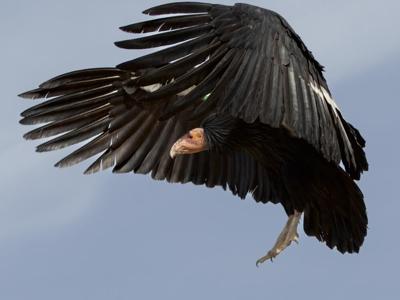

The year 2024 is shaping up to be the best year for California condors since the critically endangered species clawed back from the brink in the 1980s. In 1982 there were just 22 California condors in the world, which were subsequently captured and put into a captive breeding and release program.
The species’ recovery, led in part by local nonprofit Ventana Wildlife Society, has been slowed by a vexing problem: lead bullets. When condors feed on carcasses shot by lead bullets, the lead builds up in the condors’ bodies over time, eventually killing them.
In order to mitigate that threat, VWS has long given out free copper bullets to hunters – the presence of copper doesn’t harm the birds – and Joe Burnett, VWS’ senior biologist, feels like those efforts are finally bearing fruit, as the Central Coast flock has once again surged to over 100 birds in the wild. There are now 110, and there’s been only one death in the flock so far in 2024, compared to 11 in 2023.
It also marks a spectacular bounceback from 2020 when, just as the Central Coast’s flock exceeded 100 condors, the Dolan Fire in Big Sur took the lives of 12 of them, and in that same year 14 condors died due to lead poisoning.
As to whether that’s luck, or the beginning of a new trend, Burnett says, “We’re cautiously optimistic. The cool part is, if this would continue, the recovery [of the flock] would happen much faster.”
Burnett also hopes the trend is at least in part due to an increasing recognition by hunters that condors are amazing wild creatures to have in one’s midst, and hunters, like hikers, spend their time in the wild.
“[Condors] humble you,” Burnett says. “How can you not rally around a big, flying bird? What shouts America more than that?”
Burnett says the best way to assess the resilience of the flock is to do the math: In the past year, nine condor chicks fledged in the wild, and only one bird was lost – a net gain, absent any releases from breeding programs, of eight birds.
“If they keep producing eight to 10 a year, that’s the light at the end of the tunnel,” Burnett says. “That’s recovery.”
He adds, “We knew the lead ammunition switch was going to take a long time. We were in it for the long game… If it takes 20 years to get everyone to switch, that’s less than half the life of a condor.”


(2) comments
Stay tuned for the release of our documentary on our Big Sur flock, Condor Canyon.
Perhaps we should have a buy-back program, where people with older lead-bullets can trade in their ammo for newer bullets with copper or steel. This restoration is great, but moving way to slowly. Every condor counts.
Welcome to the discussion.
Log In
Keep it Clean. Please avoid obscene, vulgar, lewd, racist or sexually-oriented language.
PLEASE TURN OFF YOUR CAPS LOCK.
Don't Threaten. Threats of harming another person will not be tolerated.
Be Truthful. Don't knowingly lie about anyone or anything.
Be Nice. No racism, sexism or any sort of -ism that is degrading to another person.
Be Proactive. Use the 'Report' link on each comment to let us know of abusive posts.
Share with Us. We'd love to hear eyewitness accounts, the history behind an article.