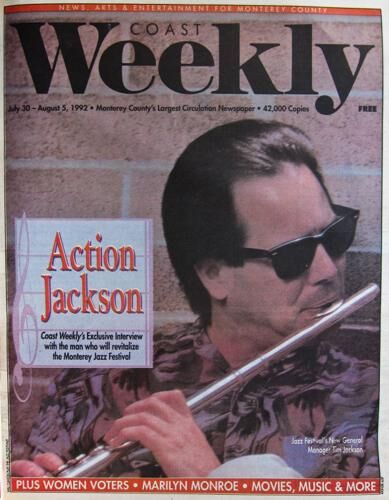

If 75-year-old Monterey Jazz Festival Founder Jimmy Lyons is the king of local jazz, then 38-year-old Tm Jackson is its crown prince.
Lyons, a former San Francisco deejay, parlayed his love of music and his innumerable connections with world-class musicians into the creation of the Monterey Jazz Festival in 1958. This year – the festival’s 35th – Lyons is stepping down as general manager to pass the scepter to Jackson, who helped found the Kuumbwa Jazz Center in Santa Cruz 17 years ago and has served as its executive director practically ever since.
On the surface, the two men don’t appear to have much in common, separated by a generation of musical taste. But if you take away the specifics, the song remains the same.
“I think of myself really as an evolutionist, as opposed to a revolutions,” says Jackson. And in their separate roles in the world of jazz, both men represent the music of their respective eras. As a deejay in Southern California, San Francisco and for Armed Forces radio, Lyons was literally the voice behind some of the best-known music of his time – Big Band artists like Woody Herman, and musicians like Dizzy Gillespie, Dave Brubeck and Paul Desmond, who were on the cutting edge of jazz in the ‘40s, ‘50s and early ‘60s.
As one of the founders of Kuumbwa, a non-profit center dedicated to bringing jazz to Santa Cruz, Jackson has sought to bring jazz into local schools and to introduce local audiences to the musical sounds of today’s jazz generation – musicians like saxist Sonny Fortune, keyboardist Joe Zawinul and the Yellowjackets.
During this year of transition, the two men are producing different parts of the three-day festival. A look at this year’s lineup reflects the blend of two generations. A host of musicians from the very first show will take the stage: Gillespie, Brubeck, Gerry Mulligan and The Modern Jazz Quartet, to name a few. Joining them this year are the artists of Jackson’s generation: the Yellowjackets, and the Marsalis brothers – Wynton, who is appearing with the Lincoln Center Jazz Orchestra and Branford, Jay Leno’s answer to Doc Severinsen. This careful blending of new and old is a tradition Jackson plans to continue.
“My feeling is that there is room for all of that in a festival setting,” says Jackson. “I want to present some of the new artists. I want to present some of the grand masters. I want to present some of the guys who are my age, who are not grand masters and not new lions, who are somehow forgotten. There’s just a phenomenal amount of artistry that can be tapped.”
A musician in his own right who plays both flute and sax, Jackson knows a thing or two about artistry and the jazz tradition. Born and raised in San Jose, Jackson started out playing rock ‘n’ roll guitar in grade school, and then moved into bass by the time he hit junior high, quickly gravitated towards the blues.
“I grew up in the Bay Area,” says Jackson. “That would have been ’67 to ’69 – so it was the San Francisco sound, the rock groups Country Joe and the Fish, and the Doors. I also heard Electric Flag and the Paul Butterfield Blues Band, which were also on the scene, and that is probably what turned me on to blues. I really hadn’t heard jazz at that point. From Butterfield Blues, it was just sort of a natural progression into jazz – sort of moving from blues to funky, more blues-ier forms of jazz: funky blues players like Jimmy Smith and Jack McDuff, funky sax players like David “Fathead” Newman and Eddie Harris. Vocalists like Les McCann.”
As Jackson’s taste evolved so did his musical interests and abilities. From electric rock ‘n’ roll bass, he moved to acoustic bass after high school as he became “pretty much immersed” in jazz. After high school, Jackson moved to Santa Cruz, bought a flute from a friend, “basically taught myself to play” and started studying flute at Cabrillo College.
From Santa Cruz, Jackson moved up to Half Moon Bay and lived for a while at the Bach Dancing and Dynamite Society, a non-profit music organization that would later serve as a model for Kuumbwa. Then came a surfing sojourn to Australia, New Zealand and the South Pacific. When that was over, Jackson finished up his musical education at Cabrillo, transferred to San Jose State University and graduated with a degree in Creative Arts in 1982.
All that study has been put to practical use in Jackson’s own career in music-making. As a member of a group called Uptown, Jackson and his musical cohorts played Top=-40 rock at clubs in the Bay Area and Reno. The band was dissolved, and then re-created as an instrumental jazz group, which produced one record before going down for the final count. Jackson now belongs to a band called Real Time that plays original instrumental jazz with some Latin overtones at select club dates around the Monterey Peninsula and Santa Cruz area. He’s been known to compose a bit, and in a flash, he can whip out his flute and warble a few clear notes, as deftly as Pan on a magical pipe.
“I never really sat down at one point and said “I’m going to make music my career,” says Jackson. “I just always pursued it, and things tended to happen.”
One of the things that happened in the course of Jackson’s warbling and wanderings was the inception of the Kuumbwa Jazz Center – really an outgrowth of ideas Santa Cruz jazz lover Rich Wills shared with Jackson and Kuumbwa co-founder Sheba Burney.
“The idea was to present jazz from a non-profit standpoint, which was really done very little before that point,” says Jackson.
Using the Bach Dancing and Dynamite Society as a jumping-off point, the three started hosting jazz concerts in venues around Santa Cruz in the mid-1970s. In 1977, Kuumbwa opened on Cedar Street in Santa Cruz I a building that was gutted and rebuilt entirely with volunteer labor and donated materials. As Kuumbwa progressed, it was able to become more and more of a community-based center. Today, the center offers such resources as Big Band nights, jazz education and big-name jazz acts for local audiences to enjoy.
“I’m very proud of the fact that after 17 years, we’re still doing pretty much what we started out to do, which was to provide a home for jazz in Santa Cruz,” says Jackson, who has served as Kuumbwa’s executive director --- a job that started out as a volunteer position – since 1977.
Jackson will continue to run the Santa Cruz center, but his new job as general manager of the Monterey Jazz Festival gives him access to more jazz artists than was ever possible and Kuumbwa.
“With Kuumbwa, in a small area doing only one major name concert a week, we don’t have the financial clout to call up Joe Blow and say ‘we want to bring you out for a concert.’ So, what we really had is tie off another date in the Bay Area and sort of ‘block book’ with other venues. But the bottom line is if a venue in San Francisco or the East Bay wanted to bring in an artist for a week, they would obviously have the financial clout to do so.
“The beauty of Monterey is now I have the luxury of reversing that role. We have the budget (approximately $1 million) and the visibility and the reputation to go out to virtually whatever artists I think would be ripe for the festival and be able to bring them out.”
Just how the new general manager will shape the line-up at Monterey is a subject of much speculation in the jazz world. Almost since the beginning, the Monterey Jazz Festival has come under fire from various music critics for remaining in a lovingly well-worn groove of familiar styles, names and well-known faces that loyal audiences came to see year after year. When Lyons first opened the festival in 1958, his personal connections were able to yield a spectacular line-up that read lie a “Who’s Who” roster of the biggest names in jazz: Louis Armstrong, Dizzy Gillespie, Cal Tjader, Dave Brubeck and even a very frail Billie Holiday.
During those heady, early years, a number of important artists premiered history-making works. The very first rendition of Jon Hendricks’ Evolution of the Blues debuted before an enthusiastic Monterey Jazz Festival audience in 1960. Duke Ellington also presented an original composition Suite Thursday in 1960. Lalo Schifrin followed with his tribute to Gillespie, Gillespiana in 1961, and Brubeck presented The Real Ambassadors, featuring Armstrong, in 1962.
Since then, the festival has primarily featured the straight-ahead jazz that Lyons likes. Gillespie comes back a lot. So does the Modern Jazz Quartet and saxist Gerry Mulligan. Some critics have charged that the festival hasn’t kept up with the times. Other jazz aficionados shrug those charges off, since ticket sales – at more than $100 a piece for a three-day admission that includes main stage acts – always sell out.
But just as the festival has always been Lyon’s show, so will it now be Jackson’s, and some people are looking forward to the change.
“It will definitely be a change for the better,” says Philip Elwood, a long-time jazz historian and critic for the San Francisco Examiner, who has been attending the festival regularly since its inception.
Elwood is a self-described admirer of Jackson and predicts, “he will get out of the rut. He’ll bring in more of an international flavor. If his bookings at Kuumbwa are any indication, he’ll be a great deal more adventurous. “
“When we asked him to take on the position, we told him we wanted to concentrate on mainstream jazz, but we also want him to reach out to a broader spectrum in terms of audience,” says Doc Etienne, a local attorney who has served on the Monterey Jazz Festival board of directors for 34 years, and is currently the board’s president. “I think there are a lot of new jazz artists out there who are successful today,” adds Etienne. “We felt Tim was a good person to reach out to the segment of the population who are buying into this new talent that is still jazz, but with different performers.”
John Livingston, a member of Kuumbwa’s board who has known Jackson for 20 years describes him as “conservative” “careful” and “even-keeled” and it is these qualities that the new general manager exhibits as he makes observations about his predecessor’s performance and what might be in store for the Monterey Jazz Festival in the future.
“For the first 15 years of the festival, it was an incredible time and Jimmy was right there,” begins Jackson. “It’s really no longer considered a cutting-edge festival from a musical standpoint. It has become more mainstream, and the artists there are phenomenal artists and all the grand masters of music, but you could make the argument that there has been a lack of diversity. I think it still ranks, in this country, among the top festivals, because you have to go back to Lyon’s personality and his individual stamp…Maybe the focus might be considered somewhat narrow, but he is absolutely committed to the music and he has garnered enormous respect, because of that, over the years.”
Jackson’s own recipe for the festival is a little like gumbo: throw in some familiar ingredients, but don’t be above adding a little unexpected spice to get everyone’s attention. He makes the point that a lot of the artists coming to Monterey this year have performed here before, even though they definitely don’t represent the typical flavor of jazz festivals past. Keyboardist Herbie Hancock has appeared at Monterey before, Marsalis brothers, Wynton and Branford – the personification of modern jazz for many listeners – played Monterey in the early 1980s.
“I’m not really doing anything this year that’s radically different at all,” says Jackson. “But if I think there’s something that’s good for the festival, sure, I’m a firm believer in rattling a few cages.”
For both the audiences and the hundreds of people who work on the festival’s backstage crew, Monterey in September has become something of a pilgrimage, a place to pay tribute to good times, good friends, good food, and of course, good music.
“Jackson says he’s happy to rely on Lyon’s old crew, and he doesn’t plan to muck up the festival’s format, which includes five shows in various venues around the Monterey Fairgrounds, a Saturday afternoon blues show and a Sunday showcase of high school talent.
Jackson’s biggest challenge may be broadening the festival’s audience base while still retaining Monterey’s sell-out crowd.
“The older audience that comes is used to having a kind of stead, mainstream, middle-of-the-road, rather consistent bunch of stuff on stage,” says Elwood. “He’s going to be presenting a lot of different kinds of music – and I imagine, younger music – to an audience not predisposed to like that kind of music because they don’t keep up.”
“I’m hoping that we develop a younger audience,” admits Jackson. “But my feeling is that the jazz audience wants to be surprised and wants to hear new things. If they didn’t have their ears open, they wouldn’t be into jazz in the first place because in many instances, jazz is a music of surprise. It’s an improvisational art form.”
So far, Jackson says he’s received nothing but support and encouragement from both board members and the members of the festival audience he’s managed to meet and talk with.
“It’s not like, ‘gee, we need a change here,’” Jackson explains. “It’s more ‘we’re looking forward to what you’re going to do’.”
Some people might be anxious about taking over a world-class festival, an event that has put Monterey on the musical map and existed – well, almost as long as Jackson himself. But all jazz musicians know the importance of timing, and for Jackson, it is simply time to take center stage and get on with the show.
“It’s exciting, and it’s a challenge, but I’ve been well-prepped,” he says. “I know what I’m doing, and I think I can represent the music. I have the commitment and I have the experience and I’m hoping I can really contribute to extending this legacy of the jazz festival. Only time will tell.”
The Monterey Jazz Festival takes place September 18, 19, 20. Five-show tickets, good for all festival events, are still available for $111.75 by calling 373-3366. Grounds passes, good for Night Club and Garden Stage performances may be available at the gate during the festival for $15 for September 18 and $20 for September 19 and September 20.
“I never really sat down at one point and said ‘I’m going to make music my career.”
(0) comments
Welcome to the discussion.
Log In
Keep it Clean. Please avoid obscene, vulgar, lewd, racist or sexually-oriented language.
PLEASE TURN OFF YOUR CAPS LOCK.
Don't Threaten. Threats of harming another person will not be tolerated.
Be Truthful. Don't knowingly lie about anyone or anything.
Be Nice. No racism, sexism or any sort of -ism that is degrading to another person.
Be Proactive. Use the 'Report' link on each comment to let us know of abusive posts.
Share with Us. We'd love to hear eyewitness accounts, the history behind an article.