





I WILL keep my private life unsullied as an example to all; maintain courageous calm in the face of danger, scorn, or ridicule; develop self-restraint; and be constantly mindful of the welfare of others. Honest in thought and deed in both my personal and official life, I will be exemplary in obeying the laws of the land and the regulations of my department.
– From the Code of Ethics of the Monterey County Sheriff’s Office
Once there was a cop who won a plum assignment. It had him on loan from the Monterey County Sheriff’s Office to the U.S. Drug Enforcement Administration in San Jose. It was there, on a DEA task force, that he would go undercover to make drug buys, or spend hours on surveillance watching people come and go. Sometimes, he would sit in a small room in San Jose listening to phone calls, determining which ones warranted further action under the Title III federal wiretap the task force had obtained, and which ones should be ignored and the recording turned off.
One day in February 2017, the cop found himself back in the sheriff’s office, shooting the breeze and helping colleagues in the sheriff’s investigations unit with a search warrant. When it was done, the commander in charge stopped by his desk and invited him out for afternoon beers at a Salinas pizza joint. It had become a thing they did – get out of the office, eat some pizza, have a few beers and decompress.
He thought about it. He was supposed to head back to San Jose that afternoon for wiretap duty, but then he figured, what the hell. He downed a few, then headed to San Jose. He finished his wiretap room duty, headed home and resumed drinking. At some point, he was hungry and got into his car to hit an ATM before going through a fast-food drive-thru.
It was in the bank parking lot that Soledad police found the detective, passed out in his county-owned vehicle, the car door open, gun and badge on his hip.
After Soledad police reported the incident to the Sheriff’s Office, the Sheriff’s Office launched an internal affairs investigation and he ultimately lost his job. But then, he won it back – sort of. He was stripped of his detective title and cushy assignment, and now works at the jail.

Sheriff Steve Bernal has declined to talk about the DSA payments and has also declined to publicly debate Davis.
Why any of that matters is this: In the midst of an atypically ugly election that’s pitted a politically savvy deputy against incumbent Steve Bernal for the job of the top law enforcement official in the county, there’s an atmosphere of internecine warfare at the Monterey County Sheriff’s Office.
It’s pitted the current sheriff’s administration against rank-and-file deputies, resulted in one commander being fired and four detectives reassigned, led to an investigation into the board of the Deputy Sheriff’s Association – the union that represents deputies and District Attorney’s investigators – by the state Department of Justice and the Fair Political Practices Commission and resulted in two lawsuits being filed against the county and Sheriff Steve Bernal. There have been leaks and accusations of leaks and lawsuits and threats of more lawsuits.
Meanwhile, the sheriff’s office is grappling with ongoing compliance challenges of a 2015 settlement agreement with inmates and the ACLU, which sued over conditions in the county jail. To get staffing up to required levels, commanders pulled 25 deputies off patrol in 2015 and assigned them to the jail – not popular among deputies – and proper staffing and overtime pay have become a major point of contention in the election.
While some of the problems had been simmering below the surface for some time, it exploded the day in February 2017 when Soledad police found the sheriff’s detective passed out in a parking lot. Because when internal affairs investigators got him in a room and asked him when he had started drinking that day, he told the truth: He had started in the middle of that afternoon, out at a pizza place with his fellow detectives.
I RECOGNIZE the badge of my office as a symbol of public faith, and I accept it as a public trust to be held so long as I am true to the ethics of the police service. I will constantly strive to achieve these objectives and ideals, dedicating myself before God to my chosen profession… law enforcement.
– From the Code of Ethics of the Monterey County Sheriff’s Office
The truth, as it turns out, can be a moving target – even in a law enforcement agency, where law and order seems to be an elusive thing. And despite a powerful code of ethics meant to guide employees’ conduct, the private lives of the 449 employees in the Monterey County Sheriff’s Office – nearly 9 percent of the county’s entire workforce – have become the source of publicly polarized factions.
In one version of the truth behind the scandal that came to be known as Pizzagate, the commander who was fired and the four detectives who were reassigned made it a habit of heading out while on duty for their beer-and-pizza decompression sessions.
In another version – this one according to the aforementioned fired commander – he and his crew would roll out after already having spent 10 hours on the job. He says that on that day, they started working a warrant at 5am and left the office at 2:01pm. It’s referred to as “adjustment of duty” and it’s done in order to keep overtime hours at a minimum – if you work 10 hours on one day, you take off a few hours on another day to compensate.
“From the beginning of time there have been people who have consumed alcohol and driven county cars,” he says. He recalls being at conferences with the sheriff and fellow command staff, where drinking and driving was de rigueur.
He says it wasn’t the drinking that got him canned. Instead, he says he was fired for three instances of “failure to supervise” by letting subordinates drink and then drive in county-owned cars, as well as improperly having a weapon in his county-owned car.
“Because I didn’t cry or beg or show remorse, they fired me,” he says. “They threw me out after 22 years and never called me to talk about any of this.”
He and the four who were reassigned are currently in arbitration – he is fighting to get his job back, and the others are seeking return to their old assignments.
“I understand the department could have liability had I gotten into an accident and I apologized for it. They could have given me 30 days on the beach [editor’s note: placed him on leave without pay] to make an example of me, they could have told me if you ever drink and drive in a county car again, you’re done. They could have demoted me and I would have arbitrated it, but I would have accepted it and just did my job.
“This is all I ever wanted to do. Yeah, I made a mistake,” he says, “but is the end result just?”
In the last election, the fired commander was firmly behind Steve Bernal, who he described as a once-close friend of his extended family. This time around, he’s all-in on Team Scott Davis – the deputy and Salinas City Councilman running against Bernal.
I WILL never act officiously or permit personal feelings, prejudices, animosities or friendships to influence my decisions. With no compromise for crime and with relentless prosecution of criminals, I will enforce the law courteously and appropriately without fear or favor, malice or ill will, never employing unnecessary force or violence and never accepting gratuities.
– From the Code of Ethics of the Monterey County Sheriff’s Office
In 2014, Bernal seemed an unlikely contender for sheriff. He was a deputy with no management experience running in a four-way primary against incumbent Scott Miller, the retired chief of the Pacific Grove Police Department. Miller was a rare outsider in a department with a history of electing its own, and Bernal came with a huge fundraising advantage: Margaret Duflock, a San Ardo rancher with leases to oil companies, is Bernal’s brother’s mother-in-law, and she donated more than $100,000 to his campaign.
Bernal also secured the coveted endorsement of the DSA in the four-way contest, after releasing a 10-year plan, focused on the jail. One section was titled “Empowering the Deputies,” and alluded to a culture of unfairness when it came to how punishment was meted out.
“It is essential for deputies to be empowered to maintain the integrity of the jail and enforce departmental policies without the fear of being sent to Internal Affairs every time an inmate complains,” the 2014 plan states.
Some deputies and at least one commander, Jose Mendoza – who had supported Bernal in 2014, then became the first candidate to pull papers to run for sheriff in 2018 – see Pizzagate as evidence of unequal treatment.
Aggrieved about what he says is an unfair promotions process (also an issue for Davis) Mendoza decided he would run himself. “There’s a lot of favoritism, cronyism,” Mendoza says. A 22-year veteran of the department, Mendoza has been a career jail guy. After Bernal was elected, he applied for the position of captain, but didn’t get hired.
For that job, he was passed over by another internal candidate, Jim Bass. Mendoza, who is Latino, also took issue with Bernal hiring white men at or near retirement, two of them from San Bernardino County, as his top-level advisers. “One promise was he was going to promote from within the department,” Mendoza says. “He made a lot of promises which he did not keep.”
Like Davis, he claims the promotion process is unfair. He complained, then says his superior retaliated against him, forcing him into an undesirable job as the commander in charge of administrative functions at the jail and requiring him to take a “fitness for duty” psych exam. He filed a complaint with the county Civil Rights Office, which Mendoza says found no wrongdoing.
“My family said, ‘Instead of complaining, why don’t you do something about it?’ I said, ‘Why don’t I run for sheriff?’”

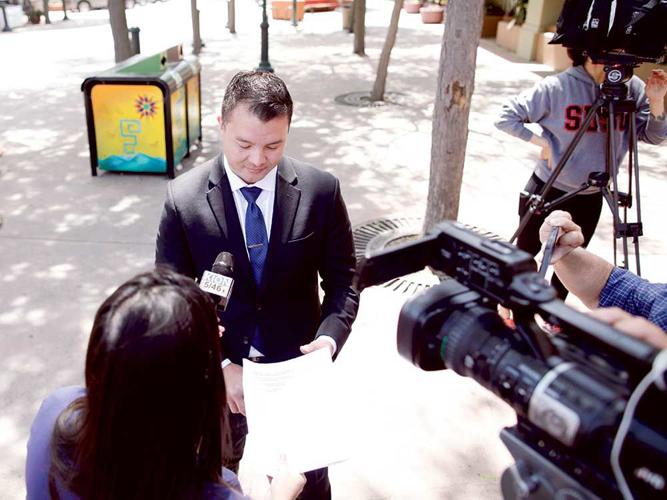
Scott Davis speaks with members of the media after a press conference in which commanders released copies of checks they say Davis co-signed from the DSA to a campaign consultant. He denied the signature was his, and called it “total nonsense” for anyone to say they were.
Mendoza withdrew after Davis, a friend of his – and his city councilmember, in Salinas’ District 1 – got the endorsement of the deputies. Mendoza became a rare member of the command staff supporting Davis. “I’ve kind of been on my own little island,” he says. “When I announced I was running for sheriff, that made me even more of an outsider.”
Davis has made the promotions process a campaign issue, arguing it’s too subjective. He says the existing system for deputies seeking sergeant positions, a 15-minute written exam, should be replaced with a more standardized process. “We need an objective, fair, transparent process where it’s not about who I know or what circle I’m part of,” Davis says. “When we get back to that as the root of our promotional process, we won’t have infighting.”
Mendoza says the turmoil of the past year has only deepened an internal rift: “Right now, the department is in crisis. Morale is at an all-time low.”
AS A LAW ENFORCEMENT OFFICER, my fundamental duty is to serve mankind; to safeguard lives and property; to protect the innocent against deception, the weak against oppression or intimidation, and the peaceful against violence or disorder; and to respect the Constitutional rights of all men to liberty, equality and justice.
– From the Code of Ethics of the Monterey County Sheriff’s Office
Scott Davis likes to tell a story on the campaign trail about a night last October. He was on patrol, driving around Prunedale, when a call came through on his radio. It was a Code 3, a domestic violence incident on Pine Canyon Road outside of King City, about 60 miles away. Davis exceeded 120 miles an hour to get there, where he found a woman who’d been severely beaten, left with deep bruises and a chunk of hair missing.
Her boyfriend had already left by the time he arrived.
“I was the closest deputy,” he says. “This is exactly what we’re living in.”
Davis promises to get more deputies assigned to patrol, reduce the department’s overtime budget and change the staffing system – promises that resonate with deputies. But it’s not clear whether he could make the staffing changes he wants to see without the blessing of a federal judge. And current sheriff’s administrators think a federal judge wouldn’t sign off on changes to the current staffing plan at the jail.
In 2013, former and current jail inmates filed a lawsuit against Monterey County in federal court, alleging substandard conditions and a series of failures when it came to medical care and access for inmates with disabilities. In 2015, the county agreed to pay $4.8 million in attorney’s fees, and to make improvements in the jail to settle Hernandez v. Monterey County. Per that agreement, court-approved monitors verify improvements are being made.
Among the conditions of the settlement: In addition to state-mandated checks on inmates that must happen every hour, the Monterey County Jail was required to add half-hour checks for certain inmates. It also required a staffing analysis. Undersheriff John Mineau has compiled spreadsheet upon spreadsheet to arrive at the current staffing level: 118 deputies.
“The jail was woefully understaffed for a really long time,” Mineau says.
By law, the jail must be staffed 24/7, and it takes about 4.5 people to fill one spot 24/7 once you’ve factored in sick time, required training and other time off, by Mineau’s calculations.
In 2012, there were 88 deputies assigned to the jail; in 2013, the sheriff’s office introduced 12 civilian positions to operate controls in the jail – essential security functions, like opening and closing perimeter gates and sally ports for inmates to come and go from court. “That ‘civilianized’ a chunk of the jail, and it freed people up for positions where we actually needed to have peace officers working the floors,” Mineau says. “We worked really hard to come up with a number; we didn’t want to underdo it, and we didn’t want to overdo it. I feel so confident in that 118 number.”
In 2015, to comply with the settlement, 25 patrol deputies were reassigned to work the jail. While most have since been transferred back to patrol, it was an unpopular decision. Two of the three sheriff’s substations, in Monterey and King City, remain unstaffed in the evenings, leading to Davis’ situation of having to make an hour’s drive to respond to a violent crime in progress.
The jail also transitioned from two 12-hour shifts to three shifts – two eight-hour shifts and a 10-hour graveyard shift, with briefings in between.
“Nowhere in [the settlement] does it say, thou shalt conduct briefings,” Mineau says. “But it refers to briefings. It would be really hard for us to run a jail if we didn’t have a chance to get everyone together.”
(Mineau declined to speak about the election, but he is an at-will employee who was hired by Bernal. He’s also the third undersheriff in three-and-a-half years; one of his predecessors, Galen Bohner, as well as former Chief of Enforcement Tracy Brown, are endorsing Davis.)
In his 10-year plan in 2014, Bernal pledged to change staffing at the jail: “Because of the arbitrary decisions of our current administration, working conditions at the jail are unacceptable to say the least. I can assure you that I understand your frustration, and plan to do all that I can to address it and change it!”
In the past eight years – under the previous sheriff, Scott Miller, and Bernal – Davis says he’s presented about 20 alternate staffing plans to the leadership, but nothing has stuck.
“We should be more efficient than we are,” Davis says. “We have quite a bit more bodies [in the jail], yet we still aren’t in compliance.”
Whatever I see or hear of a confidential nature or that is confided to me in my official capacity will be kept ever secret unless revelation is necessary in the performance of my duty.
– From the Code of Ethics of the Monterey County Sheriff’s Office
The story of that fired commander? That’s what leads to the tale of the leaks and the lawsuits.
Last Sept. 8, KSBW’s Felix Cortez broke the news that the Sheriff’s Office was investigating allegations that multiple deputies had been seen drinking while on duty – this despite the fact that all involved were plain-clothes detectives. Cortez found out about it because someone leaked it to him, and he got Bernal on camera saying he was limited on what he could say about the investigation because the department didn’t want to violate employee confidentiality. The accused are entitled to it under the Peace Officers Bill of Rights; they are represented by Mastagni Holstedt, a law firm out of Sacramento that’s paid for by the union.
Here’s where things went off the rails.
Last October, Shawn Collins, then an attorney with Mastagni Holstedt, sent Monterey County Deputy Counsel Janet Holmes a list of information he sought in the defense of his clients in advance of their Skelly hearings – a due process procedure that allows public employees to learn about allegations against them, and refute them. Among the information Collins wanted: “Any communications between Sheriff Steve Bernal and anyone in his employ or under his command, with the numerous media outlets who have reported on these confidential (internal affairs) investigations.” Collins wrote his request included all communications stored on personal or business devices.
And much like word of the Pizzagate investigation leaked to Cortez, the Collins’ letter, which included the full names of his clients, was for reasons nobody can explain made a public document and sent by an anonymous third-party to the Weekly.
It wasn’t the only thing that leaked.
About the same time Cortez reported the Pizzagate investigation, Davis filed his papers with the Monterey County Elections Department to run against Bernal. And almost immediately, deputies lined up to take sides.
The board of the DSA threw down behind Davis, who had been president of the board and on its political action committee, or PAC, in previous years – in part, that’s because Davis, if elected, has vowed to shrink the command staff.
Not unexpectedly, most of the current command staff threw down behind Bernal. (Mendoza is an exception.)

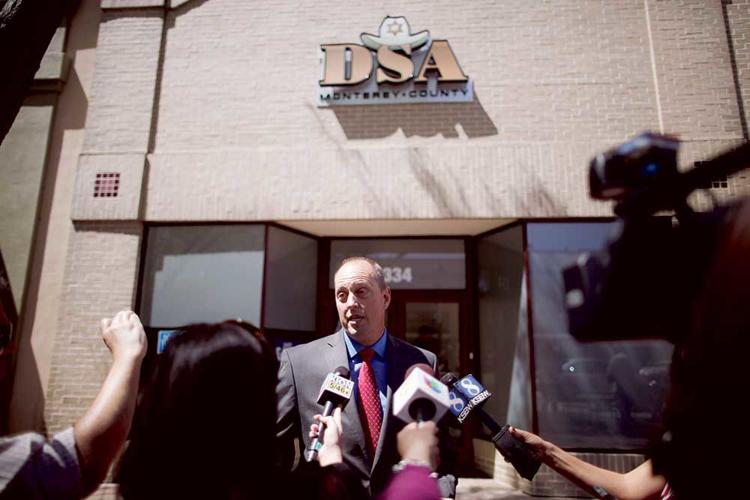
Joe Moses, a former Deputy Sheriff’s Association board member, held the first in a series of press conferences about payments by the DSA to a consultant also hired by Scott Davis’ campaign.
One pro-Bernal commander, Joe Moses, won a seat on the DSA board last fall, and began asking questions about how union dues were being spent. For example, why had the union gone from spending $4,700 for rent and office expenses in 2016 to $39,000 in 2017? Why had the cost of outside services gone from $4,200 in 2016 to $53,000 in 2017? And why had $31,000 of that $53,000 gone to a consultant hired not only to advise the union on long-term planning, but who was also hired to consult on Davis’ sheriff’s campaign?
Those complaints were handled privately, among the board and the membership, until suddenly, they weren’t. Another anonymous source emailed the Weekly a six-page manifesto titled “Deputy Sheriff’s Association President and Board Mismanagement of DSA.” It outlined a litany of complaints: the spending, the secrecy surrounding it, the difficulty Moses had in obtaining the union’s financial records and the demand by Mastagni Holstedt that sheriff’s office employees turn over their electronic devices for scrutiny. It also included DSA financial records dating back to 2016 showing how money had been spent.
Within a week of that anonymous manifesto being sent out, Moses held a press conference in front of the DSA office in Oldtown Salinas. He announced he and the other commanders had just been kicked out of the union, as a purge of the “C-Unit.” Now, members of the C-Unit were calling upon the state Fair Political Practices Commission to investigate the union’s finances, specifically the spending of union dues on Davis’ campaign consultant.
Three days later, on April 20, the DSA (and DSA Treasurer Ted Avery and President Dan Mitchell)filed a lawsuit against Sheriff Steve Bernal and Monterey County, describing the press conference as illegal retaliation against them for their political support of Davis: “Petitioners bring this action to stop Sheriff Steve Bernal and the County of Monterey from retaliating against the DSA and its members for engaging in protected activities including, among other things, refusing to endorse Sheriff Bernal in his re-election campaign.”
Then came another whammy: On April 25, two other commanders, Mark Caldwell and Archie Warren – also acting in their capacity as union members, or by then, former union members – held another press conference outside the DSA office. They presented copies of at least five checks that they say Davis – who was no longer a DSA board member – had co-signed, along with Mitchell, to a Davis campaign consultant.
Davis, who had ambled up to the press conference and stood by watching it, categorically denied the signatures on those checks are his. In a press conference of his own a couple weeks later, Davis said he wouldn’t request an investigation into whether someone forged his signature on those checks, because it looked to him like a victimless crime: “To have a crime, you have to have a victim,” he said. (He did not feel that he’d been victimized.)
The day after Caldwell and Warren’s press conference, April 26, the DSA filed a second lawsuit against the county and Bernal, alleging the release by the county of the Mastagni Holstedt letter that ended up in the Weekly’s hands violated the privacy rights of the deputies and commander named in that letter, and caused them emotional distress.
On May 8, the state Department of Justice launched an inquiry into allegations that the union committed fraud by laundering union dues into Davis’s campaign.
On May 21, Davis’ campaign staffer lodged his own complaint with the FPPC, asking for an investigation into allegedly unreported gifts to Bernal, and on May 23, asked the DOJ to investigate the commanders who announced their concerned about the DSA checks. (As of theWeekly’s deadline, FPPC had not determined whether to open an investigation; a DOJ spokesperson did not respond.)
That pretty much brings us current.
Where either the DOJ or the FPPC investigations stand as of this writing remains to be seen.
The first lawsuit filed by the DSA on behalf of Dan Mitchell is scheduled to go to court for a case management conference on Aug. 21. The second, filed against Bernal and the county by the DSA on behalf of the fired commander and the reassigned detectives, goes to court a week later, on Aug. 28.
By then, the election will be long over. With a two-way contest in the June 5 primary, there will be no runoff in November.
(0) comments
Welcome to the discussion.
Log In
Keep it Clean. Please avoid obscene, vulgar, lewd, racist or sexually-oriented language.
PLEASE TURN OFF YOUR CAPS LOCK.
Don't Threaten. Threats of harming another person will not be tolerated.
Be Truthful. Don't knowingly lie about anyone or anything.
Be Nice. No racism, sexism or any sort of -ism that is degrading to another person.
Be Proactive. Use the 'Report' link on each comment to let us know of abusive posts.
Share with Us. We'd love to hear eyewitness accounts, the history behind an article.