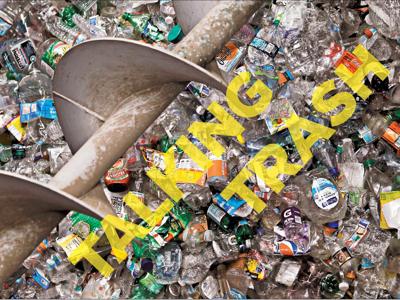

There is one city on the Monterey Peninsula that does not send its recyclables to the Monterey Regional Waste Management District’s new materials recycling facility: the city of Monterey.
For decades, Monterey has had an exclusive contract with Monterey City Disposal Service, a family-owned company that has operated a city-owned MRF in Ryan Ranch since 1994.
Owner and operator Tom Parola has been there from the start, and recently took over the company last April after the passing of his father, Gary.
Parola says he’s been seeing the drop-off in demand for recyclables for at least the past year, and probably has about 30-40 truckloads of material currently stockpiled on sight.
“I’m not panicking yet,” Parola says of China’s new restrictions, which require less than 0.5-percent contamination of loads of mixed paper and plastic (see story, page 22).
In the past, Parola says, he’s seen four to five months go by without a single truck coming to take materials away, but that was due to longshoremen strikes at ports. Past market slowdowns, he says, have typically only impacted his MRF for two to three months.
Right now, he says, his company is losing money on mixed paper – it costs more money to ship it overseas, about $30 per ton to get it to India, which is more than the $10 per ton he’s getting for it. But it’s still cheaper than the $50 per ton to send it to the Marina landfill.
He’s envious of the machinery MRWMD has at their new MRF, but emphasizes that the challenges his MRF is facing are industry-wide.
“We need to require people to sell us stuff that’s environmentally responsible,” he says.
“We rely so much on recycling, and rely on other markets to handle our recycling, and then the market goes away, and then we just went backward.”
He believes the state, and government regulators and agencies, are key to changing the landscape, because he thinks there is a “better way” to deal with our waste.
And it starts with the source of the waste – things like junk mail – that are not readily recyclable, because there isn’t a demand for it.
“Some say milk cartons are recyclable, but we can’t find anyone to buy them,” he says, adding that our consumptive habits – which skew toward convenience and disposability, rather than recyclability – are “coming home to roost.”
“We need to address our problems better,” Parola says. “It’s going to be difficult, but that’s the goal we need to shift toward.”
(0) comments
Welcome to the discussion.
Log In
Keep it Clean. Please avoid obscene, vulgar, lewd, racist or sexually-oriented language.
PLEASE TURN OFF YOUR CAPS LOCK.
Don't Threaten. Threats of harming another person will not be tolerated.
Be Truthful. Don't knowingly lie about anyone or anything.
Be Nice. No racism, sexism or any sort of -ism that is degrading to another person.
Be Proactive. Use the 'Report' link on each comment to let us know of abusive posts.
Share with Us. We'd love to hear eyewitness accounts, the history behind an article.