WHEN THE MUSICIANS, CONDUCTORS, GUEST PERFORMERS, SUPPORT STAFF AND AUDIENCES RECONVENE for the 85th running of the Carmel Bach Festival, they will see and hear a festival that will be both similar to and quite different from its previous iterations – a blending of both old and new that is very much in the DNA of this two-week-long summer festival.
As in years past, the festival’s programming will be anchored by a handful of all-stars from the classical canon – Beethoven’s Symphony No. 7, the massive Brahms Requiem and J.S. Bach’s own St. John Passion and his Easter Oratorio.
Also still present are the chamber concerts, a series of 26 events featuring smaller ensembles like duos, trios, quartets and solo recitals with festival principal keyboardist Andrew Arthur offering two all-Bach solo concerts exploring the amazing organ at the Carmel Mission Basilica on Monday mornings, and festival orchestra member Dan Swenberg on solo lute compositions in the Sunset Center foyer on Thursday afternoons. Also returning is the popular Adventures of Leonard and Rasmus Saturday morning family concert, priced at $11 and meant for listeners of all ages.
For the first time since 2019 there will be four concerts at the Carmel Mission, the two aforementioned all-Bach organ recitals and two liturgical, mostly a cappella choral outings with Festival associate conductor Andrew Megill leading the chorale.
“This program is an emotional journey through 500 years of sacred British choral music from otherworldly medieval carols right up to 20th-century modern works,” Megill says. “The magic of the concerts at the mission is the way it incorporates the aesthetic and the beauty of the building itself.”
Scott Seward, festival director of marketing and education, echoes that when it comes to the physical space itself. “It’s a spectacular venue for vocal music,” he says. “The sound just mixes and swirls way up in the cavernous roof, with candlelight and with the final notes performed outside for the audience still seated indoors. It’s pretty special.”
That’s the “old” – the stalwart, the classic.
BRAND NEW THIS YEAR, meanwhile, is the inclusion of three guest conductors – Dinis Sousa, Grete Pedersen and Nicholas McGegan – invited to the festival to fill a vacuum created by the departure of longtime Principal Conductor Paul Goodwin. The festival has also formed a search committee and hopes to fill the vacant position before their 2023 event.
A part of the festival also affected by Goodwin’s exit was programming, as he was also the event’s artistic director, so each of the three guests were asked to choose two pieces each to perform.
“This year’s programs were chosen by the guest conductors working in concert with the search committee and our seven-member artistic leadership group,” Seward says. “Everyone involved says it was quite an amazing collaborative experience.”
Guest conductor Dinis Sousa, currently principal conductor of the Royal Northern Sinfonia, a British chamber orchestra, opens the festival on Thursday, July 14 with Purcell’s lively Suite of Dances, Handel’s Concerto Grosso Opus 6 and Bach’s Orchestral Suite No. 3, famous for its joyous, highly melodic second movement which carries the nickname “Air on the G String.” He will also lead the Brahms Requiem on Saturday, July 16.
Seward is excited about this piece of the 2022 programming.
“Almost all requiems are about fire and brimstone and fear and damnation,” he says. “This one is very peaceful and almost serene, which is rare in the literature. And it’s a massive work for two choirs, two vocal soloists and the full festival orchestra.”
Another new component happens on both Friday nights (July 22 and 29) and is created by festival orchestra violinist Edwin Huizinga, who has enjoyed a 17-year history with the event. More recently, his work with Santa Cruz guitarist William Coulter as the duo Fire and Grace has become wildly popular – and this year he’s bringing it into the Bach Festival fold.
This is perhaps the most esoteric offering of this year’s festival, which Huizinga has dubbed Pangaea: One World, a geological name for the Earth’s land mass nearly 300 million years ago when the continents were all still connected to one another.
“I’m hoping it will be easy to see where I’m going by naming this concert that,” Huizinga says. “One land mass, one world, one people, one music. It’s time to reunite and conquer all the divisiveness and social isolation that has separated us all so much for far too long.”
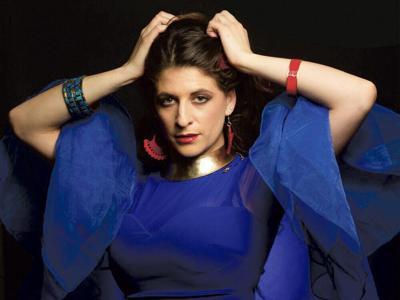
To that end, Pangaea will offer genres and instruments rarely if ever heard on a classical concert stage. Jazz-inflected mandolinist Eva Scow and accordionist Samantha Harvey will join Fire and Grace for an Americana music (pre-bluegrass) set. Harvey will also join the duo along with Irish piper Brian Bigley to make a quartet for a set of traditional Celtic fiddle tunes. The outing will also include two female dancers – Fanny Foto (flamenco) and Canada-based Tamar Ilana (Old World vocals, folk dances and percussion.)
“Bill Coulter and I have been working for two years on this concept, and I have been pitching it even longer than that,” Huizinga says. “We were going to do it in 2020, but we all know what happened with that. We’re beyond thrilled it has finally come to fruition.”
On the evening of July 17, associate conductor Megill will lead the full orchestra, the chorale and four soloists in Bach’s St. John Passion, the first of the four Passions he wrote and generally regarded as the most anguished, relentless and intense.
“The themes the St. John Passion explores go beyond the walls of any specific church or denomination,” Megill explains. “Light versus darkness, truth versus falsehood, how we are constrained by and transcend the bonds of time, and the good and evil that lie within the human heart.”
Visiting conductor Grete Pedersen, who since 1990 has been music director of the Norwegian Soloists’ Choir in Oslo, appears on Thursday, July 21, for a reading of Beethoven’s Symphony No. 7, which composer Richard Wagner once called “the apotheosis of the dance,” owing to its breakneck pace.
“While it begins slowly, by halfway through the last movement the tempo is so blistering it almost seems frantic,” Seward says.
This year’s festival comes to a close on Saturday, July 30 with Bach’s Easter Oratorio. Guest conductor Nicholas McGegan takes the podium and baton to lead the Chorale, four vocal soloists and the full Festival orchestra. McGegan is no stranger to local audiences owing to his tenure as the former director of the Bay Area’s Philharmonia Baroque Orchestra.
“Bach wrote a few oratorios,” Seward says, “but Easter is generally regarded as his most triumphant, with all of his consummate artistry and compositional genius on full display.”
CARMEL BACH FESTIVAL runs Thursday, July 14-Saturday, 30. Times and locations vary; visit the website for full schedule. Tickets run $11-$87; active military, student and youth discounts are available. 624-1521, bachfestival.org
(0) comments
Welcome to the discussion.
Log In
Keep it Clean. Please avoid obscene, vulgar, lewd, racist or sexually-oriented language.
PLEASE TURN OFF YOUR CAPS LOCK.
Don't Threaten. Threats of harming another person will not be tolerated.
Be Truthful. Don't knowingly lie about anyone or anything.
Be Nice. No racism, sexism or any sort of -ism that is degrading to another person.
Be Proactive. Use the 'Report' link on each comment to let us know of abusive posts.
Share with Us. We'd love to hear eyewitness accounts, the history behind an article.