
Steve Friedlander vividly remembers his introduction to classical music from decades ago. Growing up in Oklahoma City, the local symphony’s traveling ensemble stopped by his elementary school to set up and play a concert. The rest is history.
“I heard those instruments for the first time and the acoustics in real time and not through a record player or phonograph and it just, yeah, it got to me,” Friedlander says.
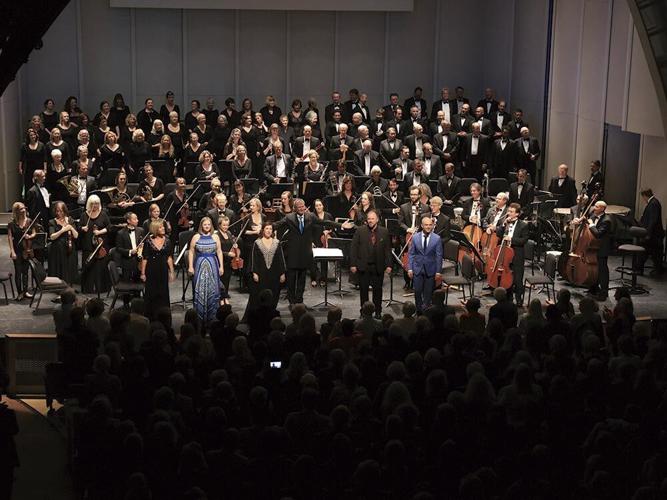
Friedlander, now executive director of the Carmel Bach Festival, is gearing up for the classical music festival’s 85th season. Despite the event’s obvious staying power – Friedlander says it is one of the country’s longest-running summer festivals – the question of longevity into the future remains a chief concern for a festival centered around music that is hundreds of years old.
“I think the questions of staying power and sustainability are real issues,” Friedlander says from his Carmel office. “But rumors about the demise of classical music are greatly exaggerated.”
CLASSICAL MUSIC’S DEATH KNELL HAS BEEN RUNG THROUGHOUT THE 20TH AND 21ST CENTURIES, especially through the advent and rise of genres such as jazz and rock ‘n’ roll. Yet cities throughout the world today claim their own well-funded classical music institutions and symphony orchestras. The National Endowment for the Arts reported that in 2015 – the most recent numbers available – nonprofit symphonies and chamber ensembles contributed $1.9 billion to the U.S. economy. The Monterey Peninsula alone hosts the Carmel Bach Festival, the Carmel Music Society, Chamber Music Monterey Bay and the Monterey Symphony, each a vibrant, established organization, the youngest of which is 56 years old.
Despite this, classical music does face some existential questions. Although the art form has remained alive through the generations, it has largely survived off the gravitational pull of the masterworks by composers from the 17th, 18th and 19th centuries. This has apparently been true throughout the 20th century. American music critic Virgil Thomson wrote of the symphonic repertoire in 1939, “From Tokyo to Lisbon, from Tel Aviv to Seattle, 90 percent of it is the same 50 pieces.” According to Bachtrack.com, a website dedicated to tracking trends and data in classical music, opera and dance, the 10 most popular concert composers in 2019 were all white men who died between 1750 and 1893 – the top three were Beethoven, Mozart and Bach. Over 13 percent of the 34,648 concert, opera and dance performances Bachtrack tracked in 2019 featured a work by Beethoven; less than a quarter of classical music concerts in the U.S. in 2019 featured a piece by a living composer.
According to Billboard and Nielsen ratings, classical music made up 1 percent of the total music industry market share in 2021, the smallest of the 11 genres the data tracks. This is a position the classical music genre has regularly occupied over at least the last decade. The National Endowment for the Arts reports that only 8.6 percent of the U.S. population attended a classical music performance in 2017, the latest data available.
Classical music may be hanging on by a thread, but it’s a sturdy enough thread to keep organizations such as the Carmel Bach Festival, Monterey Symphony, and others like them throughout the country afloat.

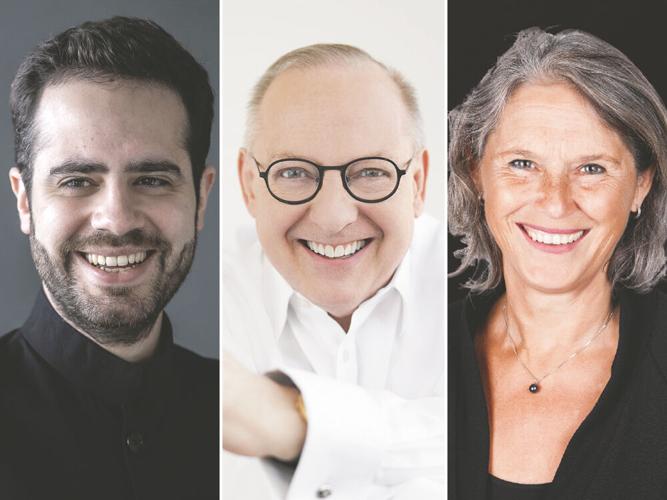
Top: (left) Dinis Sousa is one of three guest conductors invited to the 85th Carmel Bach Festival. He is currently the principal conductor of the Royal Northern Sinfonia, a British chamber orchestra.| (center) Nicholas McGegan is a well-established baroque conductor who has been called “an expert in 18th-century style” by The New Yorker. | (right) Grete Pedersen is a Norwegian conductor who will bring some Scandinavian flair to the concerts she conducts as part of this year’s Bach Fest.
REGARDLESS OF LOYALTY, NO AUDIENCE MEMBER STICKS AROUND FOREVER – Friedlander says the Bach Festival’s audience skews 65 years old and up – and new audiences are critical for the future of the classical music ecosystem. Friedlander knows from his own experience the potential impact of classical music brought to where people are. Before the pandemic, the Bach Festival prioritized performing classical music in local schools and it is something Friedlander says will pick back up again, eventually, as a way to capture attention at one end of the audience spectrum.
The well of potential new adult listeners doesn’t necessarily require new, fresh compositions to bring them in – sometimes they just need the popular masterpieces of the old guard performed with excellence. The Bach Festival enjoyed record ticket sales in 2018 and 2019, which Friedlander attributes to “blockbuster” programming, such as Beethoven’s Ninth Symphony – a piece that is nearly 200 years old.
Often, however, new audiences need a new format, something that breaks the stuffy etiquette of chamber music halls, says Nicola Reilly, executive director of the Monterey Symphony. Bringing new listeners in is central to the organization’s mission.
“There are some perceptions of classical music that I think are correct: that it’s elitist, expensive and in some cases prohibitively expensive,” Reilly says. “We’re trying to break that down without sacrificing our business model. We’re trying to take classical music to places where it’s not this sort of reverent concert hall.”
The Monterey Symphony has tried to tailor some of its programming around this crowd with orchestras that perform popular music at the Forest Theater, and with pre-concert parties where the audience can meet the conductor and musicians.
“One thing hurting classical music is that our collective attention span is getting so much smaller and classical music was not built for short attention spans,” Reilly says.
Yet, she remains unconvinced that classical music is under any existential threat. But that is not a license to stagnate creatively. After all, classical music is an art form, and artforms must remain alive and breathing lest they become cold procedures.
Cyril Yansouni, chairman of the Bach Festival’s board of directors, understands the importance of introducing new music into the repertoire, but admits the walk between pushing the envelope and leaning on the old canon is like tiptoeing on a tightrope.
“We clearly have to cater to our core constituency because, frankly, they are the people who are [older] and can write the checks,” Yansouni says. “You also have to take some risks and trust the musicians and artistic director, but at the same time you have to tell them we cannot have innovation every evening or else we’re going to go broke. You have to balance the finances with the more adventurous stuff.”

A blending of both old and new is very much in the DNA of this two-week-long summer festival.
THE MONTEREY SYMPHONY IN JUNE LET THE COMMUNITY KNOW it was going to lean more toward pushing the envelope in the future after hiring Jayce Ogren as the new artistic director. Ogren has been called one of the most innovative and versatile in his profession, and is known to take on large-scale, challenging projects. He tells the Weekly the projects he tends to pursue are “outside the normal symphonic repertoire.”
Ogren earned the position through a live concert audition. That’s a strategy the Carmel Bach Festival is also pursuing with the three guest conductors invited to come perform throughout this year’s festival (see story, right) and, potentially, take the reign of new artistic director.
That role has been empty since maestro Paul Goodwin’s 11-year reign unexpectedly ended after 2021’s abbreviated festival. Goodwin tells the Weekly a tension existed between the festival’s innovative and traditional factions – a frequent burden on artistic directors. He says although innovation is key, the most important factor in sustainability is engagement with the community and audiences festival leadership wants to attract.
“It is all very well presenting innovative and interesting musical ideas, but it is essential that you bring your public, donors and board members along with you on that journey,” Goodwin says via email.
Yansouni says the board wants a leader who can inspire the musicians and collaborate freely, as well as schmooze with patrons and donors.
Yansouni too is concerned with longevity. He says drawing in that middle-aged demographic, people in their 20s, 30s and 40s, is especially critical to the future of the Carmel Bach Festival, and programming focused on that age group is something the board will work on with the new artistic director.
“The new conductor could be a good way to highlight that,” Yansouni says. “We’ll have to use the announcement as a vehicle to get some attention.”
(0) comments
Welcome to the discussion.
Log In
Keep it Clean. Please avoid obscene, vulgar, lewd, racist or sexually-oriented language.
PLEASE TURN OFF YOUR CAPS LOCK.
Don't Threaten. Threats of harming another person will not be tolerated.
Be Truthful. Don't knowingly lie about anyone or anything.
Be Nice. No racism, sexism or any sort of -ism that is degrading to another person.
Be Proactive. Use the 'Report' link on each comment to let us know of abusive posts.
Share with Us. We'd love to hear eyewitness accounts, the history behind an article.