



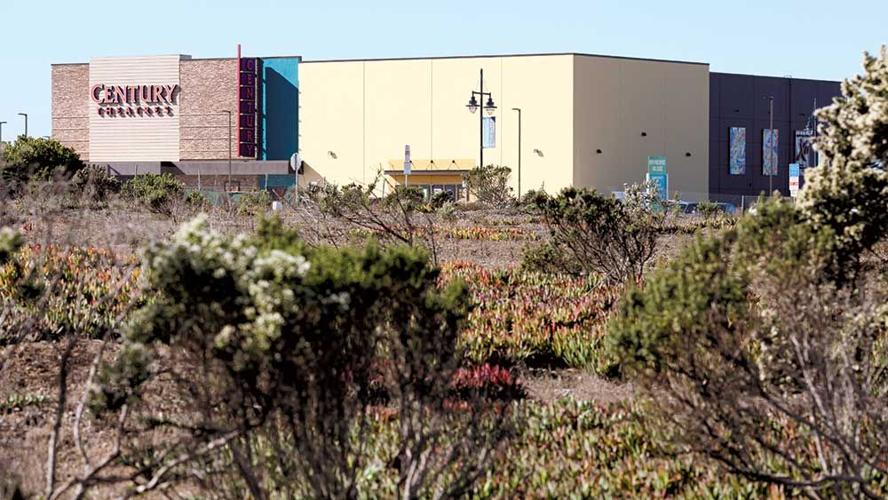


The doors aren’t yet open, but you can practically taste the buttered popcorn.
It’s just past 5:40pm, Oct. 7, at the invite-only party at Marina’s new five-screen Cinemark movie theater, which is set to open the next day.
Locals, many of them teenagers, stroll in from the parking lot and add to the line, which is stretching ever longer outside the theater doors. The Marina High School band stands off to the side, entertaining the crowd with brass and beats, while about two dozen Marina High cheerleaders dance, shake their pom poms and fill the air with high-pitched cheer.
The excitement in the air is palpable, and though the band and cheerleaders are working hard to keep it that way, maybe they don’t need to be. Marina residents have been waiting for this theater for years, and by the looks on many of their faces, some doubted this day would ever come.
Around 5:45pm, the band puts their instruments away and the cheerleaders break their formation. The cheerleaders line up on both sides of the line near the doors, forming a tunnel of sorts with their pom poms in the air.
When doors swing open moments later, the ticket takers stand ready on either side. As the attendees eagerly shuffle inside, the cheering begins anew.
“Let’s go Marina, let’s go! Let’s go Marina, let’s go!”
The evening’s films don’t start showing until 7pm, and dozens of people mill around the lobby aimlessly, munching on free popcorn but otherwise unsure of what to do with themselves.
Marina Mayor Bruce Delgado, wearing a sport coat and a well-worn University of Michigan ballcap, stands by the door, smiling widely and greeting people.
“The Visit and Perfect Guy didn’t get very good reviews,” Delgado tells a young couple earnestly, referring to some of the films showing tonight. “You should watch Mission Impossible. That got really good reviews, and it’s playing in the XD theater. That’s the best theater in Monterey County.”
Nearby, Bryan Jeffries approaches for a chat. Jeffries, a marketing director for Cinemark, the Plano, Texas-based company that built the theater, marvels at the enthusiasm in the room.
“I’ve never seen a place get so excited about a new addition to the community,” he says. “Cheerleaders? I’ve never seen that. I do 10 to 15 openings a year, but I’ve rarely seen this kind of energy.”
Jeffries grabs a microphone and welcomes people to the theater. He then calls Don Hofer, a manager with Marina Community Partners – the developer of a 420-acre area in south Marina called The Dunes, where the theater is situated – up to a podium in the corner of the lobby. Behind it, an arch of golden balloons rises to the ceiling.
“We are so proud this theater has finally come to fruition,” Hofer says.
Hofer thanks the city of Marina for its leadership, and Cinemark for sticking around after plans for the theater nearly fell through.
“It’s taken blood, sweat and tears, and a lot of money,” he adds.
Delgado comes next, and speaks with jubilant enthusiasm.
“Good evening everybody! Welcome to the Marina Cinemark!,” he says, as two cheerleaders stand on either side of him waving their pom poms. “It takes a lot of patience, it’s been four and a half billion years to get to this point right now.”
The unity in the room is a sharp contrast to the controversy over a proposed restaurant development just a few hundred feet away, one that will impact not only the theater’s vitality, but the city’s.
Some 30 minutes later, most of the remaining seats in the XD theater are in the front row, which is where I find a spot. Jan Shriner, a board member of the Marina Coast Water District, takes a seat to my right.
“This theater was the original Mission Impossible,” she says with a smile.

Nearly 10 years after they were approved, single-family homes in The Dunes finally began to hit the market this past winter.
Like nowhere else in Monterey County, southern Marina has been a hub of construction over the past two years.
The Promontory, a 179-unit dormitory next to CSU Monterey Bay, was completed this summer. A 146,000-square-foot Veterans Affairs clinic along Highway 1 began construction nearly two years ago, and is slated for completion next spring. Also to be finished come spring is a 106-room hotel off Second Avenue. Then there are dozens of single-family homes springing up south of Imjin Parkway and east of Second Avenue, and just north of them, a new local headquarters for the Bureau of Land Management. And of course, the movie theater.
Yet construction on a project that many Marina residents want more than anything – one that will bring restaurants to an area miles from the nearest dining option – is definitely not happening.
Or is at least not happening soon.
That didn’t seem to be the case in January, when Monterey developer Scott Negri closed escrow on a 3.7-acre plot of land just across from The Dunes shopping center, and announced he would be bringing in restaurants.
Negri, who’s built over 40 projects across California, said at the time that he planned to bring in “fast casual” restaurants, which don’t have table service, but offer higher quality and less processed ingredients than fast food joints. Prospective tenants included some of the usual suspects like Starbucks and Chipotle, and other franchises like Blaze Pizza and Deli Delicious not currently found elsewhere in the county.
But Negri soon ran into problems, as his proposed project didn’t meet the density requirements of the city’s general plan. Some also criticized it for having two drive-thrus, and for being too auto-centric. Many others, hungry for the types of restaurants he promised to bring in, felt an exception should be made.
Over the last several months, the fate of those 3.7 acres has divided the city, engendering online petitions on both sides and more than six hours of public comment at three city council meetings.
The project has taken on a life bigger than itself, and in many ways, has become a metaphor for the city’s future.
In the city’s general plan, as well in the The Dunes Specific Plan, there is a focus on eliminating sprawl, and in creating more bikeable, walkable, high-density communities.
Despite having this vision, one that incorporates what are widely seen as sound planning principles, Marina still needs developers to build it, and businesses that want to lease it. That has proven far tougher than anyone predicted, and the future of The Dunes – and the city’s dreams – hangs in the balance.
~ ~ ~
Marina, it’s fair to say, is a late bloomer.
The city was incorporated in 1975, making it the county’s youngest city, but its development began in 1915, when San Francisco real estate salesman William Locke-Paddon bought 1,500 acres of land once owned by David Jacks and James Bardin.
According to a history of the city on Marina’s website, Locke-Paddon sold 5-acre parcels for $75 in hopes of creating a farming community.
The vision of the farming community didn’t pan out, as most of the buyers weren’t farmers. At a time when Carmel was a Bohemian artists colony, residents of Marina – then called “Paddonville” – lived in wooden, tar-paper covered shacks and subsisted on rabbit stew and whatever food they could grow.
Marina developed slowly until the official designation of Fort Ord in 1940, when the city became a place for off-duty soldiers to rest and relax.
Over the next several decades, the military became a driving force in the city’s economy, one that all but died when Fort Ord closed in 1994.
But the closure of Fort Ord also presented an opportunity: With lands allocated to the city by the Fort Ord Reuse Authority, Marina’s acreage virtually doubled overnight, and momentum to re-imagine its future began to gain traction.
In 2000, the city adopted an urban growth boundary, which encouraged future development to occur in the south of the city on former Fort Ord lands.
“At about this time, the city’s transition began from the status quo of the bedroom community of former Fort Ord, to seeking [its] own identity and implementing Marina’s vision for the future,” the history reads.
The biggest part of that future is The Dunes (originally called University Villages), which saw its Specific Plan – a planning and zoning document for the development area – approved by the city in May 2005.
The city’s website calls it the “largest coastal development project in California,” and its Specific Plan – which has two soaring hang gliders on its cover – promises to transform the 420-acre area into a “compact, walkable, mixed-use community.”
The history on the city’s website ends at 2005, and on a high note:
“Good things are happening in our young city and people are taking note,” it reads. “Marina has become a destination of its own.”
~ ~ ~
Standing in the parking lot of The Dunes shopping center off Imjin Parkway and Highway 1, it’s hard to see how the big-box stores fit into the vision of a “compact, walkable, mixed-use community.”
It’s also hard to see across the parking lot, which stretches the distance of multiple football fields.
The stores are situated in an “L” shape, and walking from REI on the northeast to Best Buy on the southwest – and not cutting through the mostly-empty parking lot – takes more than 700 steps. Circumnavigating the lot in a car is also no small task, and requires driving more than a half-mile.
Nonetheless, to suggest the shopping center runs counter to the vision of the The Dunes Specific Plan would be unfair. In the plan’s concept maps, the shopping center looks virtually identical to what it is now, and is referred to as “regional retail,” implying customers from the region would drive there, not walk.
Had it been up to Marina Community Partners, the lead developer of The Dunes, homes would have been built first. But Wendy Elliott, MCP’s community development manager, says the city insisted the stores come first, and stipulated so in the development contract.
Not long after the stores were completed, MCP declared force majeure, a clause in contracts that releases a party from liabilities and time-sensitive promises due to unforeseen circumstances.
In this case, the circumstance was The Great Recession.
MCP came out of force majeure in 2008 when Marina agreed to renegotiate the project’s implementation agreement.
But the housing market stayed soft, and MCP held off on building homes.
Another unforeseen blow hit in late 2011, when state legislators dissolved the more than 400 redevelopment agencies across California, which had provided access to special financing for redeveloping blighted areas.
Because of this, Elliott says, MCP entered into force majeure again in 2012, and has remained in that state ever since. As such, it is not beholden to timelines promised in the contract.
And though the city hopes, as does MCP, that MCP will come out of force majeure soon, Elliott says it hinges on word from the state about MCP’s ability to issue special tax increment bonds to finance further development.
As the economy has rebounded, things have nonetheless picked up in The Dunes. Over 30 homes have been built and sold over the last year and a half, and more than 30 are under construction and have already been sold. The aforementioned theater, hotel and VA clinic have also added momentum to the region.
But 10 years after The Dunes plan was approved, one thing remains conspicuously absent – someplace to eat.

Mayor Bruce Delgado (center) asks questions during one of the three Marina City Council meetings where the restaurant project was considered.
Even from the start with Scott Negri’s restaurant project, there were signs of conflict to come. He didn’t seem worried about it at the time, but in the months that followed, the landscape began to shift.
At the heart of the issue is density: The city’s general plan, most recently updated in 2005, calls for commercial development to meet a minimum of 0.25 “floor area ratio,” or, FAR (see box below for details on FAR),
Negri’s project, as originally proposed, had a FAR of just 0.13.

The FAR number is reached by dividing the size of a property’s leaseable floor space by the total size of the property.
That’s primarily because Negri, who bought the four parcels for nearly $1.8 million, is constrained by agreements MCP made with the big-box stores. One of the agreements, which is with all the stores, says he must provide at least 155 parking spaces if he develops restaurants and retail.
Another agreement exists in MCP’s lease with Best Buy, which limits development on the property to “not more than 21,000 square feet of development on three 7,000-square-foot building pads.” (Best Buy negotiated that stipulation to ensure the store remains visible from Second Avenue.)
This puts Negri in Catch-22: Either his proposal violates the private agreements, which could open him up to litigation, or it doesn’t meet the standards of the city’s general plan. The only way to meet both would be to add a floor to a building, but he maintains it would be “un-leasable.”
When the project came to the Marina Planning Commission May 28, the commission was asked to vote on whether to recommend an amendment to the general plan that would allow the project to go forward to City Council.
The commission voted 4-2 in favor, but two voices rang out in dissent. One was David Burnett, chair of the commission.
“I want to call out to future developers,” he said. “What Marina is looking for is more dense, more intensive development, not spread-out development.”
The other dissenting vote was Margaret Davis, who spoke at length:
“The problem when you look at Marina is that it’s spread out to kingdom come. Everything looks disconnected and strewn, there is no sense of gathering, there’s no sense of a place to come and ‘be,’” she said.
“Especially in The Dunes, which has this sense of, you need to yodel to get across from Best Buy to REI.”

At the Oct. 20 City Council meeting, Kim Negri, wife and business partner of developer Scott Negri (center), says she and her husband have put their “heart and soul” into the restaurant project.
At the same time Negri’s project began to work its way through the approval process, FORA held public workshops and meetings to develop regional urban design guidelines (RUDG).
It was a task FORA was meant to do more than a decade ago, but one that was cast aside as a secondary priority.
The RUDG process highlighted the type of development common in many big cities: street-facing buildings, density, walkability and good transit.
But the process also produced an economic assessment of the former Fort Ord, one done by Berkeley-based economic analyst Dena Belzer, president of Strategic Economics.
The analysis is comprehensive and eye-opening.
While the principles of Marina’s general plan and The Dunes Specific Plan are progressive, they don’t necessarily take into account financial realities and market demands.
For one, development on Fort Ord is more expensive than development most anywhere else. Developers must pay steep fees, half of which go to FORA, and the other half to a city or the county, depending on where the land is. On top of that is a prevailing wage requirement, which forces all contractors to pay the same, roughly union-level wages that are often well-above what the private market will bear, and which carry reporting requirements that add layers of administrative bureaucracy.
Add it all up, and it’s extremely difficult for projects to pencil out unless they’re funded by a government entity.
As evidence of this, the city of Marina cut a check for $1 million in December 2013 to Monterey Peninsula Hotels Group, the developers of the Marriott hotel slated to open next spring, in order to incentivize building the project.
To lure the theater, the city and Marina Community Partners cut separate checks of $275,000 to Cinemark – also in December 2013 – in order to make the project economically feasible. This came after Cinemark originally had plans to build a 10-screen theater at the site in 2012, but reconsidered when they put their drawings out for bid and, according to a Marina staff report, “costs came back almost double what it costs to build a theater in other parts of the country.”
During an August tour of the theater while it’s under construction, project superintendent Ralph Fuhrmann, who works out of the Sacramento office of Moorefield Construction, can barely believe it’s being built on this site.
“The wages are so expensive, I’m really surprised they put this here,” he says. “It’s just crazy.” Furhmann adds that even though he’s the boss of the entire project, because he’s not doing the labor, he’s not getting the benefit of the prevailing wage.
“Everyone here makes more than me.”
Prevailing wage is one aspect Belzer’s analysis brings up as a barrier to development in the former Fort Ord, but there are plenty more. Some cast doubt about the viability of The Dunes vision.
“Vertical mixed-use development is… unlikely to be economically viable in the short – to mid-term,” Belzer writes.
“Vertical mixed-use” is a multi-story building with restaurants or retail on the first floor and residential on top, and which is meant to be the type of development that makes up “The Promenade,” a walkable, high-density part of The Dunes just east of the movie theater.
In short, it’s meant to finally give a part of Marina a downtown-type feel.
Among Belzer’s other findings were that existing, vacant office space would accommodate demand for at least a decade, and that further “regional” retail – meant to rely on those outside the area – was economically infeasible.
The only retail currently in demand, her study says, is food.
~ ~ ~
Negri’s project came to City Council Sept. 1, and because of lengthy public comment, it was continued to Oct. 20, and then again to a special meeting Oct. 26.
Many things had changed since the May Planning Commission meeting where Negri’s project was approved, including the arrival of two new planning commissioners, Adam Urrutia and Kathy Biala. In August, the commission tried to overturn its May approval of Negri’s project, only to find out later they couldn’t legally do so.
Following that August meeting, Negri negotiated a deal with Best Buy that would allow him to build a fourth building, which would raise his project’s FAR to 0.19, still below the city’s limit.
But coming into the Oct. 26 meeting, the most important things to understand are The Promenade and Village Square.
The Village Square, which is right next to the theater, is considered the heart of The Dunes project area. The Promenade, which is envisioned to approach the square from the east, is meant to be the artery.
Over several conversations with Delgado over the past months, it’s clear The Promenade is the city’s golden goose.
Public comment about the project lasted more than six hours over the course of three meetings, and was filled with heated voices on both sides. When City Council finally voted on it Oct. 26, Negri’s proposal was doomed.
With two drive-thrus, too many cars and not enough hang-out space, three councilmembers – Delgado, Gail Morton and Frank O’Connell – felt it just wasn’t walkable enough and hangout-friendly.
They wanted something more integrated into The Promenade area.
The most passionate speakers on the dais were Councilmember Nancy Amadeo and Delgado, who spoke first.
“Marina Community Partners made a private agreement that we can’t see, that we haven’t seen,” he said. “They made a private agreement with Best Buy and that’s had a major impact on this project.”
Delgado is against changing the general plan in this case, as it’s like a compromise on a compromise.
“It’s like saying, most of the redwoods are gone, and we’re going to compromise on what to do with the last 10 percent.”
Delgado also scoffed at the notion the city is unfriendly to development.
“We have $242 million in construction ongoing or recently completed. How unfriendly does that sound?”
Amadeo, countering Delgado, didn’t mince words.
“This council… has decided they’d rather have nothing, they’d rather have an empty site, a promenade that will not get built, a theater that struggles… a hotel that struggles, because they’re not convinced this is a good project?”
The vote went 3-2, and Negri’s project was denied.
For a moment the chambers went silent, and it felt like the air had been sucked from the room.

Marina’s five-screen movie theater in The Dunes opened Oct. 8, and was scaled down from the original proposal due to the high cost of development in the area.
The Marina Community Partners headquarters are surrounded by decaying barracks from the former Fort Ord. Just north of Imjin Parkway and east of Highway 1, it’s a surreal location for a developer’s workplace, as buildings to the north, south, east and west are all falling apart after 20 years of disuse, and resemble the backdrop of a zombie apocalypse.
A recent visit to those offices found them mostly empty save for Wendy Elliott, who had agreed to go over a map outlining the future phases of The Dunes.
When looking at the map, Elliott is circumspect about the future of The Dunes.
“The devil is in the details,” she says. “Once you get on the ground, you find constraints you don’t know about in the clouds. You discover the details, and the details usually add costs.”
Negri’s proposal had been denied a week prior, and Elliott is still trying to figure out how that affects the timeline of The Dunes development, and what the outlook is for the future.
“Is The Promenade feasible? I don’t know the answer to that.”
In a previous conversation, just days after Negri’s denial, Elliot speaks about the challenges facing MCP.
“I don’t think the electeds have a sense of the cost involved in what we do, and the market, and the economics. They don’t believe what [MCP says] when we say it, and that is truly unfortunate,” she says. “When we say there’s not a market for this type of product, I think they just don’t believe us. They see that it works in San Jose and San Francisco, and they think it can work in Marina.
“Marina is a different place than San Jose and San Francisco. You can’t pound a square peg into a round hole. You have to… try and find things that will fit.”
Elliott re-emphasizes the stakes for Negri as compared to his project’s detractors: “It’s not those people’s money at risk here. It’s easy to want something where you have no skin in the game.”
The “skin in the game” reference perhaps came to mind because of a comment Delgado made at the Oct. 26 meeting.
“We have to put some skin in the game,” Delgado said, referring to the hotel and theater, where the city put up cash to get the results it wanted. “I’m not confident that this is the best we can do.”
As to what that means exactly, Delgado elaborates in an email. He suggests that the city, MCP and Negri discuss what the cost would be for some of the design elements Delgado and other city councilmembers want to see, and of the city and MCP “sharing those costs to ensure an acceptable project is built.”
Negri is disappointed by the Oct. 26 vote, and can’t – or won’t – say much about what comes next. “I don’t know,” he says. “I’ve got to get together with my team.”
Among his options are to sell his property, sit on it, or redesign his project. And while he still doesn’t know which route he will take, he feels the city let a sure thing slip from its grasp.
“You don’t see projects that are 80-percent pre-leased, it just doesn’t happen,” he says of his proposal.
It would be easy to say that the Marina City Council made a mistake in denying Negri’s project: In doing so, they gave up a project that would have provided 300-plus jobs, at least $290,000 in annual tax revenue and most importantly, food.
But the leadership in Marina today – for better or worse, depending or your viewpoint – is looking for a greater vision.
Yet with the parking and building size restrictions on Negri’s property, it’s not clear that’s feasible. It’s also not clear if The Promenade is feasible, given current economic realities.
What makes it all so hard to read is: How much more money is Marina willing to stake on its dreams to sweeten the deal for future developers?
That question will likely be answered to some degree in the coming months, or perhaps it will take years.
In the meantime, Negri’s 3.7 acres will be surrounded by a chain-link fence, and for those wanting to eat in the area, there’s always popcorn.
(0) comments
Welcome to the discussion.
Log In
Keep it Clean. Please avoid obscene, vulgar, lewd, racist or sexually-oriented language.
PLEASE TURN OFF YOUR CAPS LOCK.
Don't Threaten. Threats of harming another person will not be tolerated.
Be Truthful. Don't knowingly lie about anyone or anything.
Be Nice. No racism, sexism or any sort of -ism that is degrading to another person.
Be Proactive. Use the 'Report' link on each comment to let us know of abusive posts.
Share with Us. We'd love to hear eyewitness accounts, the history behind an article.