



On a stairwell that leads to the second floor of a hangar at the Marina Municipal Airport, signs point to a room labeled the “Vehicle Software Integration Lab.”
In less technical English, it’s the flight simulation room, where new and experienced pilots practice flying a computer-generated version of a Joby Aviation aircraft.
A sign on the door advises of a simulation in progress. Inside the room, the sounds of propellers from pilots in traditional aircraft taking off outside on the adjacent runway are muffled, if not completely eliminated.
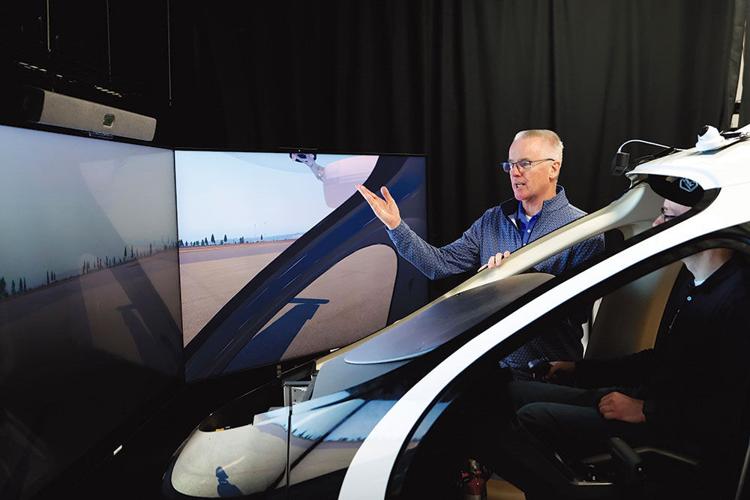
Peter Wilson, Joby’s director of flight standards and training, stands next to a full-scale replica of the aircraft’s flight deck that is situated in front of three large screens. If the image on the screens look familiar, it’s because it is: The Marina airport’s runway is shown in full high-definition display, the same scene one had experienced as they walked into the hangar in the first place. (It’s not an exact re-creation – there are too many fictional trees surrounding the airport, for example.)
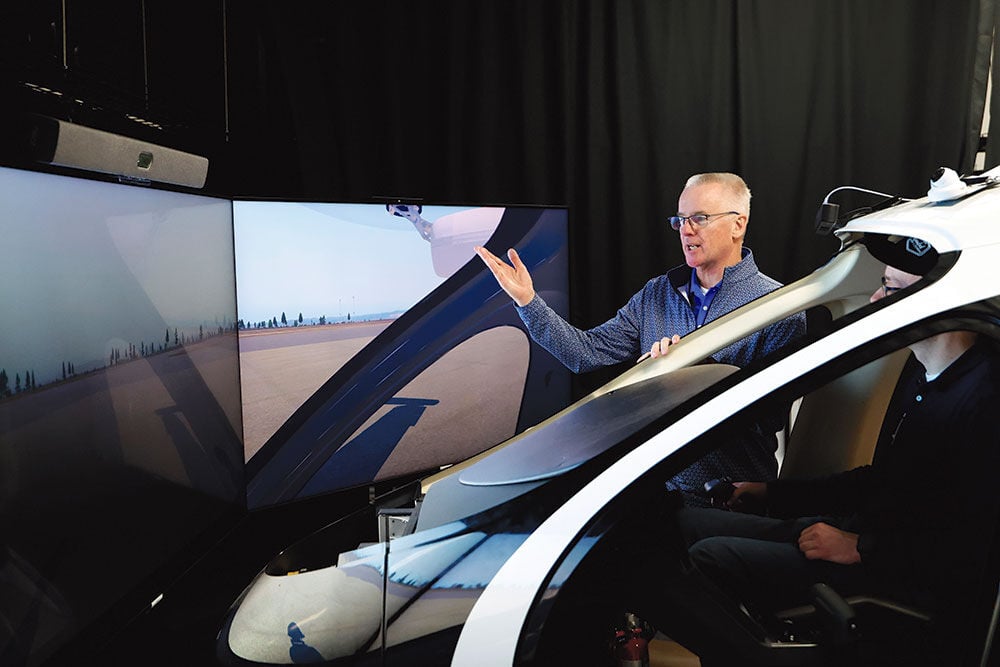
Peter Wilson, director of flight standards and training at Joby, demonstrates how to use Joby’s in-house simulator. The program includes a replica of the aircraft’s flight deck with functional controls that translate to actions on the screen, giving Joby pilots flying experience before they undergo the real thing.
Wilson welcomes this reporter into the cockpit. There are two joysticks on each side: to the left is a handle that controls various functions, while the right is where most of the magic happens – just push or pull it in the direction you want to go.
After the tap of a few buttons, the roar of the propellers (through surround-sound speakers) indicates that the aircraft has come to life (hence the quiet room – it’s important not to have sound contamination from the outside world as pilots are training). Wilson says to pull the joystick back, directing my vision to the radar on the instrument cluster, where I need to overlap two different-colored lines to reach altitude.
On cue, the aircraft rises from the ground, hovering like a helicopter. It’s at this point where Wilson asks me what I’m doing.
I admit I don’t really know – “Nothing?”
Right answer, Wilson responds. While the Joby aircraft takes off vertically like a helicopter, controlling it isn’t anything like a helicopter – it’s much easier. The aircraft hovers by itself, while a helicopter pilot would be constantly working to keep it level and in the air. The Joby craft even has a button on the joystick to automatically level it out.
It’s now time to fly to the virtual Monterey Regional Airport, and by pushing the joystick forward, the aircraft’s six propellers transition from a vertical position to horizontal, an important defining feature of the aircraft that makes it a cross between a traditional airplane and a helicopter (known by its acronym of eVTOL – electric vertical take-off and landing).
The simulated sound of the propellers goes nearly silent as they transition from hover mode to flight, and the plane begins its ascent over a computer-generated version of the Monterey Peninsula, complete with trails on Fort Ord National Monument and traffic on Highway 1.
Monterey’s airport comes into view – now is the time to land.
Wilson says to press and hold one button on the instrument cluster that brings the aircraft down to a landing speed. With no fuss, the aircraft slows down, the propellers return to their vertical position, and it’s back on solid ground.
With a handshake, Wilson offers congratulations on a job well done. He also points to the experience as how relatively quick it is to learn how to fly a Joby aircraft compared to a helicopter or other traditional aircraft, as evidenced by this test pilot whose only flying experience comes from video games.
Training pilots may be by far the fastest part of Joby’s nearly two-decade-long process to turn its vision into reality.
In 2009, JoeBen Bevirt founded Joby from a ranch in the Santa Cruz Mountains, where a team of engineers worked on components such as electric motors and lithium-ion batteries.
Bevirt remains the CEO of the company, which got off the ground thanks to the proceeds from Bevirt’s other companies that he sold, such as Velocity11, which developed robotic laboratory systems, and Joby Inc., which created products such as the Gorillapod camera tripod.
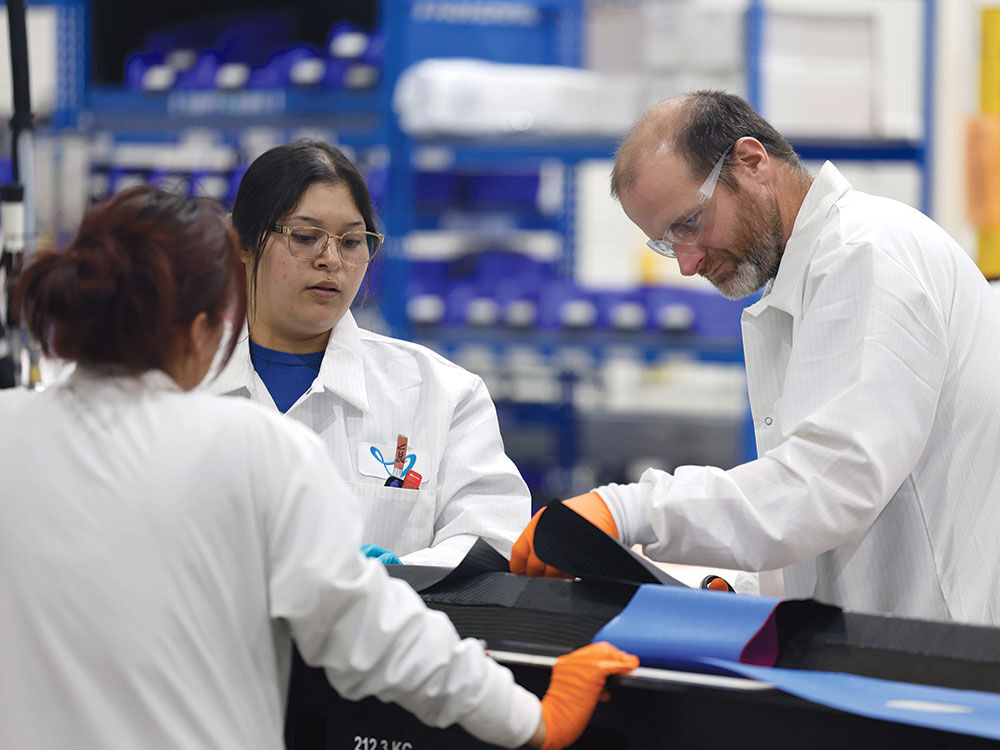
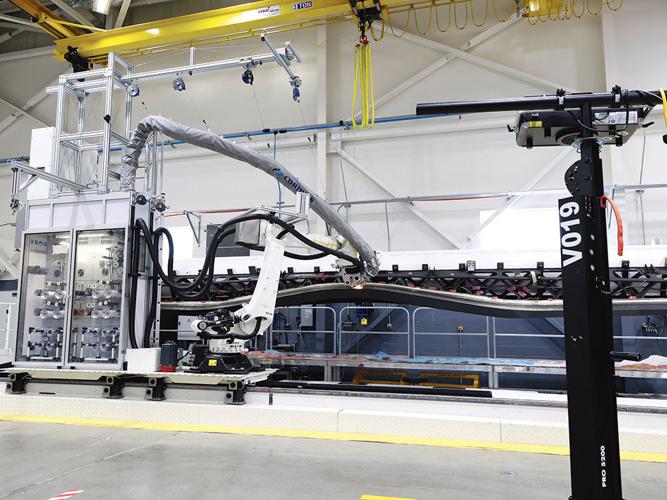
Inside one of Joby’s manufacturing facilities at the Marina Municipal Airport, workers assemble parts of an aircraft that will be used for future testing by the Federal Aviation Administration. Pieces of carbon fiber are put together and laminated. Large robotic equipment also complete tasks under supervision of workers.
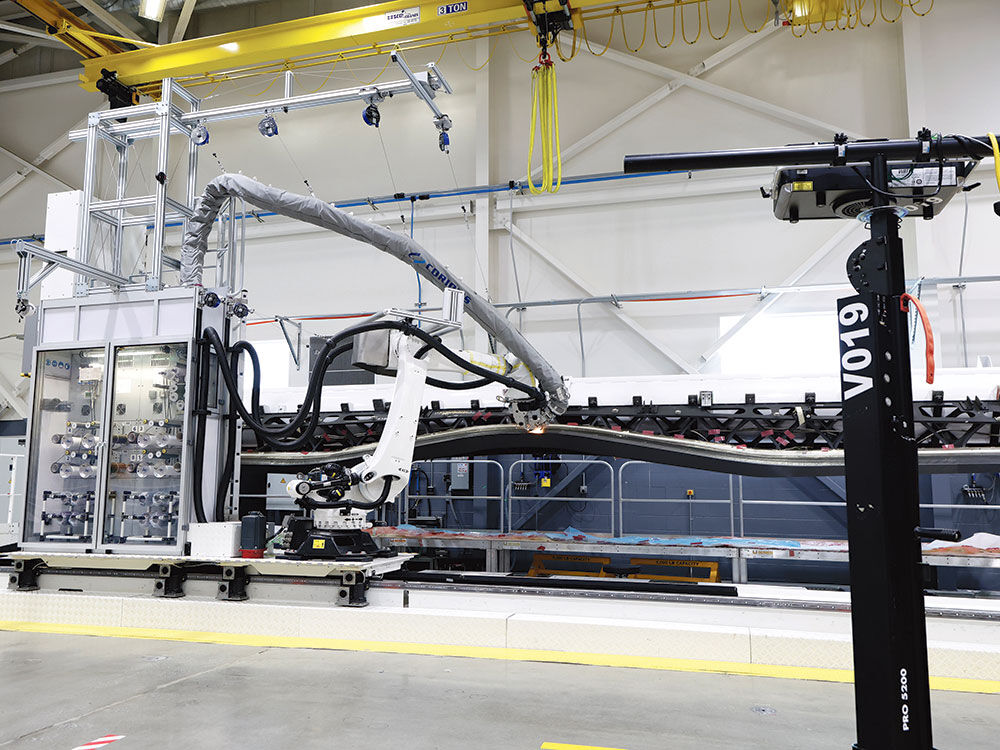
Inside one of Joby’s manufacturing facilities at the Marina Municipal Airport, workers assemble parts of an aircraft that will be used for future testing by the Federal Aviation Administration. Pieces of carbon fiber are put together and laminated. Large robotic equipment also complete tasks under supervision of workers.
According to a history provided by the company, Joby partnered with NASA in 2012 on electric flight projects. The company’s first full-scale demonstrator aircraft took flight in 2017, with a pre-production prototype following in 2019.
The next year, Joby expanded with a manufacturing facility at the Marina Municipal Airport. The company was beginning to turn heads – and was about to cause a little political drama.
In 2023, Joby searched nationwide for a new, 580,000-square-foot manufacturing facility. Marina was on the list, but didn’t make the cut, with some bemoaning that California’s leaders didn’t do enough to match or exceed the incentives offered by Ohio, the place Joby ended up choosing.
Still, Joby reiterated its desire to continue operations in California. It received a nearly $10 million grant from California’s Office of Business and Economic Development to grow its facilities in Marina, and in mid-2024, broke ground on an expanded manufacturing facility. The facility was completed in July 2025 and doubled Joby’s footprint at the airport, now at 435,500 square feet, and is expected to pump out 24 aircraft a year.
Joby proudly lists its accomplishments (online and in its Marina lobby, with stacks of “yearbooks” to browse through), showing that it’s going further than most startup companies ever do.
In 2020, Joby became the first eVTOL company to receive airworthiness approval from the U.S. Air Force to conduct testing on government bases – it delivered its first aircraft to Edwards Air Force Base in California in 2023 and announced it planned to deliver two more to MacDill Air Force Base.
The partnerships are many over the years: Toyota Motor Corporation, which is investing $500 million and time into helping Joby develop its manufacturing processes; Virgin Atlantic, to help launch service in the United States and United Kingdom; and Uber, to integrate aerial ridesharing service into the popular app; among others.
In a major milestone, Joby completed its first “full transition” flight with a pilot onboard in April 2025 – moving from vertical takeoff to horizontal flight.
Like the propellers that power its aircraft, things are humming along at Joby as it meets its goals. But one of its most significant goals remains in progress.
ON A WEDNESDAY AFTERNOON, Eric Allison, Joby’s chief product officer, leads a small group of people through one of the company’s manufacturing facilities at the Marina airport.
He advises the group to stay within the green lines as they walk deep into the facility – otherwise, they will have to don personal protective equipment. Indeed, dozens of workers are wearing white lab coats and safety goggles as they cut carbon fiber composite material to fit into molds while others sit at workstations, viewing computer monitors that are filled with rows of data.
The hum of giant robotic equipment conducting various tasks is also ever-present. One robotic arm is spraying a panel with water at a high-pressure, testing to see if any defects, such as air bubbles within the layers of material, are exposed.
Allison says Toyota has been instrumental with its vast knowledge of manufacturing, helping Joby refine and scale its process as it prepares for what it projects will be a high demand for its aircraft. That process is even down to the precise placement of workers’ tools at their stations, according to a Joby report to shareholders.
Most of the parts that are currently being put together, such as wings, propeller blades and more, will be used to construct the five aircraft that will be tested by Federal Aviation Administration pilots.
Known as Type Inspection Authorization testing, FAA pilots will test the aircraft themselves for the first time after years of reviewing documents and other things during the long certification process.
It’s a big deal, Allison says.
“It means a lot that the FAA is willing to put their test pilots in there,” he says. “It means you have passed a certain bar of maturity. It’s so critical because it shows they have confidence and you have confidence as well.”
Joby is targeting those test flights to take place in early 2026.
For now, regular test flights, whether remotely or with Joby’s pilots onboard, happen about four times a day at the Marina airport.
One such flight in August stands out.
In a first for the company, a piloted Joby aircraft took off from the Marina Municipal Airport and touched down at Monterey Regional Airport, taking 12 minutes to do so. Five of those minutes were in a hold pattern as it waited for air traffic spacing.
In a long process of incremental steps, the flight was a big one in the certification process, as Joby officials say the FAA requires the aircraft to demonstrate it can operate in shared airspace.
Didier Papadopoulos, president of Aircraft OEM (original equipment manufacturer) at Joby, said in a statement that the successful flight was further validation of the company’s work.
“As part of the natural progression of our flight test program, it was time to venture further,” he said, “and there was no better place to visit first than our neighbors in Monterey.”
The FAA controls the rigorous certification process, and like any government agency, the process takes plenty of time and patience.
The FAA requires various certifications, such as the “type” (ensuring the aircraft’s components are in compliance with FAA standards) and production (determining the manufacturing process is up to snuff). Joby has broken it down into five phases, three of which are already completed, according to Allison.
It’s now in the midst of the fourth phase, which is about submitting detailed test plans for every single component of the aircraft across numerous scenarios. For instance, Allison says the process includes intentionally manufacturing defects into parts and testing them to show they can still operate safely.
Joby estimates it’s more than halfway through this phase as of Aug. 4, according to its letter to shareholders.
The fifth stage involves final sign-offs from the FAA, which is less than 10-percent complete.
While passenger service in the U.S. is still a ways out, it appears certain that Dubai will be the first city in the world where the public can hitch a ride on a Joby aircraft.
In early 2024, Joby signed an agreement with Dubai’s Roads and Transport Authority to provide air taxi services in the United Arab Emirates, and expects piloted flights with passengers onboard in early 2026.
“That’s pretty exciting, and it’s going to progress from there,” Allison says.
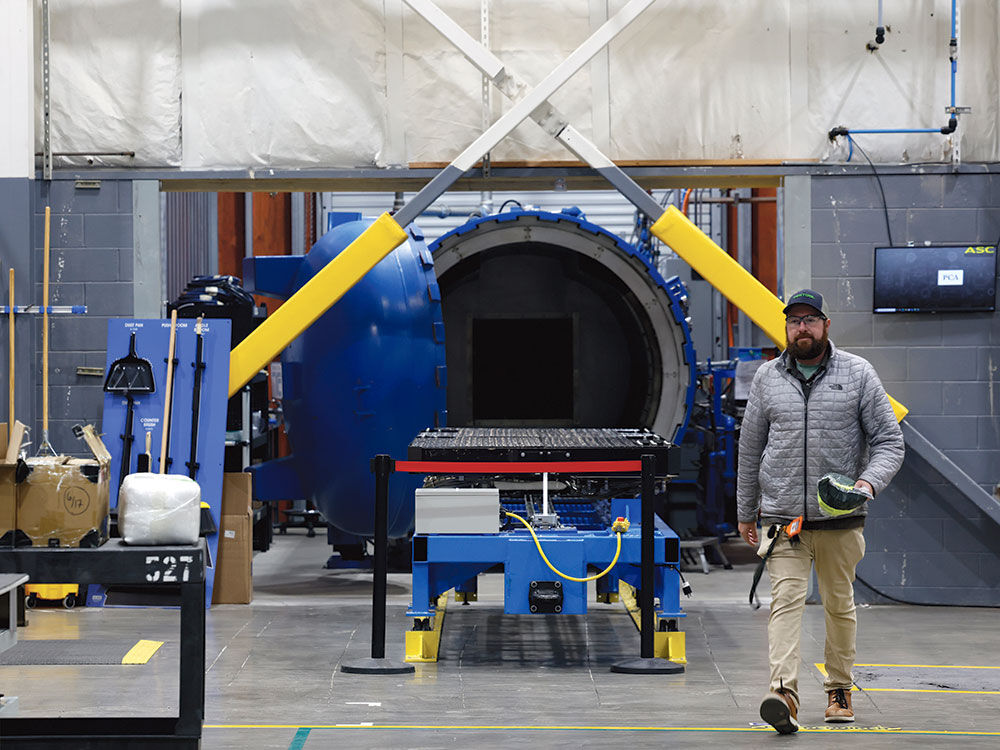
A giant oven-like piece of equipment known as an autoclave is where pieces of laminated parts are “cooked” to harden at the Marina manufacturing plant.
Stateside, Joby officials believe they are closer than ever to launching in the U.S. In August, it announced a $125 million acquisition of Blade Air Mobility, which operates helicopter service in the U.S. and Europe. Those helicopters will eventually be phased out for Joby’s electric aircraft.
THE ACQUISITION OF BLADE shows just how expensive it is to start a new industry, and that’s just one example.
According to Joby’s most recent financial report, released Aug. 6, the company spent $136 million on research and development during the second quarter of 2025.
Joby is still a “pre-revenue” company, and as such, it reported nearly a $325 million operating net loss during that quarter, more than double the loss reported for the same quarter in 2024. Joby attributes that to various factors, including the growth of the company (Joby has a staff of more than 2,000, up from 640 five years ago, according to its 2024 impact report) along with increased purchases of materials as it gears up its testing and manufacturing capabilities.
However, Joby reports its cash flow is strong thanks to investments, ending the quarter with $991 million in the bank. Joby received half of Toyota’s $500 million investment during the quarter, with the other half expected to come later, bringing the Japanese company’s total investment to $894 million.
Joby’s stock soared to its highest level in history in late July to a little more than $18 a share, on the heels of the news that it opened its expanded Marina facility. San Jose-based Archer Aviation, which is also developing eVTOL aircraft and testing them at the Salinas Municipal Airport, also saw its stock bump up during this time. Analysts say that, because the industry is in such an early state, good news for one company has a ripple effect for others in this space, as it gets the industry one step closer to commercial service.
In an article for the investing news site The Motley Fool, stock market analyst Brett Schafer wrote that Joby has “a lot of promise” as it makes progress on its manufacturing and FAA certification goals, along with its partnerships with big-name companies. Still, “the growth is all theoretical today,” he wrote – and questions about infrastructure, such as where vertiports will be constructed, remain.
“It is unlikely that Joby Aviation will generate a profit by 2030 even if it can scale up its air taxi routes and charge an average of $500 per flight, which is more than the average round-trip airline ticket for comparable routes,” Schafer wrote.
Who are those potential customers who will be willing – and able – to pay for such a ticket?
In an early 2025 filing with the U.S. Securities and Exchange Commission, Joby said its aircraft is designed to transport a pilot and up to four passengers, traveling at speeds of up to 200 mph with a battery that could last up to 100 miles on a single charge. The aircraft have also been tested at flying at altitudes that exceed 10,000 feet above sea level.
While it doesn’t have specifics when it comes to pricing for a flight, Joby hints that it will be pricey, at least in the beginning.
“It is our goal to steadily drive down end-user pricing in the years following commercial launch to make the service widely accessible,” the company wrote in the filing.
So, when will you be able to call a Joby from an app on your phone and go for a flight? It’s probably the number-one most commonly asked question to Joby.
For now, there are only projections. But whenever that launch day comes, it will happen first in Los Angeles and New York City.
Users will book a flight through an app, and be picked up by a vehicle that will transport them to the nearest vertiport, where an air taxi will be waiting for them. That aircraft will then transport the user to another vertiport closest to their destination, where another vehicle will be waiting to take them to where they want to go.
Its service itself might be out of reach financially for many in Monterey County, if it ever comes here. But Joby plans to have a much larger impact on the region’s economy and workforce, something that business and government leaders are hoping to capitalize on.
ADVANCED AIR MOBILITY IS EXPECTED TO BE AN $80 BILLION INDUSTRY globally by 2034. With Joby, Archer and other companies already doing business here, there’s economic opportunity to be had on the Central Coast should the growth follow projections.
That’s where Monterey Bay DART comes in.
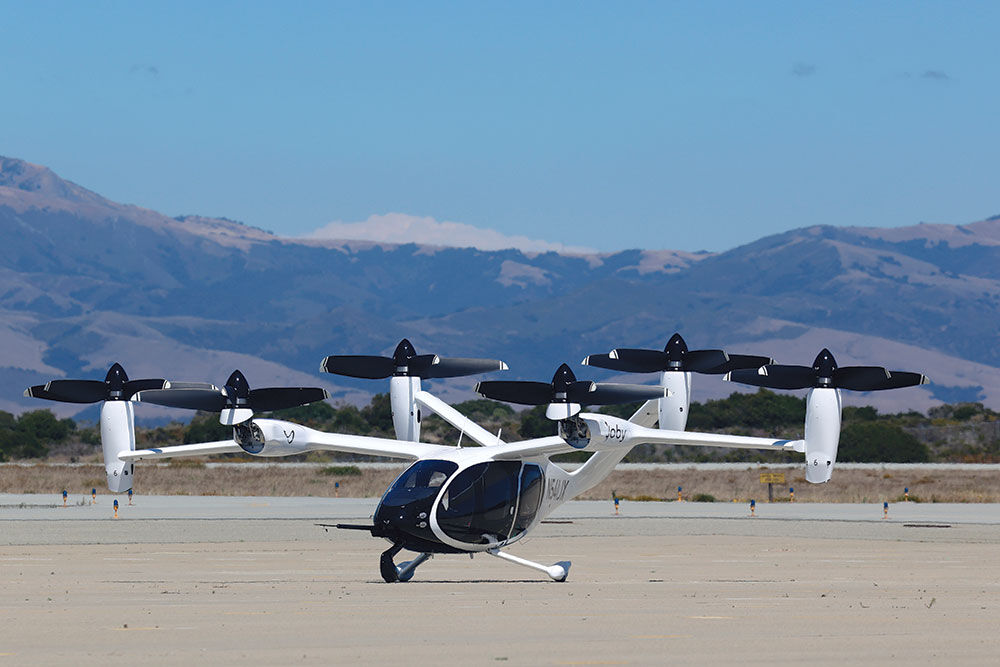
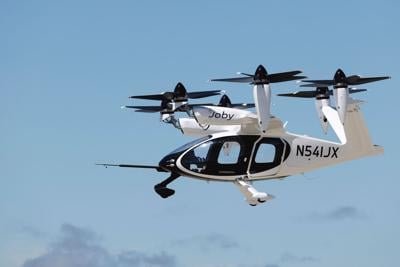
A Joby aircraft on the runway at the Marina Municipal Airport after a remote test.
The nonprofit DART (Drone, Automation and Robotics Technology) hopes to be the bridge that connects business with government, and ensure this burgeoning industry benefits the communities it’s based in.
“Our goal has been to support Joby’s growth and to attract other companies as a result of that, demonstrating there’s a skilled workforce that can support them,” DART Executive Director Josh Metz says.
The Central Coast, and Monterey County in particular, is known for its hospitality and agriculture industries – not so much its aircraft manufacturing workforce.
“How are you going to grow an aircraft manufacturing company in an area without an aircraft manufacturing workforce?” Metz says he asked Joby early on.
The answer from local leaders has been to help create that workforce.
With support from the James Irvine Foundation, DART and Joby launched an apprenticeship program in 2022 that provides a six-month paid position for local residents to be trained on manufacturing, maintenance and other entry-level jobs in the aerospace realm.
Since its launch, more than 70 people have gone through the program, including farmworkers, automotive technicians and seamstresses, and many landed a full-time job at Joby after their apprenticeship ended.
Monterey County Works and Joby also organize a summer internship program, recruiting four paid interns in 2025 working in such areas as airframe assembly, IT and tool design.
These efforts were on display during the LIFT Summit in March. The event, organized by DART, brought together leaders from the aerospace industry, government agencies, economic development organizations and the educational realm with the focus on boosting the local aerospace industry as a way to drive the economy.
The three-day event began with a tour of the Marina and Salinas airports, where attendees were given demonstrations of advanced air mobility and uncrewed aerial systems operations, before wrapping up with panel discussions at the Monterey Conference Center.
Metz says the rebranded summit had its strongest attendance yet, driven by the growing interest in the fields regionally and globally.
A theme emerged among the panels from the summit: The talent is here locally to sustain the aviation workforce – the key now is to not only encourage outside companies to set up shop here, but also prove to locals that such pathways can lead to successful careers.
Earlier this year, Pajaro Valley Unified School District, working with Joby, DART and others, announced the creation of a new Career Technical Education program, where students will build a Van’s RV-12 airplane from scratch.
The program, which launched in the fall semester and takes place at the Watsonville Municipal Airport, further cultivates a local aircraft manufacturing workforce.
“It’s going to stimulate young people,” Metz says. “If this is successful, we hope it’s of interest to a lot of different schools.”
It’s not just schools, but many big players – companies like Toyota and Uber, the U.S. Air Force – are already betting on Joby’s future. As a pioneer in a new industry, questions about which players will stay in the sky and which will be grounded remain unanswered.
(1) comment
This piece is quality business journalism. Congratulations to Erik Chalhoub and the various editors involved.
(Edited by staff.)Welcome to the discussion.
Log In
Keep it Clean. Please avoid obscene, vulgar, lewd, racist or sexually-oriented language.
PLEASE TURN OFF YOUR CAPS LOCK.
Don't Threaten. Threats of harming another person will not be tolerated.
Be Truthful. Don't knowingly lie about anyone or anything.
Be Nice. No racism, sexism or any sort of -ism that is degrading to another person.
Be Proactive. Use the 'Report' link on each comment to let us know of abusive posts.
Share with Us. We'd love to hear eyewitness accounts, the history behind an article.