



WHEN POPE JULIUS II ORDERED HIM TO PAINT THE CEILING OF THE SISTINE CHAPEL IN VATICAN CITY, MICHELANGELO WAS EVERYTHING BUT PSYCHED. First, he thought himself a sculptor, not a painter. Second, he fully understood the pressure – the frescoes had to not only please the pope, but to keep inspiring the conclave, the body of cardinals that gathers in the chapel each time a new pope is to be chosen. The frescoes had to demonstrate the power of God, the power of his kingdom on Earth, but above all they had to create a sense of unity and solidarity necessary to pick a new leader.
Frescoes are only one type of what we today call murals; the mural family includes mosaics (created from tiny pieces, such as tiles, glass or pebbles), graffiti and marouflage (affixing a painted canvas to a wall, using glues).
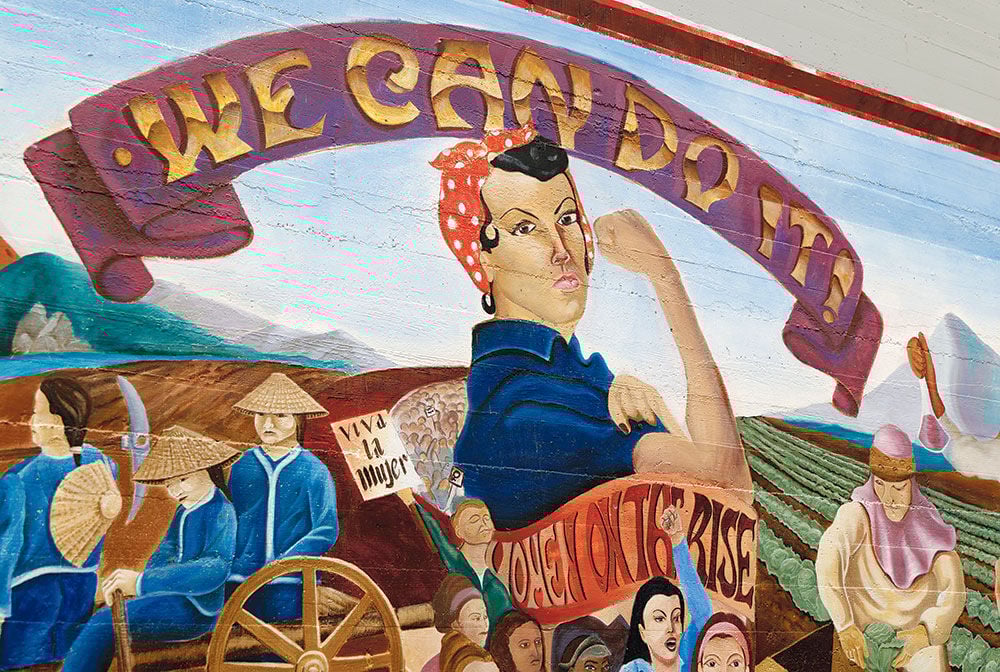
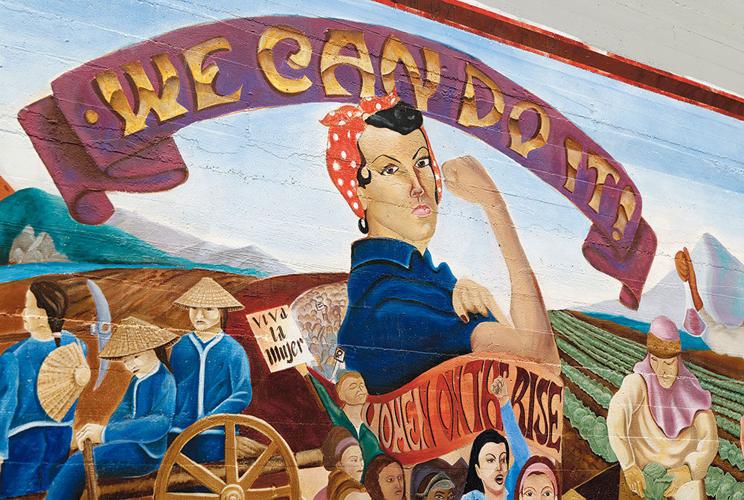
Details from the We Can Do It! mural depicting Rosie the Riveter. Located at the Service Employees International Union (SEIU) hall, it was painted by a group of muralists under the label “One Voice – Arts & Leadership Program.”
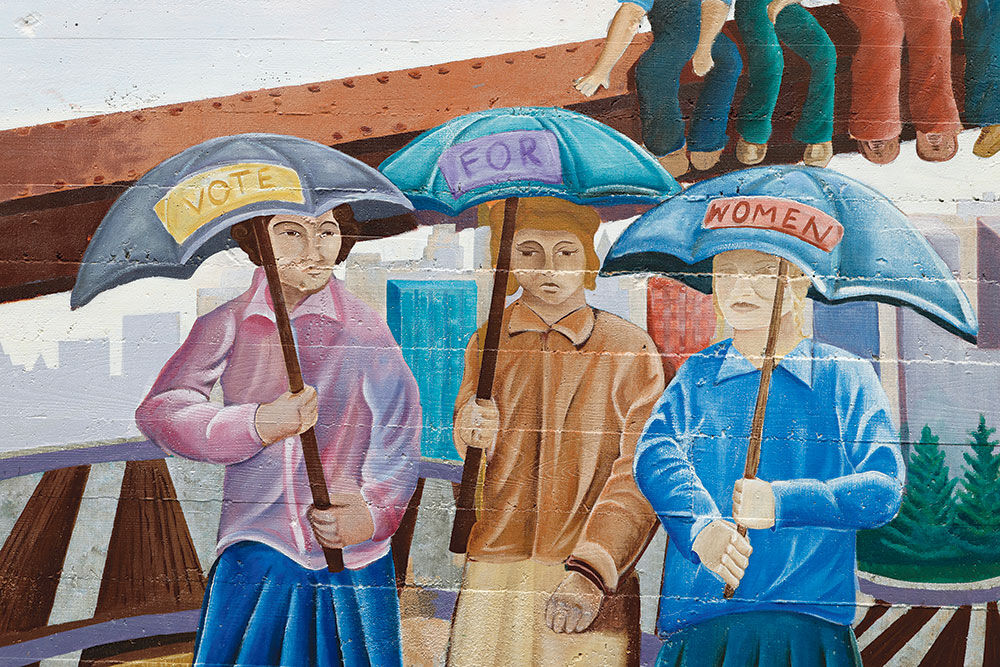
The English word “mural” is derived from the Latin “muralis” and means “wall painting.” We classify as murals cave paintings from the Upper Paleolithic, interior decorations of the Romanesque period, frescoes from the Renaissance to Rococo and, finally, contemporary murals. The latter are closely associated with a revival of large wall painting in Mexico and Latin America done by 20th-century artists such as Diego Rivera in Mexico (one of “Los Tres Grandes,” alongside José Clemente Orozco and David Alfaro Siqueiros), Pedro Nel Gómez in Colombia and Teodoro Núñez Ureta in Peru.
Since then, cities around the world have picked up murals as the most attractive, eye-catching, crowd-pleasing form of public art. In the U.S., Philadelphia, with its 4,000 murals, has been proclaimed the ultimate capital of murals, but the trend has been huge all over the world, from Mexico City to Berlin to Melbourne.
The largest concentration of murals in California – 600 pieces – is in the predominantly Latino Mission District in San Francisco. In Monterey County, the mural capital is Salinas, with its 80-percent Latino population and at least 100 murals all over town, many of them recent additions. And this is just a beginning – there’s appetite for more murals, with many actors, such as Salinas City Center Improvement Association, United Way Monterey County, the Arts Council for Monterey County (Arts4MC) and Artists Ink pushing to find new walls to cover and locating funds to pay artists.
That’s with particular reasoning in mind.
Not far from Salinas, tiny Sand City works hard to attract tourists, packing its walls with murals made every year during the We.Mural festival by artists from all over the world. In contrast, Salinas’ murals are primarily by locals and for locals. Their subject matter is devoted to local issues, their locations are picked purposely – to serve people of Salinas, to assure them of their identity as an agricultural community and even to protect them, casting light and color on particular streets and locations.
There is no better place for a mural than a back alley that suddenly is given back to the community as a safe space, where people gather to talk, take selfies or choose to walk down on their way back from work. There’s nothing that improves morale better than a well-maintained mural that says: This city, this alley belongs to someone; they are watching and they care.
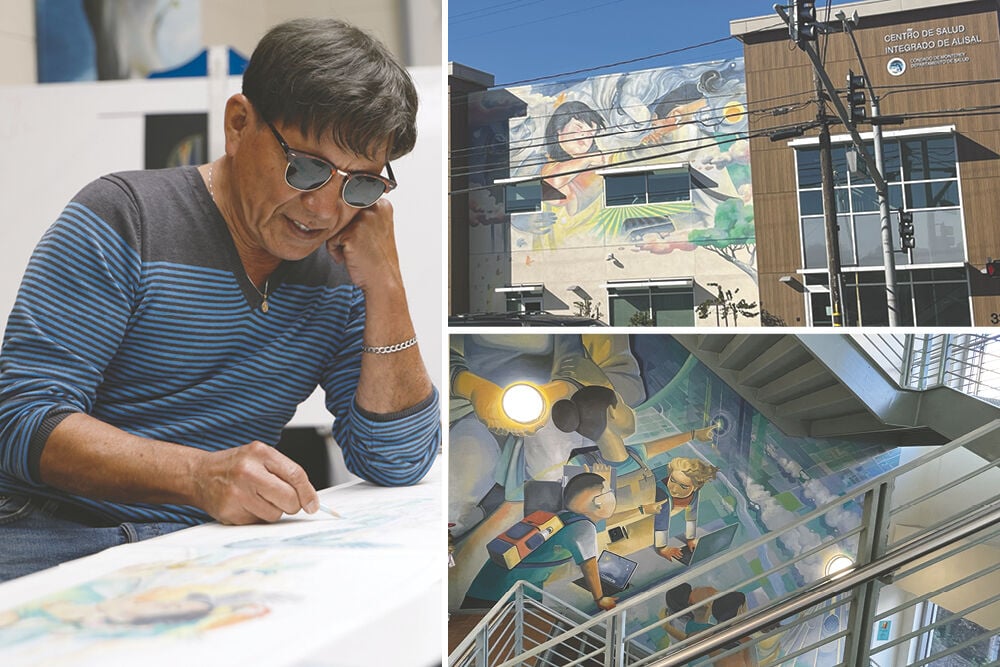
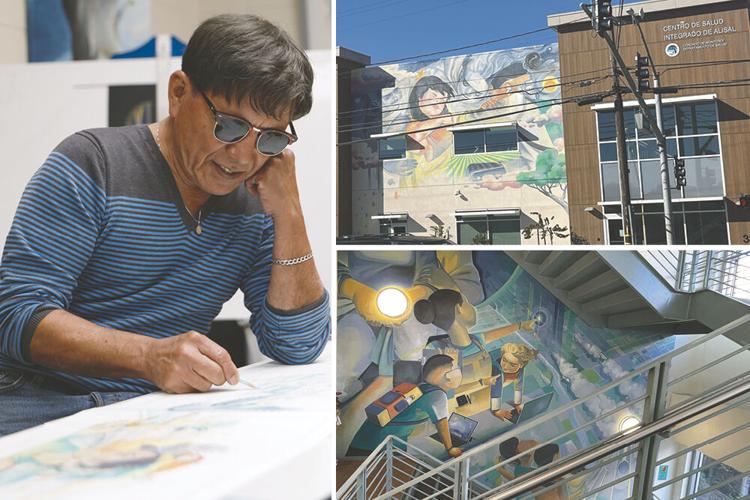
(left) Artist José Ortiz has painted dozens of murals in Salinas, and trained up a younger generation through Hijos del Sol, the nonprofit he founded. Recent work includes (above) “El Abrazo” on a wall of the Monterey County Behavioral Health’s Alisal Integrated Health Center in 2024. One example of an indoor mural (below) is “Destination, Salinas,” painted in 2022 in a stairwell of the Monterey County Administration building on West Alisal Street by Hijos del Sol artists including Ortiz, Jose “Pepe” Nolasco and Juan Carlos Padilla.
SALINAS MURALS ARE NOT CONCENTRATED IN ONE LOCATION; don’t expect to see them just by walking along Main Street. Even in downtown, they hide on the back walls of the buildings or in alleys off bigger streets. Many are made at and for schools, serving those specific communities. Some are indoors, in stairwells of buildings enjoyed by those who don’t take the elevator.
Many of them are painted far from the city center, like a series on Highway 101 underpasses in the Alisal neighborhood; Caltrans sponsored this outdoor gallery of three murals through a beautification grant program in cooperation with the City of Salinas and Arts4MC in 2023. In total, they received 40 applications from across the state. One of them was from La Neta Murals, a local mural collective based in Monterey County. The group’s mural on the Alisal Street underpass, titled “Anáhuac,” refers to the word’s multiple meanings. It was the core of ancient Mexico and means “land surrounded by water” in Nahuatl. Today, many use the term to highlight their cultural and indigenous connection to Mexico.
A new mural, produced this year by Los Angeles artist Fabian Debora at the Juvenile Hall in Salinas, is located in the garden where incarcerated youth spend a chunk of their time. It shows a hopeful, purple horizon with butterflies and flowers floating around. About 20 young men there helped Debora paint it.
Murals in Salinas started to pop up in the 1990s thanks to painter José Ortiz, the founding director of nonprofit Hijos del Sol Arts Productions. Since then, Ortiz and his team of young artists of Hijos del Sol have created over 80 murals in Salinas alone.
More initiatives followed. In 2001 came the Monterey County Summer Youth Employment Training Program, a collaboration among different agencies that recruited a whole team of California artists. Among others, they produced “The Life and Works of John Steinbeck” mural by One Main Street, home to the National Steinbeck Center. There are over 20 murals by Salinas muralist John Cerney; a 2000 Vincent Van Gogh mural, now in progress, on the Star Shopping Center building on South Main Street at Abbott is among the most impressive.
There is a long row of murals painted in 2019 at the Security Public Storage on Sun Way, a private company initiative along a popular walking path.
Today, we are in the middle of another wave of murals, the one we are observing right now – the underpass murals, the murals of Midtown Lane and more.
The list of muralists taking part in making Salinas a city of murals is long. It includes Dong Sun Kim, Colleen Mitchell, Cynthia Mitchell, CJ Gonzalez, Gregory the Artist, Basic Lee, Jose “Pepe” Nolasco and many more.
Salinas murals have been noticed and described by many, but no one has been doing a more thorough job when it comes to tracking them than Kat Morgan of Seaside. She created a map (viewable at bit.ly/MontereyMuralsMap) documenting as many murals as she can find (some 500 and counting) throughout Monterey County, including 80 in Salinas.
“Part of why Salinas is the center is because of José Ortiz and the new generation of artists he has mentored,” Morgan says. “He’s in keeping with the tradition of Los Tres Grandes. He’s still doing so many public buildings… The purpose of public art is telling the stories of communities, especially communities whose stories haven’t been told in textbooks.”
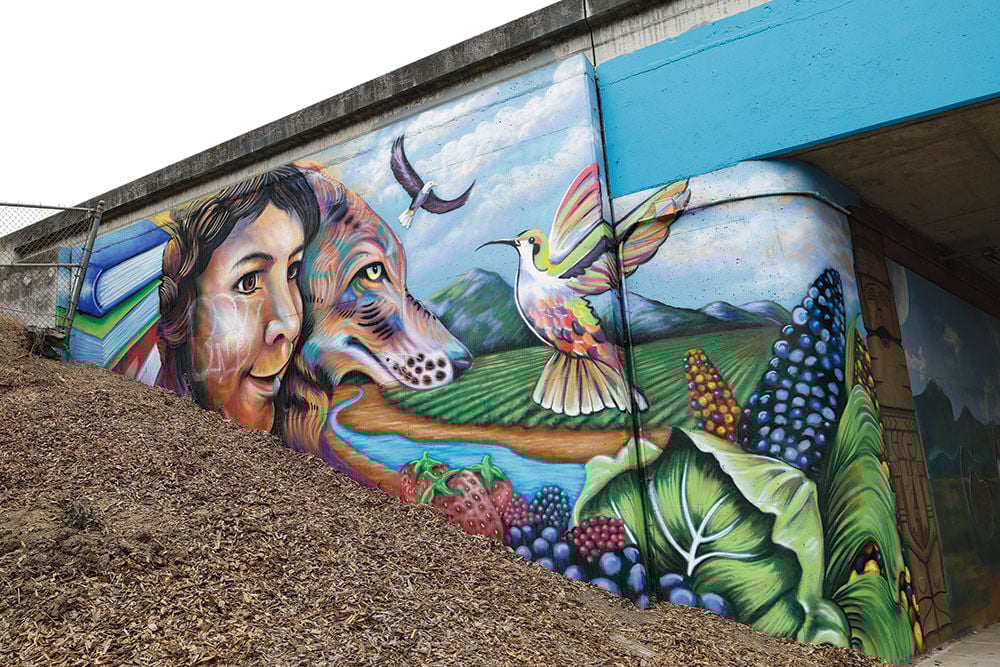
For a Highway 101 underpass project on Alisal Street, commissioned by Caltrans in 2023, local artists (then known as La Neta) built upon two existing murals by Arturo Bolaños and Jesús León that had been in place for over 20 years to make “Anáhuac.”
AT HIJOS DEL SOL, a spacious studio and exhibition space on East Alisal Street, Ortiz is leaning above pages of design for yet another mural. He is accompanied by artist Pepe Nolasco, who has been with the organization since childhood and recently designed his first work, the big blue Salinas Habitats mural that was introduced to the public in 2024.
“I’ve always known there will come a time when he will design a mural on his own,” Ortiz says. “Now, I’m his assistant.”
Before he started, Ortiz, who could be called the unofficial muralist-in-chief of Salinas, didn’t know much about murals or Diego Rivera’s tradition. Like Michelangelo, he wasn’t trained in painting murals at all. But his interest in social issues helped him to quickly figure out what murals are about. They are not about the artist, he says, and it’s not only because painting a mural typically takes a team. They are agreed upon within a community (often via community meetings or public comments) and designed collectively – which wall, what to paint on it and why here – and the artist is just a messenger, the executor of a communal will.
According to Ortiz, each muralist faces a task that Michelangelo faced upon giving in and agreeing to work on the Sistine Chapel: How to transpose the message onto walls and from there, back to the community.
Hijos del Sol’s first mural that survived and can still be admired is on the tall building of the Women, Infants and Children (WIC) center at 632 E. Alisal St., painted in 1995 and refurbished in June of this year. It depicts women and babies, portrayed as little angels and gives off almost religious vibes.
According to Ortiz, street walls are a community canvas and murals are the “least selfish” form of art, the one that forces the artist to shed their ego and any sense of artistic freedom. The project has to take so many elements under consideration – the surrounding architecture, the environment, the residents and the businesses around. As an example, Ortiz mentions a mural project he has been working on with the Arts Council for three years now. They were looking for a wall to paint local fieldworkers. Initially, the council wanted to paint it at Midtown Lane in the downtown neighborhood. “But fieldworkers don’t go to Midtown Lane,” Ortiz says. “One day I saw them loading on buses to go to the fields by Goodwill on East Alisal Street.”
And that site was eventually picked for the mural that will soon be painted, representing Salinas’ rolling fields that feed the country with produce.
THE SALINAS CITY CENTER IMPROVEMENT ASSOCIATION is composed of downtown Salinas property owners to invest in neighborhood improvements such as cleaning, security and beautification. Since property owners happen to own walls, murals became the association’s favorite way to beautify the community. They have commissioned two murals to date – the Salinas Habitats mural on the wall of the building that is home to Patria restaurant created by Hijos del Sol, and a huge, art deco-inspired fox mural by Monterey artist Lisa Haas on the back of the Fox Theater.
The fox was completed earlier this year with the help of 85-foot lifts. “Looking at a giant wall can seem intimidating,” Haas says. “But once you get into it, it’s not.”
From the property owner standpoint, there is a similar mindset. “Murals are easy,” says SCCIA Downtown District Coordinator Greg Hamer. “You find an empty wall and if the owner agrees, you go to town.”
The effect is a more colorful and safer city, where people gather in front of its murals, conversations get started and bad actors go away, Hamer says. Hamer says that he noticed that murals are rarely damaged by graffiti, but even if they are, SCCIA has a team – led by José Ortiz – to fix it. They are also working on slowly refurbishing older murals made by the Hijos del Sol team.
Two new projects are in the works. One will be located at 201 Main Street and Seaside artist Hanif Wondir is already working on the project. The plan is for a 3-D immersive mural, a perfect selfie spot that allows people to be part of the mural and take “your new social media profile photo,” Hamer says. There are also plans to create a Narnia-themed mural at the back of ARIEL Theatrical, and a plan to paint the other side of Salinas Habitats.
“These murals are not for tourists,” Hamer says. “They are for locals to show them someone cares for the community.”
After all, the murals are expensive investments; many start at $10,000. SCCIA has sought outside foundation support to pay artists. It’s a win-win for the artists, the community and the business owners who get their walls painted for free and the art is then maintained and insured by the association and its contractors.
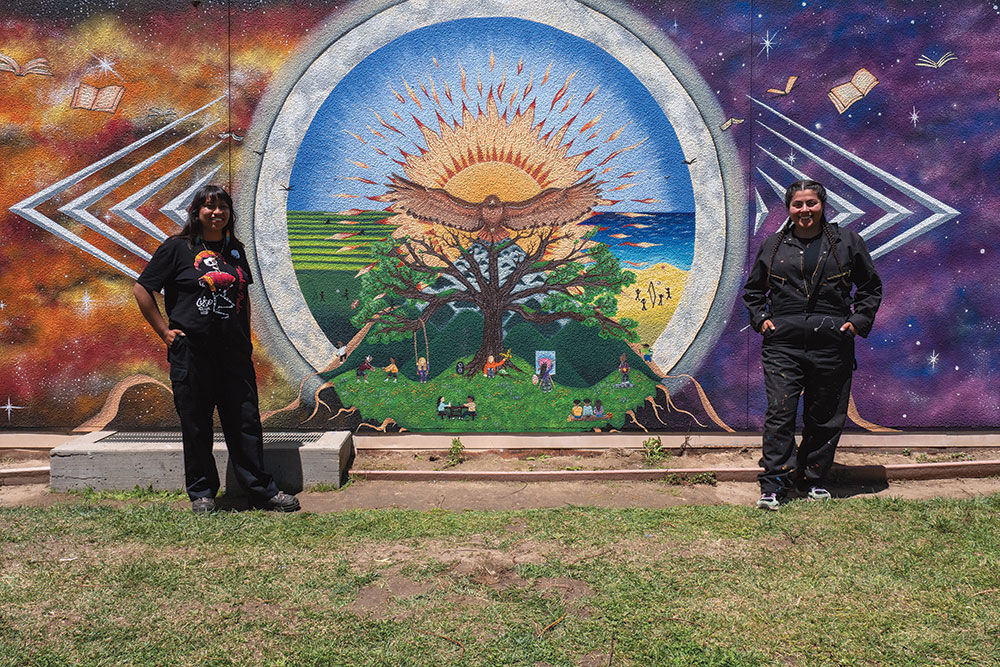
“Beyond a Memory” is one of the new murals completed over the summer at Gavilan View Middle School in Salinas. Marianna Jimenez (left) and Saihra Ruelas Zamudio of Artists Ink were part of the team behind the project.
A FEW YEARS AGO, administrators at Santa Rita Union School District in Salinas got inspired while touring other schools to beautify their walls with murals. School officials reported that it increased students’ sense of ownership, and reduced vandalism in schools.
The latest artwork in this initiative, which started in 2022, are three murals at Gavilan View Middle School. Students and artists worked together in an after-school program, from concept to design, to create a collective mural starting last year.
“Getting them inspired and pumped to express and also have the ability to be heard and listened to within this mural is the most beautiful part… seeing their faces light up, showing them the final draft of the mural, of how it’s going to look – they were super excited,” says Saihra Ruelas Zamudio, mural coordinator with Artists Ink, which was commissioned by the district for this three-mural project.
Summer Prather-Smith, director of engagement for Santa Rita, says school officials decided to incorporate art on school walls for multiple reasons: It develops a sense of ownership among students, provides cultural representation, and shows students art can be a viable career path. “It’s been really important for us to have our students see there is a career in the arts,” she says. “So often they’re told, ‘This is a hobby.’”
Santa Rita’s murals are full of symbolism and show moments depicting students’ lives and activities, like reading or painting. They also feature recognizable local places, like Pinnacles National Park and ag fields. Each mural is unique, focusing on different topics: school spirit, nature, cherished memories.
Gavilan View students will see the completed murals for the first time on the first day of school on Aug. 5.
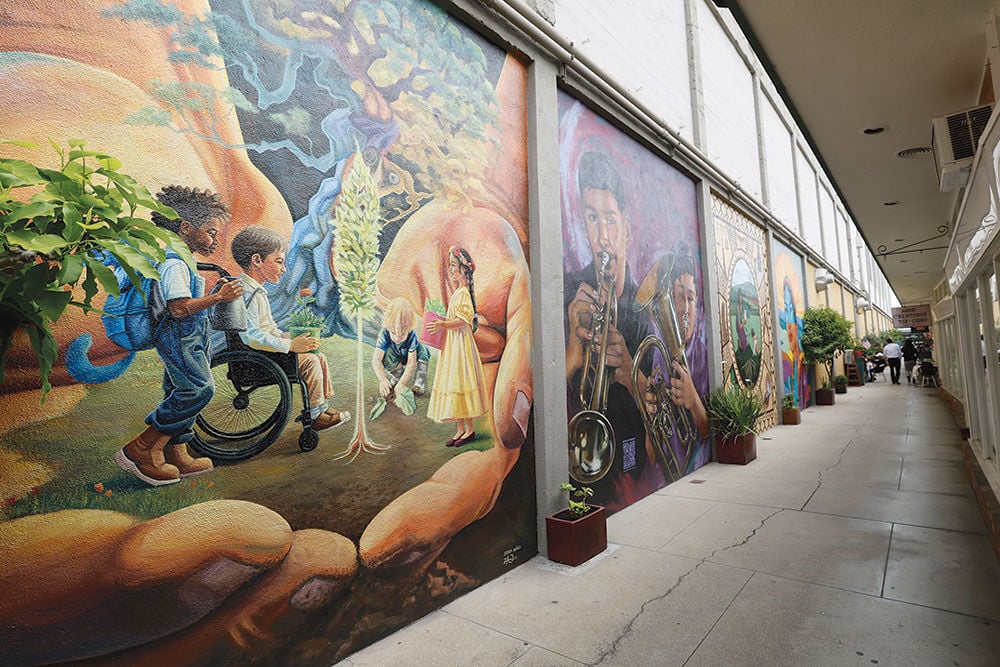
United Way Monterey County has commissioned artists to paint murals in Midtown Lane, a pedestrian walkway in downtown Salinas.
UNITED WAY MONTEREY COUNTY is a social services organization headquartered in downtown Salinas. One side of their building is Midtown Lane, a narrow pedestrian walkway between South Main and Monterey streets. “The alley had panels already designed on the wall,” says the organization’s marketing and communication manager Erin Detka. “We were looking to place ourselves in the community, so they know we are there.”
It turned out to be a perfect match: United Way leaders decided they could announce themselves to the community with murals.
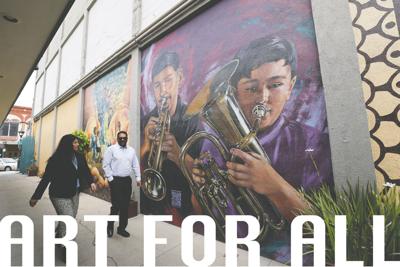
In 2023, United Way kicked off what they call phase one of their big mural project. They partnered with Arts4MC and King City-born-and-raised artist Amy Burkman to paint what is now known as the YOSAL mural. The work depicts the musicians of the nonprofit Youth Orchestra Salinas and their instruments. The United Way team loved the effect.
That led to creation of an advisory council of the community members that includes Salinas City Center Improvement Association, Arts4MC, Artists Ink and others to help them with coming up with the ideas for more murals. After announcing a call for muralists, United Way received about 20 submissions and picked three. During phase two, three more murals were created. One of them is a Filipino culture-themed mural by Jess Soriano. There is a long history of Filipino culture in Salinas. In a vignette inspired by woven textiles, printmaking and storytelling, Soriano tried to capture the story of Filipino life. In the middle of the vignette we see a woman and a child planting a tree. Around them, several motifs appear, including sampaguita (jasmine) flower and a bumble bee. Jasmine, the national flower of the Philippines, represents love, devotion and fidelity.
The second mural came from Jesus Nunez Navarro, who suggested the title “Strength from Within.” It depicts a tree held, along with its roots, in the palms of hands. Under the tree, children take care of a garden, watering the soil.
Finally, the third mural was created by a group of up-and-coming muralists under the mentorship of Burkman.
Their mural features a figure of a woman with a face covered by contrasting colors. Behind her, a radiant, sun-like formation spreads outward through the Salinas Valley’s rolling hills. Bold, warm colors like oranges and yellows evoke the region’s rich agricultural heritage, while cooler blues and greens represent the valley’s water resources and natural beauty.
United Way is far from done; they want to fill each panel of Midtown Lane. Currently, they are fundraising, looking for individual donors or organizations who want to sponsor the murals, including stipends for the muralists, equipment and so on.
Detka says murals bring people together. “The real power is when you are physically there, in front of the mural,” she says. “It’s really cool to stand next to someone and start a conversation. It’s a safe entry point to talk to people you otherwise wouldn’t talk to.”
And they are there for everyone to see. “The average person rarely steps into a gallery or museum,” Cerney says. “So murals are the ideal way to showcase the creativity of local talent where you have a guaranteed audience.”
(1) comment
The mural on the wall surrounding the parking lot at Active Seniors Inc, 100 Harvest Street was overlooked. It is an example of a young artist getting a start.
Welcome to the discussion.
Log In
Keep it Clean. Please avoid obscene, vulgar, lewd, racist or sexually-oriented language.
PLEASE TURN OFF YOUR CAPS LOCK.
Don't Threaten. Threats of harming another person will not be tolerated.
Be Truthful. Don't knowingly lie about anyone or anything.
Be Nice. No racism, sexism or any sort of -ism that is degrading to another person.
Be Proactive. Use the 'Report' link on each comment to let us know of abusive posts.
Share with Us. We'd love to hear eyewitness accounts, the history behind an article.