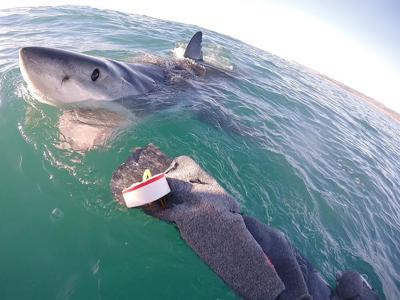

On a good day between October and November, Barbara Block, who leads the research on great white sharks and top pelagic predators at Hopkins Marine Station, says they’ll interact with anywhere from 10-15 great white sharks off the coast at Año Nuevo – a well-known home to elephant seal populations, and a hotspot for sharks.
Studying white sharks – where they go, and why – is complex and often, pricey.
A recent study led by Samantha Andrzejaczek and the Block Lab – in collaboration with researchers from the Coastal Oregon Marine Experiment Station, CSU Monterey Bay, the California White Shark Project and Montana State University – provides a substantial piece of the great white shark picture, offering the most comprehensive long-term tracking data of white sharks in Central California to date.
Big picture: There’s a lot to learn about white shark population dynamics and underwater ecosystems they inhabit. But as apex predators, understanding how sharks move and feed can reveal deeper shifts in the marine environment.
Researchers start by knowing where to reliably find these sharks, then coax them close enough to deploy a tag that collects data underwater. Boats, equipment, permits and the right weather all have to align to successfully tag and track a shark, hopefully for a full year before the tag naturally detaches.
Adding to the challenge, white sharks don’t come near the surface like say, an elephant seal, and so the most valuable data is collected entirely underwater. Advancing technology has revolutionized how researchers monitor these animals’ movements and behaviors, painting a better picture of where these animals go and why.
Still, scientists do not know where white sharks mate and breed – “It’s just really hard to track animals across such deep, vast ranges,” Andrzejaczek says.
Using acoustic tags, scientists analyzed patterns across four groups – adult male and females, and subadult male and females – monitoring 355 white sharks for more than 15 years. They saw that adult males and females used the coastline differently, with females spending more time offshore, whereas subadults were found to have more variability. Researchers think this is because subadults are still developing feeding behaviors, making their movement less predictable.
The acoustic tags attached near the dorsal fin emit unique pings every 60-120 seconds, picked up by underwater receivers anchored at specific locations, with Año Nuevo, Tomales Point and the Farallon Islands serving as the core locations. Now, the Block Lab is expanding this work, joining with other researchers to study white shark activity within the Monterey Bay National Marine Sanctuary.
“It takes a lot of hours on the water to do what that paper represents,” Block says. “Like Yellowstone, it’s a place that’s wild here in Monterey Bay. In our habitat, instead of having predators like wolves or grizzlies, we have white sharks.”


(0) comments
Welcome to the discussion.
Log In
Keep it Clean. Please avoid obscene, vulgar, lewd, racist or sexually-oriented language.
PLEASE TURN OFF YOUR CAPS LOCK.
Don't Threaten. Threats of harming another person will not be tolerated.
Be Truthful. Don't knowingly lie about anyone or anything.
Be Nice. No racism, sexism or any sort of -ism that is degrading to another person.
Be Proactive. Use the 'Report' link on each comment to let us know of abusive posts.
Share with Us. We'd love to hear eyewitness accounts, the history behind an article.