

WHEN SOME 2,000 LEADERS FROM COUNTY GOVERNMENTS ACROSS THE UNITED STATES CONVERGED FOR AN ANNUAL LEGISLATIVE CONFERENCE IN WASHINGTON, D.C. from March 1-4, they had a long list of issues to focus on. County workforce needs, land use, disaster preparedness and artificial intelligence rated on the top of the list for the group, coordinated by the National Association of Counties (NACo).
Among the attendees was Monterey County Supervisor Wendy Root Askew, who lives in Marina and represents District 4 on the Board of Supervisors. She is also a member of NACo’s health committee, and chairs a subcommittee on Medicaid and indigent care. She and her 2,000 county colleagues arrived in Washington less than a week after the U.S. House of Representatives had approved a budget resolution directing the House Energy & Commerce Committee to reduce the federal deficit by at least $880 billion over 10 years – with apparently no other way to achieve those cuts than by slashing Medicaid, the federal health insurance program for some 72 million Americans who are unable to afford private insurance.

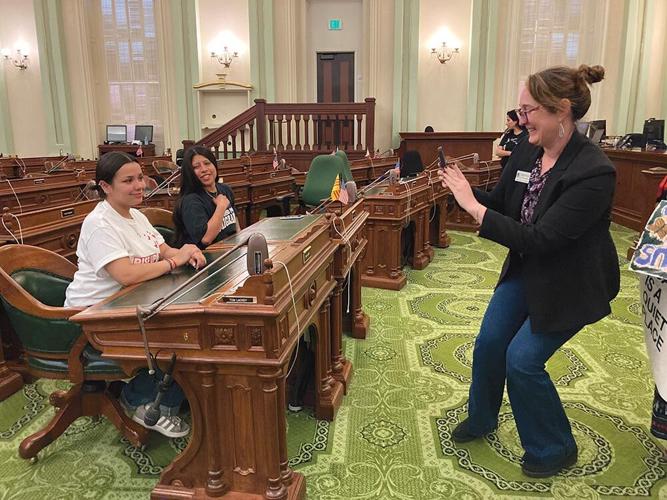
County Supervisor Wendy Root Askew photographs members of CSUMB’s Otter Dreamers Club in the Assembly chamber of the California Capitol
This came just a month after President Donald Trump had been sworn into a second term, and Republicans were moving swiftly to slash spending. Askew – who also serves back home on the governing board of the Central California Alliance for Health, which administers Medicaid (called Medi-Cal in California) locally – has traveled to the Capitol for legislative conferences like these before. But the backdrop this time felt different to her – it was crisis mode.
As she met with congressional representatives, however, it felt like something else entirely. “There was this whiplash of, it’s business as usual, and a recognition of, this isn’t business-as-usual,” she says.
The part that unsettled her was the latter, and she felt it in every meeting she had with about 10 members of Congress. “It felt like they were unaware of the crisis we were experiencing,” she says. “They were either unable to acknowledge or unaware of the dire circumstances playing out around them. There was an inability to do anything other than go about business as usual.”
She felt a startling disconnect. Back home, protests were happening with urgency; on Feb. 3, “A Day Without Immigrants,” Monterey County schools experienced 25- to 45-percent absenteeism. Dozens of teachers stayed home too.
Askew left with a sense of bleakness: “I walked away realizing our congressional leadership is not prepared to be in this fight with us,” she says. “That was a sinking feeling.”
Just after returning home, she headed for another conference in Yosemite National Park, the CivicWell Policymakers, bringing together about 100 local California elected officials – mayors, county supervisors, city council members – to brainstorm how to build resilient communities.
“It got me thinking about a framework to take all my fears and worries and put them back into local focus,” Askew says. “If there ever was a time to build local relationships and our local networks, it is now.”
THERE ARE 535 MEMBERS OF CONGRESS, COUNTING BOTH THE HOUSE OF REPRESENTATIVES AND SENATE COMBINED. There are 3,069 counties across the country, governed by some 19,350 elected county-level officials. There’s the simple matter of math: Your voice is much more likely to be heard by your local representative than, say, the president of the United States.
Monterey County residents are represented by five elected officials at the federal level, 12 at the state level and at least 336 on the local level, counting city council members, school board members, fire district and water district board members, and others, serving in nonpartisan elected roles. County Supervisor Glenn Church emphasizes that this can make local government more responsive: “They don’t pave the roads red or blue.”
“Especially with our political climate nowadays, it’s more important than ever to connect to a community-based institution,” says Watsonville-based Mayra Bernabe, an organizer with Communities Organized for Relational Power in Action (COPA), a coalition of churches, unions and other groups. “There is just a feeling of powerlessness: I don’t have control and I can’t do anything. But I can connect to my community members, and hear their concerns and their worries, then lift up their concerns and worries.
“Health care, mental health, housing – there are big problems that feel like we can’t do anything about it. How do we convert these problems into issues that become tangible that we can find a solution for? We then identify who it is we can go to to make that change. We are inviting people into public life.”
LOTS OF PEOPLE FIND THEIR WAY TO LOCAL GOVERNMENT by first engaging with partisan national issues or candidates. That’s how it was for Tyller Williamson, now in his second term as mayor of Monterey.

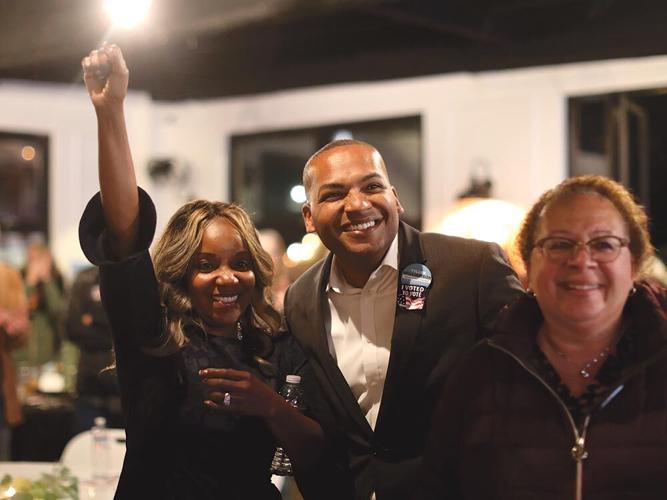
Monterey Mayor Tyller Williamson (center) celebrates his reelection to a second term in November 2024. He first got interested in politics by volunteering for a presidential campaign, before turning his attention to local issues. He built local relationships before considering a run for office through founding the nonprofit Monterey Peninsula Pride.
Williamson was a community college student in San Diego when Barack Obama was first running for president, and he signed up to volunteer, starting with phone banking. By Obama’s second campaign in 2012, Williamson had moved to Monterey. He attended a weekend training for the Obama campaign in the Bay Area, and was assigned to create and lead a neighborhood team in Monterey. “Oftentimes, people are just waiting for somebody to lead it. When you get things going, other people will join you,” he says. “Sometimes it just takes one person to get things going.”
Williamson didn’t think much about local government until after Trump was elected the first time, and he joined the nascent Indivisible movement. There was camaraderie, but he wanted to see more tangible results. “I wasn’t seeing things getting done,” he says. “I am really action-oriented and I thought, ‘instead of complaining about it, maybe it is a chance to make things happen.’
“I felt like, we can’t just throw up our hands and say there is nothing we can do. We have to find those opportunities where we can actually influence change.”
For his first foray into local government, Williamson got appointed to the Architectural Review Committee, where he learned how local government is organized and the rules of public meetings. Even more importantly, he says, he developed relationships with Monterey city staff and community leaders. “This isn’t saying you have to be their best friend, but how folks can be successful creating influence – it’s very much a relational space,” he says. “It’s not just elected officials, it’s people that surround them. Relationships are so important.”

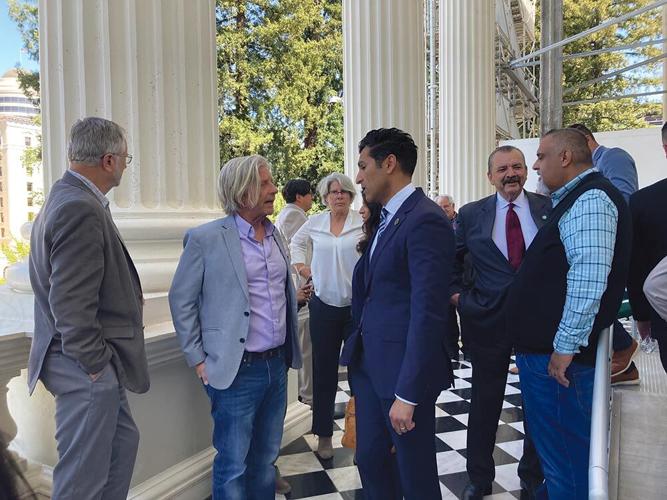
Assembly Speaker Robert Rivas (center) talks to elected officials from his district (from left, County Supervisor Glenn Church and King City Mayor Mike LeBarre) at the Capitol on April 9. At right, Salinas City Council members Tony Barrera and Andrew Sandoval joined the relationship-building trip.
RELATIONSHIPS GO ALL THE WAY UP AND DOWN THE CHAIN OF LEADERSHIP. At 7am on Wednesday, April 9, a group of local elected officials boarded a bus in Salinas to head to Sacramento for the day to get face time with Robert Rivas. Rivas was not only elected to represent District 29 in the California Assembly, advocating for the needs of his constituents in the Capitol, but he was then elected by his colleagues to become the powerful Speaker of the Assembly in 2023.
That has meant spending more time traveling throughout the entire state – he has an office in Los Angeles, for example, in addition to his Salinas district office – and expanded responsibilities. That led elected leaders in his district to feel like he is increasingly hard to reach, and to his staff coordinating the day-long field trip for 18 local mayors, city councilmembers and county supervisors.
“I have seen firsthand when we work together we are not only stronger, but we are much more effective,” Rivas told the group. “The ability to build relationships here in Sacramento makes all the difference.
“My goal is to bring you all together, to build relationships. Your voice absolutely matters.”
CHURCH THINKS A LOT ABOUT WHOSE VOICE IS HEARD. “I bristle when I hear the word ‘stakeholder’ now,” he says. “Stakeholders aren’t bad, they represent a constituency. But government has gotten so complicated that you have professionals [participating]. That is really one of the integral threats to a democracy – we’ve got tens of thousands of people who are the real stakeholders.”
Increasingly, local government itself is working to simplify that.
“Local government has historically been very much posting a meeting, holding a meeting and asking people to come to you,” says José Arreola, assistant city manager in Salinas. “Where we elevated community engagement has been really pushing ourselves to go to where people are at.”
One example of that is Salinas’ annual budgeting process. While the budget is usually not approved until May, outreach to the public begins months earlier, in December. City staff host dozens of pop-ups – at laundromats, grocery stores, La Plaza Bakery locations, youth basketball games – encouraging people to weigh in. This effort has engaged as many as 6,000 people in one budget cycle since it began in 2019.
Starting in 2012, the City has hosted a community leadership academy, an intensive seven-week course educating over 1,000 people about how local government works and what it does. A big focus is on the relationship piece: How to contact your city councilmember for your district, and ideas for how to constructively engage them on issues they have jurisdiction over. (“There is a lot of misinformation about what their taxes go to,” Arreola notes. “A lot of people think we have influence over public education or hospitals, but that’s not something we do.”)
Salinas also hosts a youth internship, and there are other opportunities for young people to learn the ropes and to have a direct impact.
Beyond Salinas only, the Monterey County Elections Department is now inviting incoming high school juniors and seniors to apply for a one-week internship (from June 23-27), in which students will be invited to design and launch projects increasing civic engagement. County Supervisor Luis Alejo is now accepting applications for his four-week-long young supervisor program (open to high school and first-year college students), originally founded in 2011 as a young assemblymember program when he served in the State Assembly, to mentor rising leaders in civic participation. Local cities including Gonzales and Soledad appoint youth councils with real decisionmaking authority.
For transportation improvement projects under the umbrella of Safe Routes to School, the Transportation Agency for Monterey County has collaborated with the County Health Department and the nonprofit Ecology Action to invite local people, including students and parents, to guide the process. The idea is that while engineers with technical knowledge are needed – somebody needs to know what a curb bulb-out is to develop a budget and design a project – it’s the regular people who walk to and from school every day who know what will truly make them feel safer in their neighborhoods.
For the past eight months, for example, the North Monterey County Safe Routes to School Steering Committee has been meeting at various elementary schools in North County, with some 25-30 community members weighing in on different intersections and ideas to improve them.
“These are folks without formal transportation knowledge,” says Gino Garcia, assistant planner at Ecology Action, who facilitates community engagement. “They get to decide how to allocate that funding so it aligns with their vision. What we say is, ‘We have a toolbox; now, community, tell us how you want to use that toolbox, and we’ll make it happen.’”
Garcia’s work begins months before the steering committee is even convened, hosting informal chats over coffee to explain the process and recruit prospective members – who need no other qualifications besides caring.
The steering committee has selected 16 finalist projects, and a survey opened on April 27 (online in English and Spanish at bit.ly/NorthCountyPB). The committee will then review the survey results and make a final project recommendation – which combination of digital speed signs, curb extensions, new sidewalk or flashing beacons will best serve themselves and their neighborhoods within their $1 million budget. The committee’s recommendations will then go to the County Board of Supervisors for consideration before a final proposal goes to the TAMC board of directors for approval.
OF COURSE, NO MATTER WHAT GOVERNMENT DOES TO ENCOURAGE THE PUBLIC TO PARTICIPATE, it’s ultimately up to the public whether they do. Building Healthy Communities launched in 2010 as a 10-year, $1 billion initiative by the California Endowment to transform 14 communities throughout California that were experiencing health inequities, including East Salinas.

a page from a legislative coloring book titled How A Bill Becomes a Law.
The idea was to empower the people themselves who face disproportionately poor health outcomes to propose solutions and advocate for those solutions – a bottom-up approach, instead of a top-down approach.
“The California Endowment learned that building voice and power via long-term investment is the best and only way to advance health and racial equity in a sustainable fashion,” according to a 10-year report published in 2021.
Building Healthy Communities has since expanded to include more communities in Monterey County, and has become a recognizable player in local policymaking. “We haven’t solved every problem, but we have shifted power,” says BHC spokesperson Tinisha Dunn. “We have redefined what community-led change looks like, in Salinas and Seaside. People once ignored are now leading campaigns, and conversations around race and equity and systemic change that used to be whispered are now happening in council chambers.”
BHC works alongside other groups like Center for Community Advocacy, Reinvest 831 and Centro Binacional para el Desarrollo Indígena Oaxaqueño to empower regular people to understand how local government operates, and how to pull the levers of power to advance their goals.
The underlying premise gets at Church’s concern about a professional class of stakeholders – anyone can be a stakeholder, they just need some guidance on how. Schools teach students about the three branches of the federal government, but less about local government. “A lot of folks don’t realize that their city council has more direct impact on their daily life than the president does,” Dunn says. “But nobody teaches us how to organize on our block, or how to make comments at city council. That’s what BHC does, and part of our work is unlearning the lie that we don’t have power.”
In Salinas, BHC, CCA and its coalition partners successfully advanced a rent stabilization policy approved by City Council last year. Organizers were relentless, showing up at town hall meetings and city council meetings, bringing dozens of renters with heartfelt stories out to tell their local decisionmakers what they wanted them to do. The bottom-up advocacy led the City of Salinas to hire an economic consultant to produce a report, and eventually, in September 2024, to approve three renter protection ordinances, including a 2.75-percent annual rent increase cap.

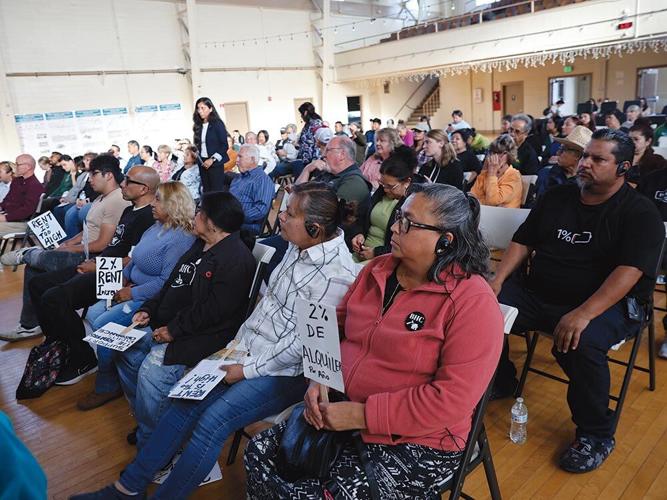
dozens of people attended town hall meetings in 2024 in Salinas about a proposed rent stabilization ordinance
“Today is a historic moment for our city,” said then-councilmember Anthony Rocha, who had championed the package of three ordinances plus a 2023 rental registry ordinance. “It’s a positive change driven by the community.”
A broad segment of the community – with guidance from BHC, CCA and others on how and when to participate – had shown up and notched a major policy victory for tenants.
But even a victory that is years in the making can be undone overnight.
WHERE RENTERS IN SALINAS FELT VICTORIOUS, LANDLORDS FELT IGNORED. They also organized. Every seat up for election in November was contested, and opposition candidates campaigned against rent stabilization. All of them won at the polls, and a new Salinas City Council was sworn in. And just a few months later, on Tuesday, April 22, the new council voted 5-2 to take steps to rescind all four renter protection ordinances passed by their predecessors.
That came after more than two hours of public testimony, with impassioned comments from dozens of renters urging council to keep the policies, and from property owners encouraging a repeal. Renter Maria Gomez said in Spanish that she received a notice earlier that day of an 8.8-percent rent increase. “It is really hard to be able to make ends meet,” she said. “Please listen to us. Thank you.”
Councilmember after councilmember thanked people for speaking up. “We heard you loud and clear,” said Margaret D’Arrigo.
“CCA is known to help tenants, and CRLA – they need to hear our residents,” said Gloria De La Rosa.
Someone in the audience shouted to interject: “You should hear our residents!”
After the vote, about 50 people led by BHC and CCA members gathered outside to grieve and to begin to plan their next steps, with about 10 people delivering remarks in Spanish.
“I have hope – you are all dedicated, all together,” said BHC organizer Luis “Xago” Juarez.
“We are going to keep fighting,” said Sabino Lopez of CCA.
One man, Miguel Pelayo – “just a community member” – proposed organizing a big protest in East Salinas, and asked people to call him to help plan it.
Arreola observes that for decisionmakers on the dais, it’s a balancing act. “We hear from the public, ‘why aren’t you listening to the public?’ Well, which public? There are strong voices on both sides,” he says.
“What I love about local government is you have the opportunity to have your voice directly heard by the policymaker and look them in the eye. For people who feel discouraged because when they’ve gotten engaged it hasn’t gone their way, there’s always another decision to be made.”
(0) comments
Welcome to the discussion.
Log In
Keep it Clean. Please avoid obscene, vulgar, lewd, racist or sexually-oriented language.
PLEASE TURN OFF YOUR CAPS LOCK.
Don't Threaten. Threats of harming another person will not be tolerated.
Be Truthful. Don't knowingly lie about anyone or anything.
Be Nice. No racism, sexism or any sort of -ism that is degrading to another person.
Be Proactive. Use the 'Report' link on each comment to let us know of abusive posts.
Share with Us. We'd love to hear eyewitness accounts, the history behind an article.