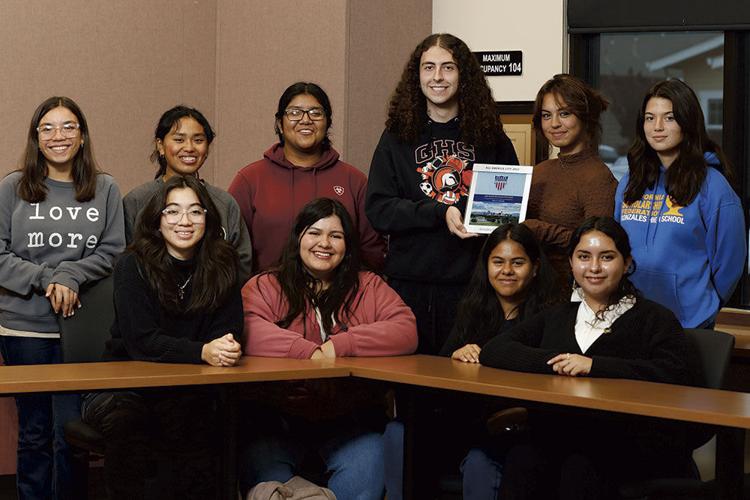
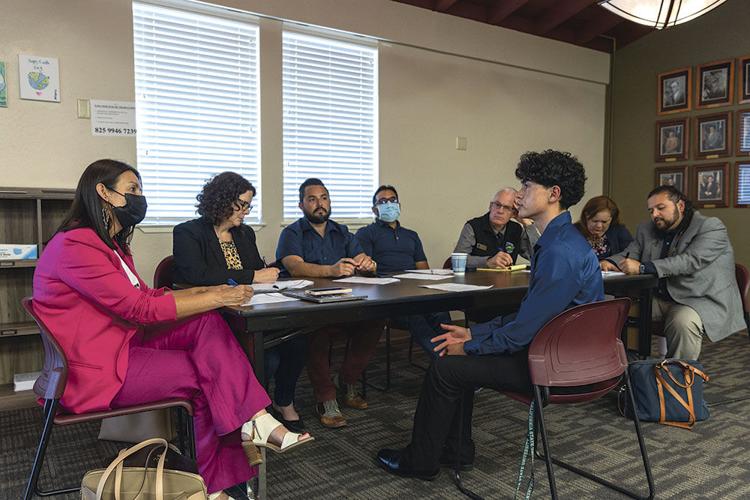


The 2023-2024 Gonzales Youth Council has established its priorities for the year. The council will work with the city on such issues as drug abuse prevention, housing insecurity, tenant rights and community beautification.
IN 2013, THE CITY OF GONZALES AND GONZALES UNIFIED SCHOOL DISTRICT ORGANIZED A YOUTH FORUM AT GONZALES HIGH SCHOOL. Students of all ages presented ideas for projects and changes they wanted their city or school to implement. They pitched ideas to the public about reducing graffiti, tackling bullying and increasing recreational activities.
“That was the first time that I really saw our community come together,” says Jeffrey Alvarez, one of the participants.
Former mayor Maria Orozco and former city manager René Mendez attended the forum. The student presentations, along with the data and the research they cited to back them up, impressed Orozco. “I looked at my city manager and I said, ‘These kids have so much talent. How can we continue to get them more involved?’”
The interest of city officials led to the appointment of two students – Alvarez and Yesenia Camacho – as youth commissioners, with the charge of growing youth participation in the city. The two took part in the first summer youth leadership program in Gonzales. They completed a community service learning action project. This research project included different ways the city could grow youth community engagement, and the two commissioners recommended to Gonzales City Council the creation of a youth council.
Their proposal included creating an appointed body that would work with and advise city officials and the Gonzales Unified School District. The City Council unanimously supported the commissioners’ recommendation. “That’s how the youth council was formed,” says Michelle Slade, chief strategist at C4 Consulting and GYC’s leadership development adviser.
The council – an idea pitched by and for students – was formally established in 2015. Eight years later, it is still active, with a new generation of young commissioners, and has concrete successes to point to. And at a time of hand-wringing nationally over shortcomings in civics education, the Gonzales Youth Council is serving as a template for other local cities aiming to create and formalize ways to get young people involved in government.
BY 2017, THE GONZALES YOUTH COMMISSION WAS LOOKING TO SUGGEST CHANGES TO POLICIES THAT MATTERED TO THEM. Fabiola Moreno, a former commissioner, says underage drinking was common at parties and that parents were aware of it. She remembers there was an uptick in car crashes in Gonzales involving teens, and she and others wanted to bring awareness to this issue. For Moreno, it was personal. “My family has always struggled with addiction to alcohol,” she says. “And they started drinking alcohol when they were teenagers.”
In 2017, the Gonzales Youth Council worked closely with City Attorney Michael Rodriguez, nonprofit Sun Street Centers and the Gonzales Police Department to address underage drinking.
Slade says members of the Youth Council looked at the issue beyond the punitive side and included an educational framework for a policy. The GYC voted unanimously to recommend a social host ordinance, targeting adults who allow underage drinking with fines of up to $350 for the first violation, more for repeated offenses. On the education front, instead of paying a fine for the first infraction, residents can opt to take an online course from the North American Learning Institute called Minor in Possession.
City Council adopted the ordinance in 2017. “It became the first formal policy driven by youth,” Slade says.
For years, GYC advocated for a teen innovation center. In 2021, Gonzales received $5 million from the state for this purpose. It will be part of a larger, $35 million project, the community center complex. The 23,000-square-foot project at Gavilan Court and Fifth Street will start construction next year. Members of the GYC met with architects, visited other teen centers and were part of the decision-making process.
The GYC has weighed in on other matters, including the local cannabis ordinance and mental health issues among their peers. The Mental Health Action Project, which started before the pandemic hit, brought awareness to challenges students were facing, including anxiety, depression and low academic performance.
Later on, the youth council partnered with Jennifer Lovell, an associate professor of clinical psychology at CSU Monterey Bay, and developed a survey to find out about the impact of isolation on teens during the Covid-19 pandemic and the resources they had available to them. They received 374 responses, which showed more than half of students were having issues staying motivated at school; 30 percent of respondents said their grades dropped or their post-high school plans had changed.
GYC presented the findings to the City Council, the school board and the Monterey County Board of Supervisors. In response to ongoing research on mental health, in 2020 the city and school district agreed to collaborate to fund an additional licensed clinical social worker position for up to $69,000 per year for the 2021-2022 school year.
The Youth Council’s mental health project research, which is currently in its third year, has been published in the peer-reviewed School Psychology Review of the National Association of School Psychologists.
The youth council’s work on mental health has put Gonzales, a small rural city in South Monterey County, in the national spotlight. Gonzales won the 2022 Ruth Vreeland Award for Engaging Youth in City Government from the Helen Putnam Awards. This year, Gonzales was one of 10 cities nationwide that received the All-America City Award from the National Civic League, a nonprofit that promotes civic engagement and building equitable and thriving communities.

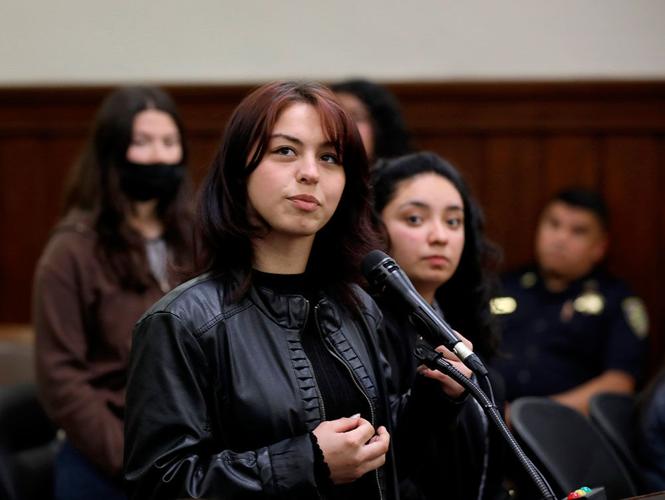
Aliyah Castillo and Sherlyn Flores of the Gonzales Youth Council.
THE GONZALES YOUTH COUNCIL’S IMPACT HAS GROWN BEYOND CITY LIMITS. Soledad started a youth council in 2019, and Greenfield is now working to launch one. In the City of Salinas, Community Safety Administrator José Arreola says he and his team are researching models that could work, with the potential for a proposal in the next fiscal year. (Salinas disbanded an earlier youth council in 2016 – one participant was now-Councilmember Anthony Rocha.)
In 2019, several students spoke at a Soledad City Council meeting and showed interest in creating their own youth council. Mayor Anna Velazquez, then a city council member, Soledad Unified School District officials and teens organized a meeting with the Gonzales Youth Council to learn about their model and how to implement it in Soledad.
Velazquez was invested in bringing the concept to Soledad after seeing a positive impact in Gonzales. When she was younger, she couldn’t wait to leave Soledad – and she was interested in a different framework for today’s youth. “I didn’t feel like I was invested or engaged in the community, so I really wanted to change that,” Velazquez says.
The Gonzales Youth Council relies on two adult advisers; this year they are former youth commissioner Cindy Aguilar-Castañeda (who now works for Slade’s C4 Consulting) and Jessica Olmedo-Albor, the city’s recreation coordinator.
It is also a peer-to-peer model where former commissioners guide upcoming young leaders. Both youth councils include 12 to 16 teenage members, with at least two representatives from ninth through 12th grade. In Gonzales, youth commissioners attend a seven-week paid summer fellowship to learn about how the city and the school district works; the group has dedicated staff and $41,408 annually from the city’s budget, which includes the contract with C4 Consulting. Soledad’s youth council, on the other hand, currently operates with volunteers. (This year, SYC members will be city interns. “Having that deeper time commitment to this council and to local initiatives is important,” Soledad City Manager Megan Hunter says.)
Becoming a commissioner is a lengthy process, which includes an application and an interview process in both Gonzales and Soledad. “We really want to see is somebody who has the intention to change their community, and the intention to collaborate with others and work as a team – that their commitment is to really not only represent their voice, but others’ voices,” says Ivan Ibarra Mora, Soledad Unified School District president and Soledad Youth Council adviser.
In September, four students applied for two commissioner positions in Soledad. The interviews, held inside council chambers, were a formal affair. On one side was a five-person panel consisting of city and district officials – Mayor Velazquez, City Manager Hunter, Community Engagement Manager Jesus Valenzuela, Superintendent Randy Bangs and Ibarra Mora. Across from them, one teenager at a time faced the panel to respond to questions.
The interview process lasted two days, with two applicants per day. They were asked a series of questions and also asked to role-play with the mayor to discuss alternatives to a hypothetical commercial development proposal that would bring businesses and jobs to the city but mean losing Veterans Memorial Park, which many residents use for recreation, such as soccer practice and dogs walking.
Both Soledad and Gonzales youth councils are starting a new cohort this school year and will start brainstorming projects they will focus on. “One of the things that we emphasize a lot in the youth council is ensuring that your ideas are informed,” Ibarra Mora says. “Another aspect is to ensure that when we look in the room, see who’s missing and seek that input.”
In 2021, SYC’s focus was on students who are neurodivergent or have other special needs. They partnered with PANECS (Padres de Niños Especiales del Sur del Condado – or parents of kids with special needs from South County), a primarily Spanish-speaking parent group, and hosted a virtual forum. Students presented in English while parents collaborated in Spanish. “It was really interesting to see intergenerational collaboration between adults and youth,” Ibarra Mora says, noting language barriers often marginalize Spanish-speaking parents.
Teen participation has increased in Soledad, with young people weighing in at the city’s housing element workshops and on local ordinances. That includes a tobacco retail license ordinance approved last year, which prohibits selling flavored tobacco. Youth also advocated successfully for getting free Wi-Fi at Orchard Lane Park, the first inclusive park in South County, which opened in August.
A youth-led organization like this holds a direct connection with the school district, but provides an opportunity for students to weigh in on issues outside of their schools.
Liliana Negrette, 17, is a 12th-grader at Soledad High School and is serving for her second year on the SYC. “I was never a part of student government,” Negrette says, noting she didn’t know that city council meetings were open to the public. “I had no idea the public could go and really learn about what’s happening within their city.”
After two years in the SYC, Negrette knows the ins and outs of city government and she feels empowered: “My voice does mean something. It makes me feel really good that there are people who are willing to listen to you, no matter how young you are or how old you are.”
Ibarra Mora says their main goal was to ensure youth input on the city’s future and district’s decision-making. And in a city populated heavily by young people, that can be especially important to the future.

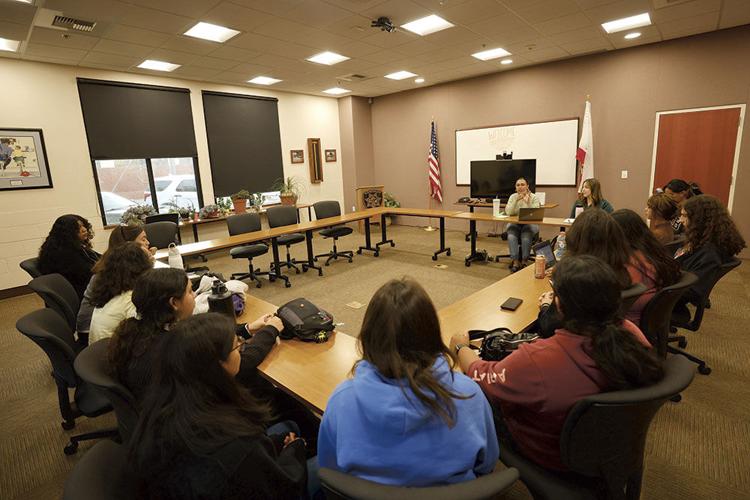
Youth councils meet every other week to work on the projects selected as points of emphasis for the year.
WHEN SOMEONE IS UNDER 18, THEY DON’T HAVE THE RIGHT TO VOTE; they can’t make decisions in many medical procedures or own property. However, the youth council model has shown they don’t need to vote to influence public policy and participate in the decision-making in the place they live and the future they want to see.
Hunter says getting youth involved in city matters is a win-win. She sees the Soledad Youth Council as a local pipeline for potential government workers. “I see the challenges that we have, sometimes hiring people locally, and [bringing in] people who better reflect the community that we serve,” she says. Soledad has implemented a summer internship program hiring six to eight interns, mostly high school students, to work on projects with departments including IT, public works and communications.
Hunter has experience in planning the future makeup of a city. Before joining Soledad, she was the director of Salinas’ Community Development Department, where she worked on projects that will come to fruition 10 or 20 years from now and will impact things like traffic, housing production and commercial areas. “In 20 years, they’ll be 38,” Hunters points out. “These are obviously going to be the key residents, the key demographic at the time that these plans are sunsetting.”
One reason Salinas Valley cities are seeking youth involvement is demographics. According to the U.S. Census, 30 percent of the population in Gonzales is under 18; in Greenfield, it’s 36 percent; in Soledad, it’s 23 percent; in King City, 36 percent; and in Salinas, 31 percent. (That’s higher than Monterey Peninsula cities, as compared to 16 percent of the population in Monterey, 18 percent in Carmel, 19 percent in Pacific Grove, and 21 percent in Marina.)
“More towns should have a youth council because the future of the cities is with the youth,” Negrette says. Without including voices from residents under 18, “It’s not the full representation of the city itself.”

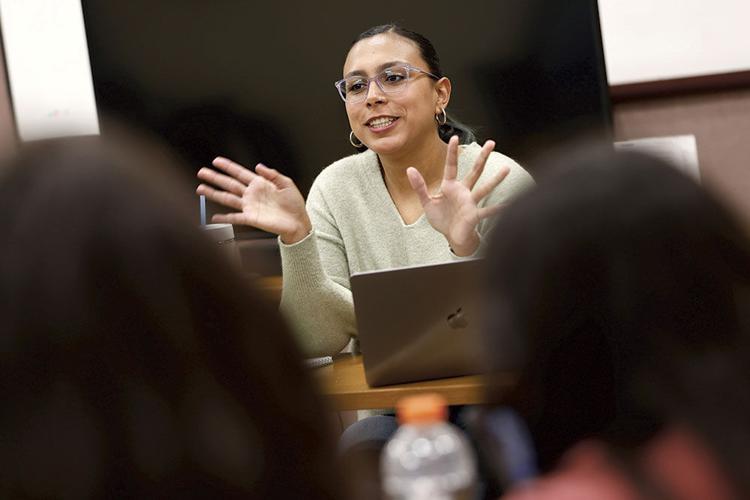
Cindy Aguilar-Castañeda is a former youth commissioner. She returned to Monterey County after graduating from college and now guides the current Youth Council.
NOT EVERY JURISDICTION HAS EMBRACED THE IDEA OF FORMALIZING A YOUTH COUNCIL. One thwarted effort came from the Monterey County Gang Violence Prevention Initiative, when staff were trying to address underlying issues related to violence: things like homelessness, continuity of services for youth in foster care, mental health services, immigration status, poverty, gang and drug activity. Rosemary Soto, then the manager for the violence prevention initiative, and Jessica Perez, a CSU Monterey Bay student, were part of a team that was looking for solutions in 2013. They came across Watsonville’s Teen Action Council and liked the model; they proposed tailoring it to a county structure. “We really felt what would have been impactful here was to develop a youth council or commission,” Soto says.
The team’s proposal was to provide a platform for teens from different backgrounds – including lived experience with various risk factors – to participate in local government and advocate for change in their communities. Soto was working in violence prevention and she knows firsthand that teens with behavioral issues, and those who are in the justice system, don’t have the same access to get involved and participate in school and their community as their peers. “Youth who are experiencing those challenges are not always presented with those opportunities,” Soto notes.
She believes that giving leadership opportunities to teens with challenges could be life-changing: “It could really set them on a path that they probably never would have imagined or even thought of,” she says.
Plus, their own experiences could bring a different light to the issues. “I’ve always believed that those who are closest to the problem are closest to the solution,” Soto says. “It was a key opportunity for bringing in community voices that were going to also impact systems change.”
Soto and former assistant County Administrative Officer Manny González say the county wasn’t prepared for this project back then – including a request for ongoing funding – and the concept failed to gain approval from an initial advisory board. “It was a good idea that got squashed quite early,” Soto remembers.
“We never really got the chance to present it formally,” González adds.
There are other county government programs for youth. During the summer, supervisors Luis Alejo and Chris Lopez offer the Young Supervisors Program. Participants learn leadership skills, collaboration and problem solving. They also learn about community engagement with local government and higher education institutions.
Soto has followed the rise of local youth councils in Gonzales and Soledad. “I’m very, very proud of the success that they’ve seen,” she says. “Many of the youth that have been a part of it have gone on to college and come back and now serve in their community in different ways.”
“I don’t think there was ever a question whether I wanted to come back home and serve my community,” says former SYC member Aguilar-Castañeda, who attended UC Berkeley and now lives in Soledad, near her hometown of Gonzales, where she is still amplifying young voices. She has worked with nonprofit Partners for Peace to launch a pilot mentoring program in Soledad. She’s also hoping to help bring a Youth Commission to Greenfield.

High school student Rodrigo Chavez meets with a panel that includes Soledad Mayor Anna Velazquez, City Manager Megan Hunter and Gonzales Unified School District Superintendent Randy Bangs as part of the application process to serve on the Soledad Youth Council.
THE IMPACT THAT YOUTH COUNCILS HAVE HAD ON LOCAL CITIES can be seen in different areas. It’s as simple as having free Wi-Fi at a local park, or hidden inside municipal code and ordinances on issues like underage drinking and flavored tobacco.
“When we talk about the future of our communities, we really need to engage our youth because, after all, they are the future,” says Orozco, the former Gonzales mayor.
Even more than specific achievements, youth councils give teens an opportunity to share the same space with adult stakeholders and city officials. “We’re sitting right next to the board members. We’re not just in the audience,” Negrette points out.
Perhaps the biggest change is for young participants, who say they now see their hometowns as places they can return to instead of escape from.
Cesar Quintero Jr., a senior at Soledad High School and ASB president, says serving on Soledad Youth Council helped him see Soledad through a different lens. Before, he was counting down the time to leave the city where he grew up. Now, he thinks: “This town has so much potential, and we can help change it.”
Quintero’s goal is to study liberal arts and become a high school history teacher. And returning to Soledad is in his plans.
He says he plans to apply what he’s learned in the future. “I would like to run for council when the time’s right,” he says. “I would like to see a new and younger face at the council.”
(0) comments
Welcome to the discussion.
Log In
Keep it Clean. Please avoid obscene, vulgar, lewd, racist or sexually-oriented language.
PLEASE TURN OFF YOUR CAPS LOCK.
Don't Threaten. Threats of harming another person will not be tolerated.
Be Truthful. Don't knowingly lie about anyone or anything.
Be Nice. No racism, sexism or any sort of -ism that is degrading to another person.
Be Proactive. Use the 'Report' link on each comment to let us know of abusive posts.
Share with Us. We'd love to hear eyewitness accounts, the history behind an article.