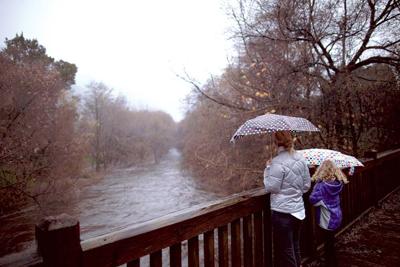

It was around 9:30pm on Jan. 8 when Carmel Valley resident Gary Briant, who was working on his motorcycles, saw water coming in under his garage door.
Despite the recent rains, Briant, whose home is on Paso Hondo and just adjacent to Dampierre Park, didn’t think he had cause for concern – he had been keeping an eye on the the Carmel River, and didn’t think it was rising toward his home. But as the water continued coming into his garage, Briant decided to investigate.
“I opened the front door, and I could see basically a river flowing through our yard,” he says. “It was one of most helpless moments, seeing the water level rise and you can’t do anything about it.”
As their three young boys were asleep upstairs, Briant and his wife, Andra, began shuffling their valuables in the garage to higher ground. Also on the ground floor are a bathroom and guest room, which Briant “wrote off” completely.
On the advice of firefighters who stopped by the house about a half-hour after the flooding began, he and Andra moved their cars to higher ground. Sometime between 1am-2am, firefighters urged them to evacuate, and they helped carry the kids through 2 feet of water.
Andra left, but Briant decided to stay.
He rented a pump the next day and pumped the water out of his home. Thankfully, he didn’t return the pump.
“Early Wednesday morning, around 2am, a firefighter started banging on the door,” Briant says. “He says, ‘Get up, it’s happening again.’”
Around 5am, when Briant felt like the water wasn’t going to get any higher, he turned on his pumps and started all over again.
Just downriver from the Briants’ home, Kate Daniels – chief of staff to the new District 5 County Supervisor Mary Adams, who was sworn in Jan. 10 – saw her garage start flooding on Jan. 11. It wasn’t from water that jumped the riverbank – it was literally spouting up from cracks in the ground like a series of drinking fountains she couldn’t turn off.
They’re called “boils,” Daniels says, and a fire captain told her they occur when storm debris causes blockage on the river and the water has nowhere else to go.
“For the entire day there were fissures spouting in our garage,” she says.
Daniels rented a pump, ordered a dumpster and got to work.
In all, at least 10 homes were flooded, five of them severely, on Paso Hondo and the surrounding area, in a week where local rivers flowed mightily.
~ ~ ~
As heavy rains persisted for days, Gerry Malais, manager of Monterey County’s Office of Emergency Services, worried there could be severe flooding along the Big Sur River. Debris like fallen logs has the effect of creating dams along the river, forcing the water to overflow the banks.
But the flow was so extreme, it actually helped minimize problems: “The Big Sur River was so violent, it dislodged downed redwoods,” Malais says.
Twenty miles north, from Jan. 9-12, about 21,500 acre-feet of water flowed out of the Carmel River to the sea, says Monterey Peninsula Water Management District General Manager Dave Stoldt. Due of a mix of conservation and the increasing price of water on the Peninsula, Stoldt says the annual demand in the region’s California American Water service area has held at about 10,000 acre-feet annually. That means, in just four days, enough water flowed into Carmel Bay to supply the Peninsula for about two years.
But there is no existing way to capture that water because, as Stoldt brings up, Peninsula voters shot down a proposal in 1995 to build a new dam, below the existing Los Padres Dam, to create a reservoir with a capacity of 24,000 acre-feet.
But not all the Carmel River water is being lost: Stoldt says the rains have allowed more than 230 acre-feet of surface water to be pumped into the Seaside aquifer for storage, which can only happen when a variety of conditions are met.
He adds, however, that the existing Los Padres Reservoir started to spill over Dec. 16, exceding its limited 1,670 acre-feet capacity.
In all, it’s a paltry amount compared to the volumes that are flowing into the ocean, especially when comparing it to the amount of water coming into the South County reservoirs – Lake San Antonio and Lake Nacimiento – since the beginning of the year.
On Jan. 1, Lake San Antonio held 21,150 acre-feet of water and was only at 6-percent capacity. By Jan. 17, it held 48,050 acre-feet and was at 14-percent capacity. During that same time, Lake Nacimiento went from holding 93,275 acre-feet at 25-percent capacity to holding 218,110 acre-feet, reaching 58-percent capacity.
In other words, in less than two weeks, the amount of water in each reservoir more than doubled. Nevertheless, neither reservoir is anywhere near being full.
All of that water came from streams flowing out of the Santa Lucia Mountains, which got dumped on during the recent storms, with some parts of Big Sur seeing more than a foot of rain from Jan. 6-8.
The wettest place in the county has been at the Three Peaks gauge in southern Big Sur, which saw 34.5 inches of rain from Jan. 2-12.
A report from the National Weather Service’s San Francisco Bay Area/Monterey office – which covers roughly from Fort Bragg to Cambria – on impact of the January storms on the region, states: “The beginning of 2017 started off with rain in the blockbuster department. However, as the old saying goes, ‘You can have too much of a good thing.’”
The saturated mountains, while a good thing with respect to the drought, have predictably led to landslides and closures on Highway 1. To date, the January storms have caused four slides that have closed at least one lane. By Jan. 16, two of the slides had still not been cleared, and the southernmost slide, at Mud Creek, just 8.8 miles north of the county line, is impassable.
Susana Cruz, a spokesperson for Caltrans, says it’s not yet known when that slide will be cleared, and that it will require an engineering project to be built – like a bridge, or a retaining wall or rock netting to stabilize the hillside – before Caltrans will open it back up. Cruz says the hillside at Mud Creek remains unstable, and technical crews are currently assessing the best project to undertake.
In all, though, she says, past engineering projects have greatly helped stabilize hillsides on Highway 1, and that – compared to the damage some past storms have done to the road – “This is like nothing.”
More storms are in the forecast, however, and Cruz says how the highway will fare is hard to predict.
“You’re living by Mother Nature, and she does what she wants,” Cruz says.
~ ~ ~
Though there was a flood warning in place in North Monterey County near the Salinas River mouth and along the Pajaro River, no region in the county has been more impacted by the storm than District 5, which stretches from Big Sur to Monterey.
For brand-new County Supervisor Mary Adams, that means it’s been a trial by storm.
Adams says that because of the relationships she and Daniels, her chief of staff, developed in the community after she was elected June 6, she knows who the local leaders are and has been in regular contact with them.
“We’ve been able to function as a conduit,” she says, adding that throughout the storms she repeatedly received text messages from her constituents about road and flood conditions, and that she would send the information along to the relevant agency to handle it.
“What am I going to do? Go out there with sandbags?” she says. “That’s not the idea. I need to make sure county offices know where to pay attention.”
She’s also been contact with Briant, and adds that she formerly lived on Paso Hondo for decades – and during that time it never flooded past half the field at Dampierre Park.
At Briant’s home on Jan. 15, scores of the family’s belongings are drying out in the sun, where they will remain until an insurance assessor can document them.
He shows the dark ring left by the water about 2 feet from floor in the garage, and explains that all the drywall will have to be torn out so that the studs in the wall – two-by-fours – can dry out. His water heater and furnace were destroyed, he adds, leaving him without hot water for at least a few weeks.
In his backyard, next to his small pool, he explains that he needs to have the water tested to see if it’s contaminated, and laments how the damage on his property beyond the footprint of his house – including his septic tank, fences and driveway – is not covered by his Federal Emergency Management Agency (FEMA) flood insurance.
Then he leads the way into his backyard and heads east, toward where the river jumped the banks, where a wall of sandbags is covered in white sheet plastic. Crews from Gabilan Camp, a prison in Soledad housing inmate firefighters, put the bags out following the flooding on Jan. 9, but they failed to prevent the second flood.
“Sandbagging is a band-aid,” Briant says. “The solution needs to be something more permanent.”
Briant, who grew up in the area, says when he was younger the river wasn’t so overgrown, and that vegetation was regularly cleared to help prevent flooding.
The current state of affairs, he believes, is due to groups, agencies and regulations that put people’s needs “at the bottom of the totem pole.”
On the way back to his house, he says it will cost him a lot of money to fix all the damage, particularly given how much his FEMA flood insurance won’t cover.
“Even if we wanted, we can’t buy enough insurance,” he says. “There’s literally no way to cover ourselves.”
More rains were forecast, meanwhile, in just a few days.
NWS meterologist Anna Schneider predicted a series of three storms would move into the area Jan. 18, bringing rains through the weekend and beyond.
But unlike the deluge of early January, these storms are drier and will move faster, she says, and only about 3.5-5 inches of rain are predicted for Big Sur. About half that is expected for Carmel Valley.
(0) comments
Welcome to the discussion.
Log In
Keep it Clean. Please avoid obscene, vulgar, lewd, racist or sexually-oriented language.
PLEASE TURN OFF YOUR CAPS LOCK.
Don't Threaten. Threats of harming another person will not be tolerated.
Be Truthful. Don't knowingly lie about anyone or anything.
Be Nice. No racism, sexism or any sort of -ism that is degrading to another person.
Be Proactive. Use the 'Report' link on each comment to let us know of abusive posts.
Share with Us. We'd love to hear eyewitness accounts, the history behind an article.