
IN 1984, MYRA AND DREW GOODMAN STARTED WITH A 2.5-ACRE RASPBERRY FARM IN CARMEL VALLEY. Their priority was simple: No chemicals, no toxic inputs. They would sell at their roadside stand they named Earthbound Farm. Living near their crops and consuming the food themselves, they were determined to avoid synthetic inputs they viewed as harmful.
Organic certification already existed, though it had not yet been adopted at the national level. At the time, it generally meant the same as it does today: farming without synthetic pesticides, herbicides or chemicals, eventually picking up enough steam to fuel the Organic Foods Production Act of 1990.
As the Goodmans expanded their operations–partnering with Mission Ranches in Salinas and diversifying into commodities like leafy greens and salad mixes – they eventually landed their first big-box retailer, Costco, in the early 1990s. However, at the time, the organic label faced challenges in the marketplace.

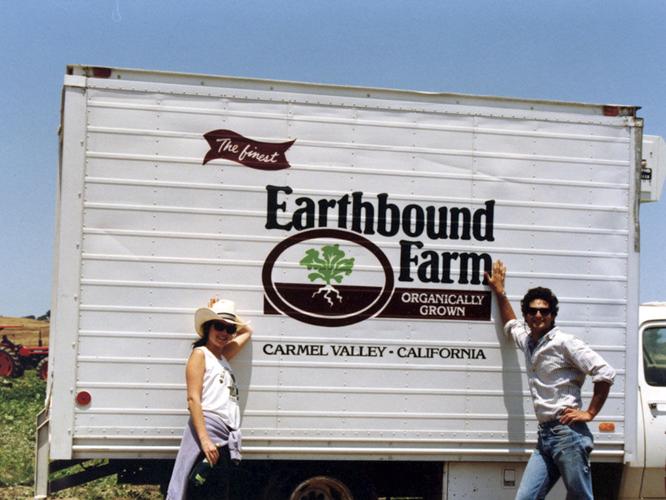
Myra and Drew Goodman, founders of Earthbound Farm, with their first refrigerated delivery truck, in 1988 or ’89.
“In the beginning, Costco did not want our salad labeled as organic. They thought organic meant overpriced, worse quality. They were like, ‘‘fine if it is organic, but we don’t want it to say organic on the label,’” Myra Goodman says. “That was a really big ethical decision: Do we want to use the Earthbound brand to sell a product that isn’t [labeled] organic?”
But quickly, demand grew.
Food safety problems were running amok, with tainted seafood and poultry making headlines, alongside growing concerns around pesticide residues – particularly the Alar scare, involving a pesticide used on apples that posed a cancer risk to children. Meanwhile, Whole Foods, once a small hippie marketplace, was taking off.
And the Goodmans were at the forefront. By the late ’90s, the organic label was no longer to be avoided – the Goodmans say Costco was receiving complaints about not having organic options available in its stores. Earthbound Farm became the largest grower of organic produce in the United States in 1998; it is still the largest organic salad producer today, now owned by Taylor Farms.
“The organic industry is way too small,” Myra Goodman said at her TED Talk in 2014, over a decade ago. “Sadly, less than 1 percent of our farmland is organic.”
That remains true today, even though more than ever, consumers are purchasing organic products and bringing with them a better understanding of what the organic label means, as well as a belief that it is healthier and worth the premium. In 2023, U.S. sales of certified organic products reached a record high of nearly $70 billion, according to a report by the Organic Trade Association. Monterey County plays a key role in this market, ranking as the top county in the U.S. for organic production, and accounting for 8 percent of U.S. organic sales, with $740 million in 2022, according to the most recent agricultural census.
Yet, while demand for organic products continues to grow, certified organic farmland in the U.S. still represents less than 1 percent of the country’s 880 million acres of farmland, according to the USDA. Of this, 17 percent is in California, which continues to expand its organic acreage. In Monterey County, it’s 15 percent.
HISTORICALLY, ORGANIC FARMING HAS BEEN THE UNDERDOG, going against the tried-and-true systems of industrialized agriculture. Transitioning to organic means considering time, money and risk relative to the status quo, where margins are slim and shaped by markets, climate, subsidies and monopolies.
Economically, organic farming is often more expensive than conventional. Crop yields can be lower and with no quick fixes for pests without synthetic fertilizers and pesticides. Those who want the label must adhere to a process, which is more time, money, and recordkeeping – challenges that become even harder during years when inflation drives up operational costs, making it difficult just to reach harvest, where many farms make much of their income.
For example, Dirty Girl Produce, a fan favorite which supplies locals along with restaurants like Chez Panisse in Berkeley with its famous, dry-farmed tomatoes, launched a GoFundMe last summer, raising over $50,000 to help them get to harvest.
“We have maxed out our farm funds and available credit lines and have another month before our income exceeds our expenses,” Joe Schirmer, owner of Dirty Girl Produce, wrote in the campaign. “In the 30 years I’ve been farming I’ve never been in quite this hard of a position.”
Yet, the long-term benefits have the potential to outweigh the initial costs for many farmers. Organic produce can command higher prices – and also build healthier soils that absorb more water, and improve long-term productivity.
Over time, consumers have come to share the Goodmans’ priorities: fewer chemicals and cleaner produce. While a direct link between synthetic pesticides and rising cancer rates – especially among younger generations – remains difficult to connect, the prevailing culture has embraced the idea that chemical-free produce is worth a premium. All of which has created a fundamental shift in the way people view their food, driving the market to demand more organic food.
Even as demand is growing, overall acreage is stagnating due to a variety of cost pressures, including international competition favoring international growers with lower production costs. Additionally, more consolidation has led to more competition against economies of scale.
“Organic is very much now a global market. And so the competition is really heightened,” says Kelly Damewood, CEO of California Certified Organic Farmers (CCOF). “All the market studies show it is anticipated to increase, but where it’s getting sourced from has really changed… A lot of it comes down to just economics and price point.”

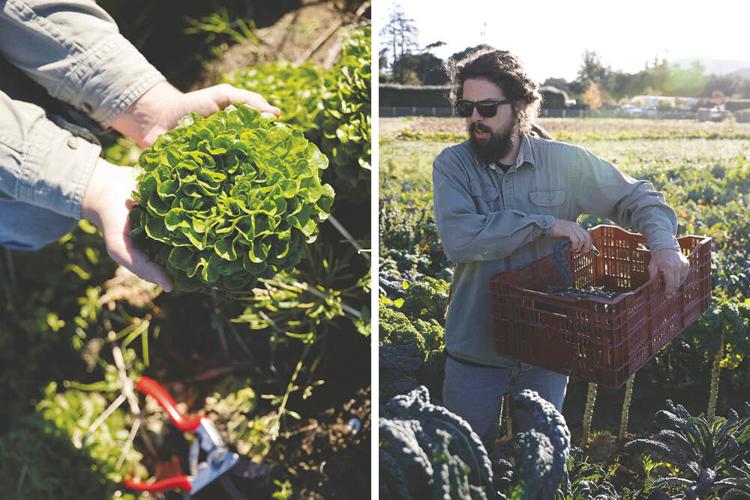
(left) Tommy Pham and CJ Silva harvest lettuce at Earthbound Farm in Carmel Valley (right) TJ Silva harvests kale at Earthbound.
ON A SUNNY DECEMBER MORNING IN WATSONVILLE, an inspector with CCOF, an industry leader in organic certification, visits a farm for its annual, routine inspection. But the scrutiny is mostly inside an office, not out in the sun in the fields.
“It’s all about keeping a paper trail,” says the farmer, who remains anonymous for confidentiality, part of the Weekly’s agreement with CCOF to accompany an inspector on the tour. The farmer shares that they had one of his roughest years ever, due to rising costs of materials, labor and fuel.
The CCOF inspector begins a 3.5-hour rundown of the paper trail, meticulously assessing all aspects of the supply chain to ensure compliance with organic standards – prohibiting harmful chemicals and maintaining proper records and labeling methods.
As one of roughly 80 USDA-accredited organic certifiers, CCOF plays a role in certifying and enforcing national organic standards. While these standards were initially established in 2002, they were updated significantly in March of this year, expanding certification requirements to encompass every stage of the supply chain.
The Strengthening Organic Enforcement rule, which amends the original standards, mandates that everyone from farmers to shippers to packers maintain thorough documentation to trace organic products throughout the supply chain.
However, before the inspector even reaches the supply chain review, the Watsonville farmer is flagged for non-compliance after failing to register newly acquired parcels of land. Still, the CCOF inspector proceeds through the inspection process, spending most of their time in the shed, surrounded by boxes and stacks of paper, followed by a walk across the property to inspect everything from the farm’s boundary lines to the labels on the fertilizer canisters.
Materials list? Check. Any inputs, like pesticides, and what kind? Check. Labeling mechanisms, delivery tags, crop updates? Check.
According to the Agricultural Commissioner’s annual crop report, Monterey County had 95,475 acres dedicated to organic production in 2023, representing a 17-percent increase from the year before and a 186-percent increase from a decade earlier.
The top commodities in 2023: strawberries, lettuce, broccoli and wine grapes. While larger farms tend to more easily absorb the costs of transition across their operations, smaller farms, in theory, have more access to transition costs via government grants and reimbursements.
Still, it’s tough.
“The consumer demand is there. We have not seen it go back by any means, despite how the economy is going with inflation,” Meghan Diaz, senior director of local and regional produce at Sprouts Farmers Market, said during a panel at the Organic Growers Summit in Monterey on Dec. 4.
“Stepping out of my role as a retailer, understanding the life of those within the supply chain, everyone is being squeezed in such a way that makes me nervous about the longevity of this industry. It won’t exist without people being able to make some sort of profit.”
Local growers may have easier access to local, independent grocers, says Jamie Collins, owner of Serendipity Farms and who used to assist the produce manager at Elroy’s Fine Foods in Monterey. She would compile lists of local farms and what they were growing, then provide those lists to the produce manager for sourcing. “The buyer really has to give a shit,” she says.
And at the end of the inspection in Watsonville, the grower is flagged, unable to label some of their produce as USDA organic-certified this year.
ROY FUENTES OF FUENTES FARMS has been farming strawberries in Salinas since 1993. He began by managing strawberry operations for Reiter Affiliated Companies in Watsonville, a grower for Driscoll’s – the world’s largest berry producer – before moving positions to grow organic berries for Driscoll’s five years later.
He shares that his contract with the landowner is a positive partnership, which saved him significant time in transitioning to organic farming. Since the land was already certified organic, he avoided the three-year waiting period required to transition from conventional methods.
Fuentes notes challenges that both organic and conventional growers face, and says that rising labor costs and minimum wage increases have been difficult to keep up with. Pests, he adds, are especially problematic for strawberries.
“My harvesters, they come in year after year now, because they know me and they know that I like to do something about the field and make it good for them,” Fuentes says. In the past, he says, it was difficult to find harvesters to work on organic farms where the yields might be less, meaning fewer full boxes and less pay.
Fuentes is constantly trying to figure out how to manage new pests and diseases, and how to make his soil better. He’s a collaborator with the Agricultural Research Station (ARS) in Salinas, which focuses on climate-smart and organic farming systems, emphasizing cover cropping and improved soil management. He’ll cultivate about 15 acres of strawberries at ARS on a four-year cycle, contributing to their research while also selling the harvested crop.
Walking through rows of strawberry varieties, he points out that he’s evaluating which varieties are more resistant to certain pests. Some diseases, like verticillium wilt – a fungal infection that invades the soil and causes plants to wilt – can only be managed with synthetic fumigants. It’s one example where organic farming means greater risk.
If these diseases get into the soil, which he’ll know when he sees the strawberry plants grow in with dry, brown and curling leaves, typically organic farmers rotate the field, which means losing the entire crop.
JUST 25 MILES AWAY IN SOLEDAD, Braga Farms is preparing their fields for cool-season vegetables, namely greens, broccoli, cauliflower, celery, spinach, spring mix and herbs. Braga cultivates over 20,000 acres split between conventional and organic farming, with the majority – about 77 percent – dedicated to organic production.

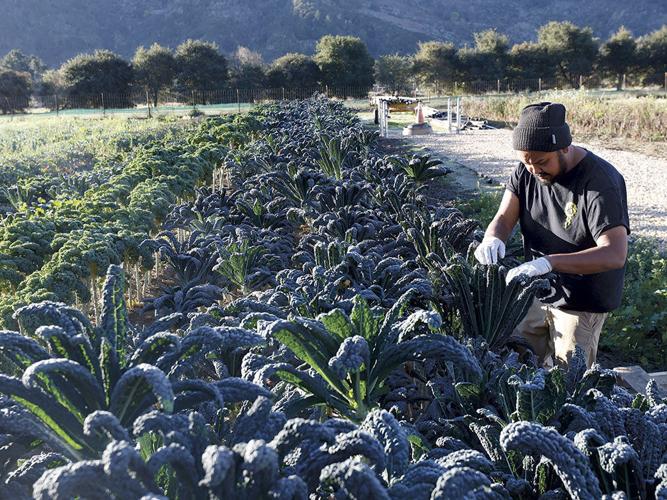
On a sunny day in Carmel Valley, farmer Tommy Pham sifts through rows of kale at Earthbound Farm, a pioneer of the organic movement in the 1980s and now part of Taylor Farms.
Visually, bystanders wouldn’t be able to distinguish between conventional and organic farms. Even seeing a spray tractor at work wouldn’t make things clear without knowing what is being sprayed.
Between the two types of farming styles, there are 30-foot buffer zones. While it doesn’t seem like much, farmers are generally respectful of each other, says Katie Chiapuzio, director of environmental science and resources at Braga.
“We’ve had issues in the past where they test our field and it doesn’t pass inspection because there’s residue, a conventional chemical on it, and we have to investigate it,” Chiapuzio says. “We have to find out what they sprayed, when they sprayed it. Was it our negligence? Or was it someone else’s negligence?”
Every single piece of farmland has to be managed in relation to other farms in adjacent fields, Chiapuzio adds, relying on skills that most farmers, regardless of their farming style, are familiar with. This means managing water flow, which, during heavy rain years, can cause eroded soil to funnel water (and chemicals) into nearby farms if not properly controlled. It also means monitoring pesticide use by ensuring that wind conditions won’t carry chemicals onto other farmers’ properties.
“I can’t risk my certification because of your negligence,” she says.
Like Fuentes, Braga has dealt with soil bugs and soil diseases, in some cases so bad that they’ve lost entire fields, switching to conventional farming methods to kill the pest before transitioning back to organic.
“We tried everything in the world to take care of [this one] soil bug, and nothing worked,” says Eric Morgan, vice president of environmental science and resources at Braga Farms. “I’m optimistic that we’ll figure it out. We need our farmland to be productive growing food. We prefer to do so organically, but in certain, weird cases, you can’t.”
Most of the larger growers maintain both organic and conventional production to meet customer demand, Morgan explains. For example, Taylor Farms sells and markets organic produce under its Earthbound Farm brand, while also producing conventionally farmed goods.
The same holds true for Braga, which markets its organic produce under the label Josie’s Organic. Morgan adds that the business often relies on its conventional crops when their organic operations are struggling.
How deeply they commit to organic farming “is going to be reflected in what the consumers want,” says Morgan. “But it’s hard and it’s more risky, and potentially in certain times it has better rewards, too, in terms of markets. But not this year.”
And there is no guarantee of getting a premium for organic. “We’re selling conventional and organic at the same price sometimes,” Chiapuzio says.
The organic produce industry’s supply chain is a well-oiled machine that must balance production, handling and processing while meeting grocery retailers’ exact demands – delivering produce on time and in the specific condition they require. Smaller local organic growers, Chiapuzio notes, may have more flexibility in offering products that are less visually perfect. However, she adds, they may struggle entering into the wholesale market more than a larger farm.
For Braga, despite their efforts, carts of produce sometimes never make it to store shelves. “Often, I’ll get at least seven rejection emails a day. We sent 100 cases to this or that grocery store – it didn’t make specs. So, it’s going to be dumped or donated,” she says, referring to their organic goods.
Farm to farm, across commodities, every year is different.
WINE GRAPES, a top commodity in Monterey County, operate in a unique space both in the marketplace and ecologically.
Wine grapes are a permanent crop, harvested once a year rather than in cycles, typically starting in the late summer. While climate challenges have affected other crops in recent years following the volatile swings between heavier rains and long, hot summers, the conditions in Monterey County have actually benefited wine grapes, boosting them to the No. 5 spot among top-valued commodities in 2023, up from No. 7 in 2022.
In terms of organic farming, only a small portion of the county’s 40,200 acres of wine grapes are certified organic – just 795 acres, according to the crop report.
Wine grapes may be easier to farm organically, says Greg Hill, co-founder of Tira Nanza Wines in Carmel Valley, who first became interested in growing them after a family friend suggested it was relatively straightforward to do so organically.
Having spent several years farming wine grapes before purchasing the winery with his family in 2020, Hill believes the local climate is uniquely conducive to organic grape farming, especially when it comes to managing certain pests.
“It would be possible some years to get through an entire vintage without spraying anything; you would have a mildew-free crop here, where that’s just not the case for a lot of [crops],” Hill says.
“If you’re growing berries in Watsonville and you didn’t spray at all, you’re going to lose most of your crop. Even if you’re growing grapes closer to the coast or in the Salinas Valley where the fog is so present, if you don’t spray anything you’re going to lose a lot of your crop to mildew.”
There is also a stronger value proposition compared to other commodities. Producers have more flexibility in pricing wine, as consumers often view it as a specialty item and are willing to pay a greater premium, more than for staples like organic lettuce.
Through the California Department of Food and Agriculture, 75 percent of Tira Nanza’s certification costs are reimbursed. Hill believes that if you’re producing something better, the final product will speak for itself, allowing the farmer to focus less on yields.
Even still, he adds they’ll get very comparable yields at their vineyard to other local, smaller nonorganic farms.
“I truly believe that we can produce something better by being organic,” Hill says.
Tira Nanza has roughly 30 acres of vineyard, as well as 620 acres of cattle ranch. Some of their biggest pests are gophers, mites during dusty seasons, and ground squirrels which eat the baby vines close to the ground. All of which they are trying to control by using birds of prey – Cooper’s hawks, owls, red-tailed hawks and golden eagles – as a natural form of pest control.
Not using pesticides, he adds, also protects the birds from being poisoned. This can be packaged into the marketing and aesthetics that come along with the wine-making experience.

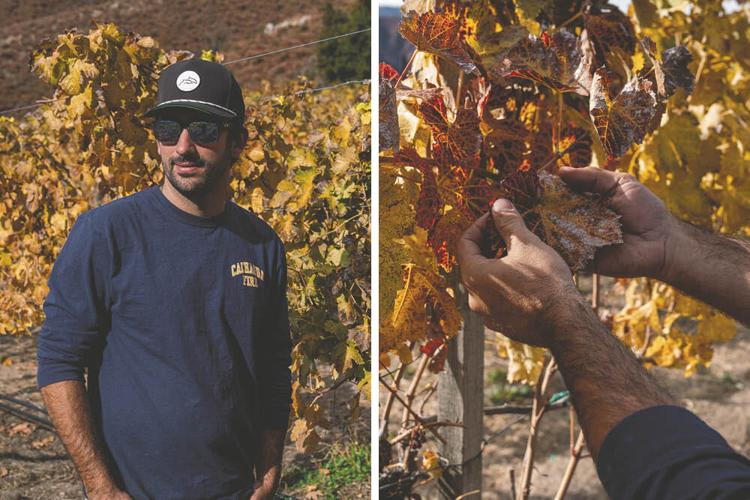
(left) Greg Hill, a co-founder of Tira Nanza Winery in Carmel Valley, stands beside rows of vines after harvest. (right) Hill holds up a Syrah leaf and a Viognier leaf, representing two wine grape varietals, at the end of the season.
“Especially in the wine business, where it’s all tours and tastings and stuff, anybody can say, ‘Yeah, we farm organically.’ But if you don’t have any certification, there’s no way for people to distinguish whether you’re completely making it up, or whether it’s real,” Hill says.
Still, wine grapes are not immune. For example, vine mealybug spread across the state in 2007, including in Monterey County. It is hard to control once established. As Jay Sughroue, area manager of BioSafe Systems, a biopesticide, notes: “Sometimes, there’s no silver bullet approach.”
FOR MANY FARMERS, both organic and conventional, the relationship between soil health, plant health, and pest and disease management is becoming better understood. Although organic farming still faces challenges, the demand for products that rely on more holistic farming practices is exploding.
“[Demand] for regenerative agriculture is proof that society wants the food system to progress,” Thaddeus Barsotti, director of fresh supply chain innovation at fieldTRUE, said at the Organic Growers Summit.
“The elephant in the room is we need to rethink how the food system works from a very high level. There is not a good way to get that money to the people who are doing those practices. The challenge we have is: How do we take that economic power and move it to the right places?”
Today, CDFA is working to define regenerative agriculture, a term which has already begun showing up in the marketplace without a uniform understanding of what the term means, drawing from the history of organic farming to create a legitimate term that holds value.
At Braga Farms, Morgan shared at the summit that despite the struggle to keep up with organic on the production side, Walmart has reached out to do Project Gigaton, a project which in part, works to encourage farmers to adopt practices that reduce emissions, improve soil health, and enhance water quality.
“This,” Morgan said, “is where we’re going.”
(0) comments
Welcome to the discussion.
Log In
Keep it Clean. Please avoid obscene, vulgar, lewd, racist or sexually-oriented language.
PLEASE TURN OFF YOUR CAPS LOCK.
Don't Threaten. Threats of harming another person will not be tolerated.
Be Truthful. Don't knowingly lie about anyone or anything.
Be Nice. No racism, sexism or any sort of -ism that is degrading to another person.
Be Proactive. Use the 'Report' link on each comment to let us know of abusive posts.
Share with Us. We'd love to hear eyewitness accounts, the history behind an article.