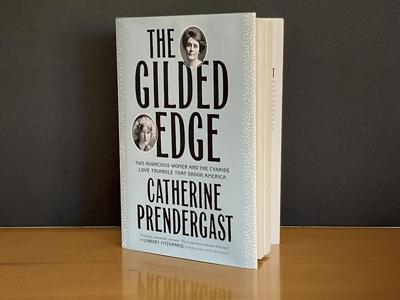

English professor Catherine Prendergast set out to write a set of scholarly books about U.S. towns that built themselves as artist colonies in the early 20th century but instead “stumbled into the hornet’s nest that is Carmel’s past” and realized she had a very different story to tell. She became enthralled by two women who collided in the village by the sea only to be forgotten for more than 100 years. The result is a gripping narrative nonfiction book called The Gilded Edge: Two Audacious Women and the Cyanide Love Triangle That Shook America.
If “cyanide love triangle” isn’t shocking enough, Prendergast begins the book in as audacious a way as the two women – Nora May French and Carrie Sterling – were themselves. The introduction features the accomplished poet French writing in 1907 to her lover as she’s enduring the abortion of his child with pills she purchased at a drug store.
“It takes some kind of woman to write a letter about an abortion to her boyfriend while she’s administering it,” Prendergast writes. Approximately eight months later, French would be dead at the home of George and Carrie Sterling while George was away, apparently by suicide, but under mysterious circumstances.
The Gilded Edge is timely as the U.S. continues to argue about abortion and women face losing autonomy over their own bodies, sadly so. Sad as well that Prendergast had to dig through archives devoted to men to find these women’s stories. One larger theme of the book is how men are memorialized but women are pushed to the margins, if they’re allowed to be left on the pages of history at all. Prendergast sees her book as part of the movement of recent nonfiction books recuperating the largely forgotten past of women’s contributions, similar to Hidden Figures, about NASA’s mathematicians. The challenge, she says, is that publishers want happy endings that celebrate women. As Gilded Edge demonstrates, not all endings are.
“We can celebrate women but we also have to mourn them because there are a lot of lost accomplishments as well as unacknowledged accomplishments,” Prendergast says.
Locals will find the book fascinating as a tale about Carmel and it’s mythical bohemian past. It doesn’t glitter like the golden tales that current Carmelites like to tell. Photos of the time featuring writers posing on Carmel Beach were just marketing material and behind the idyllic facade there was darkness. Poet and lead bohemian George Sterling (also a seasoned land developer) was recruited by Frank Powers of the Carmel Development Company to move to Carmel from Oakland and to lure the famous writers to move to the tiny town in hopes of attracting wealthy people to buy plots of land. It was a business scheme that ended in disaster. George Sterling drank heavily and moved from woman to woman, including Nora May French. Yet, the myth persists.
Weekly: George and Carrie Sterling were really the influencers of their time in California’s literary circles. How are they still influencing Carmel today?
Prendergast: Locally in Carmel, the bohemians are invoked over decisions made in City Council, like what the founders would have wanted and imagining it would be anti-progress, anti-wealth. But in fact what Carmel has become, a wealthy resort, is what was planned all along.
I wonder if Carmel would be different if they had not been brought in to attract other bohemians?
I think there would be less of a myth around it. Carmel still had artists through the arts and crafts clubs. The writers considered the clubs a bunch of old ladies and prudes, whereas the writers really carved out the myth of Bohemia at Carmel. But the thing is, by 1910 Frank Powers [president of the Carmel Development Company] realized the scheme of having writers draw other people wasn’t working. George Sterling never got Jack London or Ambrose Bierce or Upton Sinclair to move to town. The writers weren’t paying their rent, they were more trouble they were worth, and they were squabbling.
Oh George…
(Laughs) Well, George was a mess by that point. He was drinking and causing all kinds of problems. So the company cut their losses.
How frustrating was it that people destroyed documents, including George Sterling, who burned papers before he died?
It’s very frustrating. There are no letters I could find between [George Sterling] and his wife Carrie, even though I know they were written, or any of the other women he was involved with romantically. So I can only imagine that those were among the ones he burned. Actually, not, because as I like to tell my students, lack of data is data. It tells you something. If pages are missing or ripped or crossed out when people are talking about certain women – that told me quite a lot. It just made me look harder.
Nora dies by suicide in Carmel less than a year after one of her abortions, which opens your book.
I know. The frustrating, depressing, horrifying, saddening thing is what she would have written had she not died at the age of 26.
As I was reading your book against the backdrop of the current abortion arguments, it was hard not to be sad about how far we haven’t come.
Now we put bounties on women for doing exactly what Nora May French did and frankly, let’s face it, what millions of other women did and are still doing. Very little has shifted, and I think that women particularly will find the women in this book recognizable, and their struggles also fairly resonant.
It was also sad to see how little has changed in a century with women splashed across the pages, only to be burned up and forgotten as the media turns its attention to someone new.
I think the whiplash part comes when supposedly you’re experiencing a moment of progress. At the time Nora and Carrie were living they had more opportunities than at any time before as a woman in this country. That’s the difficulty, the expectations running headlong into reality. Women have to constantly adapt and remake, to fit a world that’s not accommodating to them.
A lot of people say this book makes them sad; I hope it makes them mad, productively mad, as well.
Maybe what I’m doing is, as you referenced earlier, mourning the losses. As much progress as we’ve made as women, we’re still fighting an uphill battle.
You’re making me glad with these questions, because if you’re asking them it means the message got through. This is really in the end what it’s about, moreso than about Carmel.
(0) comments
Welcome to the discussion.
Log In
Keep it Clean. Please avoid obscene, vulgar, lewd, racist or sexually-oriented language.
PLEASE TURN OFF YOUR CAPS LOCK.
Don't Threaten. Threats of harming another person will not be tolerated.
Be Truthful. Don't knowingly lie about anyone or anything.
Be Nice. No racism, sexism or any sort of -ism that is degrading to another person.
Be Proactive. Use the 'Report' link on each comment to let us know of abusive posts.
Share with Us. We'd love to hear eyewitness accounts, the history behind an article.