
“A psychotic killer recently escaped from a mental asylum and has chosen Daniela as his next victim to fulfill his satanic dark Lord’s wishes.”
“Four intercutting stories taking place at the same crappy LA motel in a night when secrets are revealed and drama is doomed to unfold.”
“Walter Lachman was 13 years old when he and his Grandmother were resettled from Berlin to the Riga Ghetto in Latvia. She was shot the first week. He was alone for the first time in his life.”
These are just three of the blurbs for films screening at the 2015 International Monarch Film Festival this Thursday and Friday evening. Respectively, they describe feature film Adaline by Bidisha Chowdhury, the feature The Last Night by John Heath, and 3 1/2 Years Without a Toothbrush, a documentary by Ren Blood.
It’s a sundry set of films, made with more faith and gumption than money and polish. The festival attracts indie diversity because the mission of the founders, Cristiana DiPietro and Matthew Kalamane, is to bring together “cutting edge, artistic and original content” without forgetting “local filmmakers of any age.”
That’s a lot of mission, even across four of Lighthouse Cinema’s screens, but it brings interesting festival mates into proximity.
A Social Life (5:35pm Thu), by Kerith Lemon, is embedded in the short narrative block of films. It’s a clean and quiet number, using subtlety to draw the viewer into its study of a young urban woman and her dual lives – the life she portrays on social media, and the one she actually lives. In its eight minutes, it explores the “branding” social media allows us to do.
In one scene, the woman takes a picture of verdant veggies on a cutting board, pulls out her phone, aims – here, the image of the food in her phone’s camera window magically hovers above the actual food – snaps a picture, and writes a caption: “Gettin’ saucy!”
Then she pauses, walks to the fridge, pulls out a box of takeout and starts eating from it.
“No one is as perfect as their social feed might look,” Lemon writes by email. “I’ve often posted photos that were perceived as something else, which wasn’t my intention.”
She noticed that social media “conversations” trended away from people’s true feelings and inner lives, toward more “face value” or trafficking in envy.
“Photos can easily crop out the reality in life,” she continues. “The messy room outside of the perfect food shot, the 20 selfies it took to get that perfect one.”
Eight minutes isn’t enough time to tell a lot of story, but Lemon uses it productively to start crucial tangents of thought and conversation. Lemon will speak after her film to catalyze them.
If it’s not subsumed by all the other messages. The festival has a competition component and each filmmaker wants you to live in their world for a while.
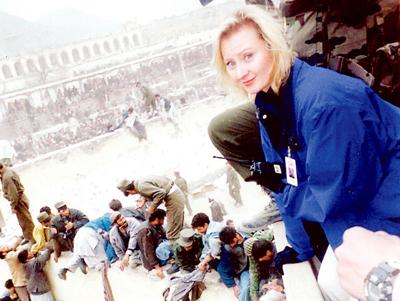
Actually, Alex Quade wants you to live for a while in the world of U.S. military special forces. She’s been a reporter for CNN and Fox News, but has increasingly made independent documentaries about those military forces in campaigns in Iraq and Afghanistan.
Chinook Down is her assemblage of the Taliban blowing up a U.S. Chinook helicopter in Afghanistan, killing all the soldiers on board. Quade spent 5 years collecting the documents, videos and interviews to make the film. She was motivated. If not for a last-minute switch, Quade, who was embedded with those combat troops, would have been on that helicopter.
In military lingo, she explains her methodology.
“I’m usually ‘out in the dirt, boots-on-the-ground,’ meaning tip-of-the-spear, remote combat outposts,” she writes by email. “In the middle of ‘bad-guy country.’ NOT big Forward Operating Bases. I’m out on missions, air assaults or other operations with them; so, I do what they do when we’re out in the field. Sleeping on the ground or on tarmacs, in body armor, and using my poncho as a blanket. Going days or weeks without a shower.”
That kind of embedding has been critiqued for its propensity to compromise reporters. But Quade doesn’t buy it.
“I disagree with this theory, because for me personally, my own experience is that I’m a professional and I’m there to do a job. The Green Berets or Combat Controllers or SEALs or Rangers I’m with, have their own job to do as well. I’m not a cheerleader for the military; I will report exactly what I witness.”
But it’s apparent that her short films – one of them picked up by The New York Times, another the winner of an Edward R. Murrow award – harbor a reverence for the men she’s covering, with a military-friendly narrative arc told from their perspective. Which could play well on the military-friendly Peninsula.
All three of her short films comprise the military block, which starts 8:15pm Thu. Quade is sure to have thrilling stories to tell during the Q&A. She won’t be alone. With entries from students, locals, shorts, features and documentaries, a swirl of ideas will be flying about in the darkened theater.
(0) comments
Welcome to the discussion.
Log In
Keep it Clean. Please avoid obscene, vulgar, lewd, racist or sexually-oriented language.
PLEASE TURN OFF YOUR CAPS LOCK.
Don't Threaten. Threats of harming another person will not be tolerated.
Be Truthful. Don't knowingly lie about anyone or anything.
Be Nice. No racism, sexism or any sort of -ism that is degrading to another person.
Be Proactive. Use the 'Report' link on each comment to let us know of abusive posts.
Share with Us. We'd love to hear eyewitness accounts, the history behind an article.