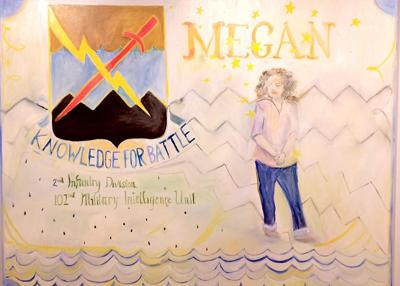

The Insignias of Fort Ord: Art in Everyday Military Life exhibition, opening at Monterey Museum of Art this Thursday, was created and curated by my wife, Enid Baxter Ryce. I’ve had a front row seat to its conception and execution, and she claims I have helped with it. I don’t know how much that’s true, but I have a lot more respect for the “work” part of the “artwork” equation. Man.
Her own work can require some background to unlock it – in global warming, California history, water in the West, subjects embedded in where she lives. She grew up in a Revolutionary War re-enactment town in Pennsylvania, from which she saw a mountain peak obliterated by mountaintop removal mining. The lesson was that history never really ends, while big foundational things, like mountains or communities, can.
When it was deemed unnecessary to national security, Fort Ord ended, closing with 35 other U.S. military bases in 1995’s Base Realignment and Closure (BRAC).
“When I took the teaching job at CSUMB nearly 10 years ago, part of the reason was the landscape,” she says. “I’m interested in a sense of place and understanding the land we’re walking on.”
In 2009, she and her students systematically documented the ruins of Fort Ord, including its ecology, architecture and the soldier art hidden inside the buildings. That work becamePlanet Ord, a website that’s garnered more than 4 million hits since launching. One big reason for the response: More than 1 million soldiers (and their families) passed through Fort Ord. When it closed, many felt like part of their past was gone. Planet Ord was a forum to keep it alive.
Art institutions promised to put on exhibitions mirroring Planet Ord, but backed away when they realized her work wasn’t critical of the military in the way they expected. They were seeing soldiers as policy, not people.
But her father was a Holocaust refugee who grew up in a refugee camp in Berlin run by the U.S. Army: “He [ate] food dropped from U.S. helicopters and told me how grateful he was for it,” she says.
The Carmel Woman’s Club invited Ryce to talk about her work in January 2014. The Santa Cruz Museum of Art & History put on the multi-media exhibition Planet Ord in April 2014.
Charlotte Eyerman, director and CEO of the Monterey Museum of Art, attended both and started talking to Ryce about doing something at MMA. Representatives from the Veterans History Project at the Library of Congress were also talking to Ryce about collaboration, while the Smithsonian wanted to screen her and her students’ Fort Ord films at their National Gallery in Washington, D.C.
So Ryce interwove her work with the museum, the Veterans History Project, CSUMB, Smithsonian and veterans into a big, moving project with key convergences like Insignias of Fort Ord.
MMA Director of Education and Community Partnerships Ami Davis had started art therapy workshops with homeless vets from Marina’s Veterans Transition Center. Ryce conducted three of those, guiding the veterans to draw insignias that represent meaningful portions of their military service. She converted those drawings into giclee prints.
She painted large portraits of four veterans – three friends and one family member – in colorful and expressionistic style. She resurrected the insignias that had flanked the soldier-painted mural at Inter-Garrison and Fifth, now painted over by CSUMB’s art department.
There is a loop of short films created by her students who interviewed 100 local vets for the Veterans History Project, and as part of an environmental filmmaking class. Some of those will screen at the Smithsonian.
“[It] is profound and moving,” Ryce says. “I can’t wait for people to see it.”
With coordination from Davis, Ryce has lined up related programming in the weeks and months to follow, including a talk by Megan Harris and Rachel Mears from the LoC-VHP and others on Feb. 25.
Part of Insignias asks visitors to not just look and absorb, but to make their own insignias, and add their thoughts to a chorus of others – a form of exchange that modern museums are venturing.
“While the voice of the museum is typical in most exhibitions, this [one] upends that, and features community voices first and foremost,” Davis writes by email.
“It is a hybrid,” Eyerman adds. “And we think very innovative thanks to Enid’s commitment to collaboration. It’s Enid’s show, but not a conventional ‘solo exhibition’ because it includes community and student work, which reflects her multi-dimensional role of artist, curator and artist in residence. We love the show.”
Fort Ord’s veterans have been scattered across the globe, the soldier artwork has deteriorated, the barracks are being demolished, and CSUMB, Fort Ord National Monument, and Ord Military Community are rightfully displacing the military base of old. Change was built into Fort Ord’s existence.
This art show is about more than the nomenclature of military symbols, or paying homage. It’s about acknowledging the vibrant, collective lives lived here. It’s them saying, “We’re still here.”
(0) comments
Welcome to the discussion.
Log In
Keep it Clean. Please avoid obscene, vulgar, lewd, racist or sexually-oriented language.
PLEASE TURN OFF YOUR CAPS LOCK.
Don't Threaten. Threats of harming another person will not be tolerated.
Be Truthful. Don't knowingly lie about anyone or anything.
Be Nice. No racism, sexism or any sort of -ism that is degrading to another person.
Be Proactive. Use the 'Report' link on each comment to let us know of abusive posts.
Share with Us. We'd love to hear eyewitness accounts, the history behind an article.