



At Mexico City’s historic central square, or zócalo, Jose Adan Garcia Canales is busy balancing a small pipe organ on a wooden peg. He turns its crank, and the instrument lets out a shrill tune reminiscent of circus music. Garcia’s partner strolls amid the shoppers, tourists and vendors with a hat in hand, asking for change.
The organillero, or organ-grinder, is one of many in the capital’s massive unofficial economy.
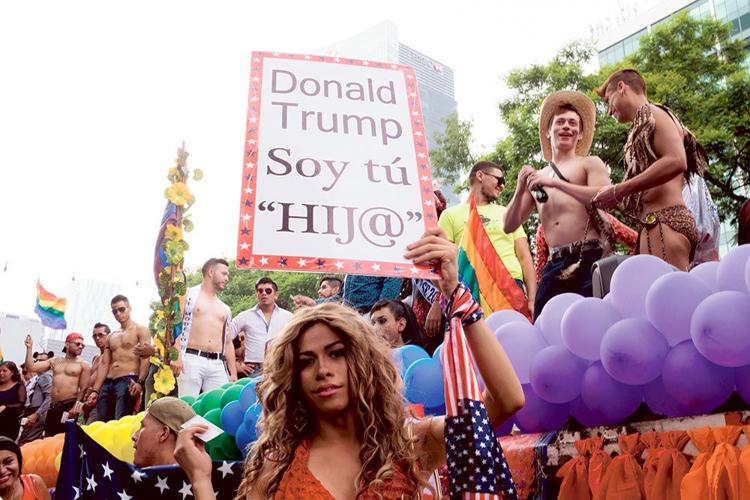
He’s a man of the people, with his fingers on the pulse of the city, and that’s why I asked him about one of the most pressing issues in Mexico today: Donald Trump.
What does the everyday Mexican think of “The Wall,” or Trump’s plan to send the millions of undocumented immigrants from Mexico living in the United States back to Mexico, among so many other contentious proposals?
Garcia’s response is to the point: “They’re very radical,” he says in Spanish. “I don’t like them.”
In the weeks leading up to the Republican National Convention, I interviewed a number of Mexico City residents – from teachers to musicians to fellow journalists – about Trump, and whether the candidate had changed their perception of America.
Responses varied. While the organillero didn’t believe Trump would win the election, some predicted that Trump would take it all in November. Others hinted at a conspiracy between Trump and Mexico’s president. A few bluntly compared Trump to Hitler. And some likened his campaign to a stunt, instead of an honest attempt to win the White House. Lots of people described the man with dark humor: His campaign is a joke, but not a funny one.
~ ~ ~
Fabiola Valdez Gutierrez is a Spanish-English interpreter, but her message for Trump needs no translation: He will never build “the wall.”
She actually believes that, if he were in fact elected and did try to push the wall, a litigious private sector on both sides of the border would stop his plans in the courts. “Mexican companies have American partners that would likely lose money, as well, and I cannot see the federal government trying to solve all the possible lawsuits that will be surfacing” because of the wall, she says.
Valdez understands issues north and south of the border. She works for a firm that supplies translators for clients of Languageline Solutions, a company based in Monterey, with clients in the United States and other English-speaking countries. She also has family in America and, in 2003, spent a summer in Texas and Arizona. So, for her, the border is personal.
Like many people I spoke to, Valdez is cynical when it came to Trump and his bombastic style. “He presents himself as a great business success, but a lot of reporters have caught him lying,” she says. She thinks his number-one motivation is to further his Trump brand with scandals and constant media attention.
But “his message is so full of ignorance that it is a joke to think that his proposals are serious,” she says.
Is there anything new about Trump’s brand of bigotry? Valdez doesn’t thinks so, calling it a byproduct of “a racist America that is still palpable and very alive, present in a lot of cities.”
The only surprise is that he’s a legitimate major-party candidate, she says – one supported by extremists who “won’t recognize the multiculturalism in their own country,” and who want “to go back to an America that never existed.”
For Valdez, that’s why Trump’s popularity is scary: It validates the idea that “racists think they have the right to impose their worldview on the rest of the population, and ultimately the world.”
Despite her concern about Trump and his supporters, she says his vision is basically a punchline in Mexico. “He is like a clown,” she says. “Nobody has real concerns or fears about him becoming president. At least not in my social circle.”
~ ~ ~

Federico Campbell Peña
As a TV journalist who works for Canal Once, or the “Mexican PBS,” Federico Campbell Peña has followed Trump’s campaign from day one. And he is certain that Trump, whom he calls a “unique species,” will win.
And that’s from a man who also recently wrote a self-published book, Stop Trump: Una cronología abreviada, or an “abridged chronology.” Campbell doesn’t want Trump to move into the White House; his hope with the book is to inspire Mexican leadership to develop a plan to deal with the possibility of a Trump presidency.
The writer partially attributes Trump’s appeal in America to the scandals that have beset Hillary Clinton. But he also believes that global instability is setting the table for a Trump presidency.
“ISIS is helping Mr. Trump,” he explained, “and also the police attacks.”
If Trump becomes president, Campbell predicts that he would immediately enact a series of “publicity policies,” such as building the border wall, to prove his might.
Another demonstration of power Campbell expects in Trump’s hypothetical first year is the cessation of diplomatic relations between Mexico and America, as extreme as that sounds. “We are not going to have ambassadors in D.C. and in Mexico City,” he predicts.
Campbell does not believe Mexico would fork over the billions of dollars needed to erect Trump’s wall. He cited President Enrique Peña Nieto, who recently said, “There is no way that Mexico can pay.”
He does expect a truly massive deportation effort, although not of every undocumented immigrant, as Trump has promised. According to Campbell, that would be physically impossible. “But he is going to deport more people than Obama,” he projects.
If that happens, he predicts the U.S. economy could collapse, due to the sudden removal of a large percentage of its labor force and consumer base. And the situation would be equally as dire on the receiving end. “Mexico cannot receive a lot of migrants,” he says. And with the loss of remittances from Mexicans that had been living in the states, the Mexican economy could suffer, too.
In an interesting twist, Campbell says conspiracy theories about Trump abound. “A taxi [driver] told me that Peña Nieto has just been with Donald Trump,” he says, implying that the two are somehow in cahoots. He explains that many Mexicans share an inherent distrust of mainstream news outlets, because of their close ties to government.
But it’s also possible that conspiracy theories are simply a means for those who feel disempowered to make some kind of sense of Trump.
Speaking of which: How does it feel to be Mexican and hear Trump’s message? Campbell was blunt: “We feel as [though we are] Polish in 1938, when Adolf Hitler reached power in Germany… We are Poland and Trump is Germany.”
~ ~ ~

Ali Gua Gua
Like many Mexicans, Trump wasn’t on Ali Gua Gua’s radar. “We only knew he had some hotels and had a lot of money,” she says while seated in the middle of a protest encampment full of striking teachers in the heart of Mexico City, where she lives. Gua Gua – a globe-trotting musician prominent in the Latin American punk scene – is perhaps best known as part of the Kumbia Queers, an all-women outfit whose members hail from Mexico and Argentina.
She views Trump’s popularity in America as a byproduct of a strong strain of cultural intolerance. “I think in the U.S., [people are] more aggressive when you’re different,” she says. “And I think Trump is representing these people who think all the problems are because of immigration.”
Although she thinks Trump will ultimately lose the election, Gua Gua says it’s still frightening that his ideas carried him to the nomination. “The easiest way is hate,” she says.
And she also wants to share a warning for Trump supporters in America: White people will soon be outnumbered.
She dismisses Trump’s claim that the Mexican government uses the U.S. as a “release valve” for its own domestic poverty. Instead, she says, common people are often faced with an impossible situation.
“If you’re a young guy, in a small town in the middle of Mexico, you have a few choices: You’re a peasant and you starve, you become a policeman, te vuelves narco [or you traffic drugs], or you go to the States.”
In the end, Gua Gua likens his candidacy to dystopian farce with a musical twist: “For me, it’s like a comic, no? It’s like Jello Biafra’s worst nightmare.”
~ ~ ~

Brillyl Sanchez
Brillyl Sanchez sits in a Quaker-run hostel and community center in central Mexico City, where he sometimes practices English with expats and hostel guests. Sanchez, who is gay, says the current groundswell of global reactionary conservatism, including Trump’s overwhelming popularity, feels dangerous. “I hope that he doesn’t win,” he says.
Sanchez brings up the “taco bowl” episode: On Cinco de Mayo this year, Trump tweeted a picture of himself at his desk with a tortilla shell – a classic example of Americanized “Mexican” food – with the caption “I love Hispanics!”
“It’s very weird,” Sanchez says. “It’s a comedy.”
Sanchez sees Trump’s extremism as a side show. “Se sabe que no va a ganar,” he says, or in English: It’s known that he is not going to win.
Sanchez speculates that the entire campaign is about creating a high profile and a publicity stunt.
Sanchez dismisses Trump’s statements referring to immigrants as criminals or drug-smugglers.
“It’s like saying all Colombians are narcotraficantes. Of course not. It’s absurd.”
~ ~ ~
On most days, you’ll find Cuauhtli Contreras at his news kiosk in Mexico City’s zócalo, where he sells papers and magazines, bottled drinks and loose cigarettes. He’s a man of the news – so you might be surprised, then, that he sympathizes with Trump.
“He’s defending his country,” Contreras says. “No one sees it that way, but it’s true.”
Nonetheless, he believes Trump will lose, because his vitriol disassociates so many voters.
“If you’re not blond and tall, you’re opposed to Trump,” he says in Spanish.
For Contreras, Trump isn’t directly threatening Mexico. His message is not about Mexicans in general: “His whole campaign of hate is against Mexicans in the United States,” he says.
Contreras’ views also stands out because, he says, if Trump were to win, he thinks the Mexican government would go along with his plans. “Mexico belongs to the United States,” he says.
He says it’s been this way since the Mexican-American War, when the U.S. Army occupied Mexico City and flew the Stars and Stripes over the very square where he runs his kiosk.
That’s why Contreras believes Mexico might bend to pressure and pay for a border wall – even though his country would have to borrow money from the World Bank, International Monetary Fund, or possibly the U.S. itself to make it happen. If that occurred, Mexico would carry the debt for generations.
“Mexico is not in a position to refuse the United States,” he says.
This story originally appeared in the East Bay Express.
Editor's note: This story has been updated to reflect the following correction. Fabiola Valdez Gutierrez works for a firm that supplies interpreters for clients of Languageline Solutions, not directly for Languageline itself.
(0) comments
Welcome to the discussion.
Log In
Keep it Clean. Please avoid obscene, vulgar, lewd, racist or sexually-oriented language.
PLEASE TURN OFF YOUR CAPS LOCK.
Don't Threaten. Threats of harming another person will not be tolerated.
Be Truthful. Don't knowingly lie about anyone or anything.
Be Nice. No racism, sexism or any sort of -ism that is degrading to another person.
Be Proactive. Use the 'Report' link on each comment to let us know of abusive posts.
Share with Us. We'd love to hear eyewitness accounts, the history behind an article.