
- Many people today want to know where their food comes from. Sounds like a worthwhile pastime. But do people want to source their arts writing? Not much, apparently. I don’t recall in 8 years any readers asking about my training or credentials. But in the event it helps, here is a little background.
- I was born in Korea, but grew up in Seaside. I was a voracious learner, maybe because English wasn’t my native language, but a new language.
- Most of what I learned about arts criticism I learned from film critics Roger Ebert and Pauline Kael. From Ebert, how to see a work in its context and to be compassionate. From Kael, to draw from any part of life. From both, none of that matters if the writing doesn’t cook.
- As a teen, I freelanced as a cameraman for a video production company, worked at a video store and took film courses at Monterey Peninsula College. I made films, too (on video), and screened them, and so got to know the terror of exposing oneself to criticism.
- At San Jose State University I majored in creative arts, a cross-disciplinary study of music, art, theater, literature, writing, etc. It’s very helpful if you want to be an arts writer at an alternative newspaper. I minored in advertising, which helped me hone in on the subject’s selling points… uh, essential qualities… and taught me to write succinctly. (Sorry, that’s the sound of my editors laughing.)
- I did odd (and mostly fun) jobs and wrote ad copy for a number of years, but my main involvement with arts writing came from reading it – including in other alt-weeklies likeWillamette Week in Portland and the New Times in Miami.
- I started, and abandoned, a blog in 2006; wrote a handful of freelance articles for Miami magazines. I returned to Monterey County where I worked temp jobs at Coldwell Banker and Fresh Express before I walked into the Weekly with a torturously confident cover letter.
- Maybe this helps to answer a question that nobody asked, but I think it’s an interesting question: Who is the person behind the byline who gets to interpret our culture? But this isn’t quite adequate because the question of who somebody is, is complex, elusive and changing.
- Maybe nobody asks about the person behind the byline because the writing is already speaking for that person, and the reader is judging not by the credentials behind the writing but on the merits of the words themselves, on the resonance of their honesty and soundness of their reason. If so, I’ll gladly take that.
Artifacts: Who is that person writing your arts stories?
ARTIFACTS 01.14.16
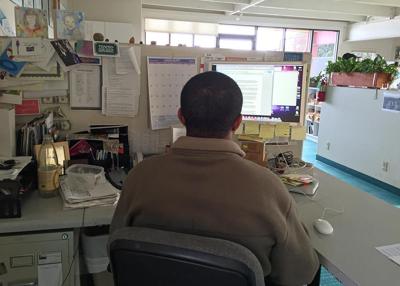
The writer at his desk, from whence the stories are laboriously constructed.
(0) comments
Welcome to the discussion.
Log In
Keep it Clean. Please avoid obscene, vulgar, lewd, racist or sexually-oriented language.
PLEASE TURN OFF YOUR CAPS LOCK.
Don't Threaten. Threats of harming another person will not be tolerated.
Be Truthful. Don't knowingly lie about anyone or anything.
Be Nice. No racism, sexism or any sort of -ism that is degrading to another person.
Be Proactive. Use the 'Report' link on each comment to let us know of abusive posts.
Share with Us. We'd love to hear eyewitness accounts, the history behind an article.