I have seen the future of food.
It comes as sea urchin on a ginger pancake, quail eggs in cast iron, intoxicating salmon tartare on a dim sum table and “world peace” peanut muscovado milk in a shot glass.
That future appears – and tastes – vibrant at a place called State Bird Provisions (415-795-1272), the James Beard Foundation’s 2013 New Restaurant of the Year, as in the very best in the country, ahead of restaurants including Restaurant 1833 in Monterey (643-1833), which deserves love as our first local nominee since Doc Ricketts andMack and the Boys were hosting frog-leg buffets.
Luckily for us, State Bird doesn’t require migration to New York, L.A. or New Orleans, as it nests in San Francisco. I ate there last week for its much-awaited, post-remodel reopening after four hours north on a bus, train and a streetcar, and an hour in line on the wind-swept sidewalk. Weekly contributor David Schmalz actually camped out for two and a half hours.
It was worth it.
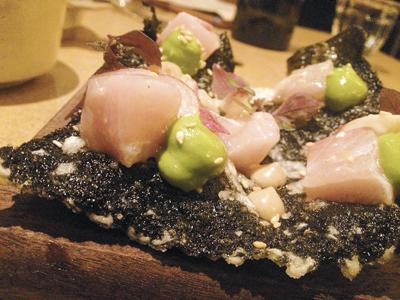
The rolling dim sum carts demand restraint to not order everything that swings by – godly five-spice fried bread and burrata, glorious umami blasts of steak tartare that led Schmalz to break vegetarian ranks, and the avocado cream and sashimi on deep-fried seaweed wafer we talked about for the rest of the weekend.
Those dishes run $2 to $12 a plate, and are buttressed by the pancakes, “commandables” and desserts categories from the menu, from which we plucked fried green tomatoes with shishitos ($14), simple-perfection pork spare ribs in their own sauce ($10/$20), a sourdough pancake with sauerkraut and pecorino ($8), the melting half dozen quail eggs ($12), the succulent signature fried state bird (quail, $8/$16) and the shot of muscovado sugar milk that I tried to stretch out with sips a butterfly would find big.
A tour de force of flavor, lifted by exotic mint and spice and mandarin, but also a demonstration of depth, freshness and versatility. Somehow nothing clashed. Somehow enjoyment, instead of dipping and weaving, only grew.
Service was spiffy despite the sheer volume of different staffers who visited – including Chef Stuart Brioza – and despite the bustle of a natural-high opening night that saw them hanging decorations minutes before show time.
San Francisco Chronicle critic Michael Bauer has called what Brioza and co-chef/owner/wife Nicole Krasinski are doing “the type of place that makes chefs stand up and take notice” and a spot where “everything is a must-order item.” We called it great fun. And thoroughly original.
The menu format provides a mirror to the unique mix of ideas and inspiration. But surprisingly enough, it’s not dishes like the barbecue rabbit with buckwheat spaetzle and lime pickle ($20) – or the provisions section where hash marks tally the number of quick-accumulating plates – that reveal what is most significantly progressive, even futuristic, here.
It’s the line beneath the tally marks: “$1.50 per person service charge will be added to each check to support SF employer mandates.”
~ ~ ~
Interesting things happen when you wait in line for a long time. I’ve suddenly become an expert on these things, since the day after we did State Bird, Schmalz and I waited another hour and a half for old-school seafood bar Swan Oyster Depot on Polk Street (415) 673-2757) – which rivaled State Bird in style and freshness – and another hour-plus for wet dream dinner spot Flour + Water in the Mission (415-826-7000).
You bond with strangers, for instance. One new friend gave a shivering Schmalz her pashmina. Later, while waiting for the fresh crab salad, Miyagis and Kumamotos at Swan, we were confronted by a grumpy dude in line. He took exception with the fact that our group had grown from our original pair, setting him further back. (And that a friend was resting his brown bag beer on the sidewalk!)
I tried to stretch it with sips a butterfly would find big.
He later identified himself as a former economist, professor and current ethics lecturer, and I ended up talking to him for 20 minutes about how you slice queuing protocols – i.e. is it OK to let our friend on crutches into line with us? Is it kosher to sell a spot (and for how much)? We certainly had enough time on our hands to talk.
What we didn’t get into is the ethics of tipping. Or San Francisco’s unique place in the moral spectrum of restaurant worker treatment – opposite the end where service staff sometimes has to pay the restaurant after a long night of back-breaking work.
~ ~ ~
Last Sunday, author and activist Saru Jayaraman stood in front of a modest and attentive group at the Unitarian Universalist Church of the Monterey Peninsula and told scary food stories.
She described how American restaurant workers are denied paid sick days by law, leading them to work the line with documented cases of contagious Hepatitis, typhoid and norovirus; how workers chose between caring for a sick child and keeping a job; and how – yes – an IHOP server in Houston was forced to give money to her employers after a grueling late shift because a table dined and ditched and her employers illegally stuck her with the bill.
Similar stories – plus those of sexual harassment, stolen tips, pathetic benefits and pay lower than every sector – are commonplace in the industry. This, despite the fact so many have worked in restaurants, the fact that 10 million Americans work in them today, and the fact every one of us is touched by them, particularly along such a touristy and epicurean coast. The abuses are documented in her book Behind the Kitchen Door, a mix of narrative and investigative journalism that will ultimately do for restaurant labor awareness what Eric Schlosser’s Fast Food Nation did for our view of Big Macs, factory farms and injected cheese flavoring.
She demonstrates how “the other NRA,” or National Restaurant Association, while not famously lobbying to have pizza declared a vegetable, has quietly capped tipped worker wage at a little more than $2/hour.
That’s what’s scarier still: Even though 80 percent of Americans are in favor of a higher minimum wage – and most everyone feels paid sick leave is a great way to manage health outbreaks – President Barack Obama is the first sitting president to even mention the Fair Wage Act. Lobbyists have helped make it illegal in numerous states for cities to provide that sick leave. The only city that does it in California: San Francisco.
The good news: “There is a movement,” Jayaraman says, “but we are gonna need a groundswell of support.” Ten years ago restaurant owners used similar “It’ll break the bank” whines to ward off requests for organics. Now they’re jumping into everything pesticide-free because consumers demand it. If we can get gluten free bread on the menu, we can get restaurants to prioritize better care for their most important asset. (For strategies, visit the blog, www.mcweekly.com/edible.)
Like restaurant owners, we don’t have to be magnanimous about it. We can do it purely for our own benefit. When workers are taken care of, turnover and training costs go way down. Quality of service goes up. And – oh yeah – people aren’t working when they’re contagious. Make it a cash tip – often credit card fees are deducted from tips – and talk to the manager that you want to eat in places that treat workers well. “Just say, ‘As a paying customer it’s very important to me,’” Jayaraman says. “The owner hears that a few times a month and he will notice.”
The beautiful guinea pig thing about San Francisco and its worker rules: The thriving culinary scene and its progressive labor policies – higher wages, paid sick leave – speak for themselves, with more restaurants per capita than New York, pretty impressive service and more places I want to eat in than any city on Earth. I’ll even wait in line.
~ ~ ~
As part of the 25th anniversary issue, we asked remarkable taste-moving minds like Julie Packard, Leon Panetta and Gustavo Arrellano to riff on the future of everything.
Locally based author Schlosser was one of them. Some of his thoughts:
A quarter of a century ago, Chicken McNuggets seemed like the food of the future. It was an entirely new thing, recently invented, tasty, bite-sized, cheap, and easy to chew. The American fast food industry was booming. The big chains were eagerly competing to trademark their own frozen, fried, reconstituted meat products. Science and technology had apparently triumphed over common sense.
Well, McDonald’s, Burger King, and KFC are still in business. But their growth rate has slowed. Their best days are behind them. And nobody seriously looks to them for how to eat. Much like tobacco, fast food is widely regarded as a bad habit, a guilty pleasure, a public health disaster.
Today the future of food can be found in Monterey County. Strawberries, lettuce, broccoli and spinach; raspberries and artichokes; asparagus, kale, onions, and peas – some of the healthiest fruits and vegetables on earth are grown here. Add some wine from the Central Coast and you’ve got a real happy meal.
Wait a sec, Schloss – no mention of the next big movement in food, worker welfare?
Fear not. He’s on it: He wrote the intro to Behind the Kitchen Door.
The future was worth waiting in line for. But we can’t afford to keep our restaurant workers waiting for justice. Like State Bird Chef Brioza says, “Food is culture.” And I don’t want to be a part of one that treats its animals better than its people.
QUICKBITES
• Don’t sleep on Big Sur Food & Wine. Key tickets will—and already have—sold out. It starts Thursday, Nov. 7, with Gateway to Big Sur at the Hyatt Carmel Highlands,www.bigsurfoodandwine.org.
• After listing 20 beautiful burgers in last week’s Wine & Food issue, I’m getting great nominees—including Lokal (659-5886), Will’s Fargo (659-2774) and Toro Place Cafe (484-1333)—as I eat toward the top 10 list at www.mcweekly.com/edible. Email yours to edible@mcweekly.com.
• Halloween should be bloody. Shirts and treats go to donors during CHOMP’s annual Halloween blood drive, Oct. 28-Nov. 1 at 576 Hartnell St., Monterey. It’s fun, fulfilling and fast, call 625-4814.
• Chef Didier Dutertre’s weekend specials at Bistro Moulin (333-1200) have gotten so hot they now go all week, like this week’s cassoulet Toulousain ($25). Track ’em via www.bistromoulin.com.
• Just spotted: A line out the door of what appeared to be potential waitstaff at new Patria in Oldtown Salinas.
• Tony Baker and Montrio introduce a new menu this week. Get the details—and other zesty Downtown Dining restaurant family news, including a shakeup at Tarpy’s—on the blog.
• New pirate-island restaurant Bay of Pines (920-3563) does Day of the Dead Saturday, Nov. 2, with family festiveness free with lunch (11am-2pm)—face painting, tasty treats and skull and mask decorating—then a dinner, dance and performance ($30, 6-11:30pm). The dance floor freak out (cover a la carte, 8:30-11:30pm) with salsa band Que Caliente starts at 8:30pm.
• Hip and arty Haute Enchilada Galeria Dos (633-5843) throws a party 4-6pm Saturday, Nov. 2, with live music, light hor d’oeuvres and a lump of proceeds going to Food Bank for Monterey County. Donated food earns an entry for prizes.
• Nov. 3 at the Marriott, the Chefs Association of the Pacific Coast holds a black-tie dinner ($150) to honor 2013’s Antonin Careme Medal recipients, including Lars Kronmark, Thomas Macrina, Bobby Moghaddam and Leon Panetta. www.montereybaychefs.org.
• “Food for the body is not enough,” Dorothy Day said. “There must be food for the soul.”
(0) comments
Welcome to the discussion.
Log In
Keep it Clean. Please avoid obscene, vulgar, lewd, racist or sexually-oriented language.
PLEASE TURN OFF YOUR CAPS LOCK.
Don't Threaten. Threats of harming another person will not be tolerated.
Be Truthful. Don't knowingly lie about anyone or anything.
Be Nice. No racism, sexism or any sort of -ism that is degrading to another person.
Be Proactive. Use the 'Report' link on each comment to let us know of abusive posts.
Share with Us. We'd love to hear eyewitness accounts, the history behind an article.