BLACKSBURG — Virginia Tech has lost upwards of $60 million since the onset of the coronavirus pandemic, mostly due to losses in dining and housing revenue.
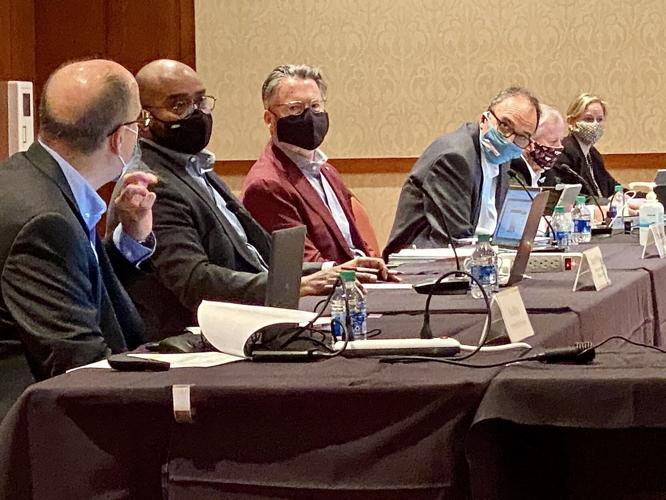
Tech’s board of visitors met Monday to approve the university’s adjusted $1.6 billion operating budget for 2020-21. Board members also gave Tech the power to postpone debt bills and issue new debt to help boost cash flow, if more choppy economic waters emerge.
The university’s auxiliary budget — which encompasses housing, dining, athletics, health services and parking, among other areas — lost $85.6 million between July and the end of September. Those offices made up $25 million in savings, for a net loss of $60.6 million.
That shortfall, for comparison, is roughly equal to what 1,700 average households in Montgomery County combined would earn in a year.
“So then the question would be, a $60 million gap is a large gap. How are you going to manage that?” Tim Hodge, associate vice president for budget and financial planning, told the board.
University staff is compiling a “portfolio of strategies” to combat the loss, which reflects a 22% reduction in the auxiliary budget, Hodge said.
“Federal support’s key. ... The key item we’re monitoring closely is the next stimulus act,” he said. “There’s a lot of signals out there that higher education is, I believe, going to be a significant component in the next stimulus.”
State support in the amount of $4 million and debt restructuring could also help fill the gap, according to Hodge.
The university’s budget shows Tech lost $24.2 million in dining revenue, $17.3 million in athletics and nearly $9 million in housing. Because of the pandemic, the university restricted off-campus students from buying dining plans, freed up dorm halls for quarantine space and hosted football games without ticket sales.
However, the university’s educational and general budget, which pays for faculty salaries and academic costs, avoided a pitfall.
Virginia’s General Assembly recently approved a revised two-year budget that kept intact a $1.5 billion commitment to the university. While Tech’s educational and general budget saw a $4 million shortfall — largely because of a decrease in graduate students and out-of-state undergraduates enrolling — the university had hedged $7.8 million because of enrollment uncertainty, Hodge said. That put $3.8 million back into balancing that budget.
Since the spring, Tech has scaled back hiring, and it has avoided major layoffs.
Board member Jeff Veatch questioned whether the university couldn’t do more to cut costs.
“It just seems like we need to find better ways to streamline things,” Veatch said. “I just feel like every meeting we sit in we talk about how we’re spending more money.”
Tech officials acknowledged that increased costs is a phenomenon across higher education.
“The line of conversation you’re highlighting is absolutely something we need to stay on top of,” President Tim Sands said.
Still, Sands noted, one metric Tech uses to measure its value — how much the university spends to educate a student — has not changed drastically in 20 years, adjusted for inflation.
“What has changed is the burden,” Sands said. “The burden has shifted from the state to the students,” as state disinvestment forces universities to increase tuition.
Moving forward, the university plans to operate at a 3% reduction in spending at the college level, and 5% in nonacademic offices. Tech began the year with 5% cuts to colleges and 7% cuts to other areas.
Tech’s investments have also taken a hit.
“We had a difficult year,” John Cusimano, university treasurer, told the board.
A $402 million endowment fund managed by the Virginia Tech Foundation fell 5% for the fiscal year ending in June, he said.
Before the pandemic, the endowment portfolios were “overweight in energy” investments and “underweight in technology” stocks, Cusimano said.
Commuters stopped driving and using gas. “And the cost of oil went from $50 a barrel to 40, to 30, to 20, to 10. There was even one point in time when it was negative,” he said. “So that really hurt the portfolio.”
Since Tech’s investors have shied away from expensive and risky technology stocks, the university couldn’t take advantage of their skyrocketing value once people rushed to set up home offices and Zoom became a household word.
Board members also greenlit the university’s plans to restructure $21 million in university debts and to restructure another $31 million in athletic bonds. By postponing payments on those debts for a couple of years, the university will be able to use the freed-up cash to plug in budget gaps.
The pandemic has had mixed impacts on Tech’s fundraising efforts.
New gifts through the end of October have outpaced donations over the same period last year, which Charles Phlegar, vice president for advancement, called “surprising.”
To date, Tech has raised nearly $686 million of its $1.5 billion “Boundless Impact” campaign, which launched publicly in October 2019.
“Now just a word of caution. During a pandemic, visiting with people is very difficult,” Phlegar said.
He noted that 65% of donations to Tech are gifts of a million dollars or more.
“I would anticipate a slight decline this year when all is said and done,” he said. “A little more difficult to ask for gifts at that level behind a black mask on a screen.”

(0) comments
Welcome to the discussion.
Log In
Keep it Clean. Please avoid obscene, vulgar, lewd, racist or sexually-oriented language.
PLEASE TURN OFF YOUR CAPS LOCK.
Don't Threaten. Threats of harming another person will not be tolerated.
Be Truthful. Don't knowingly lie about anyone or anything.
Be Nice. No racism, sexism or any sort of -ism that is degrading to another person.
Be Proactive. Use the 'Report' link on each comment to let us know of abusive posts.
Share with Us. We'd love to hear eyewitness accounts, the history behind an article.