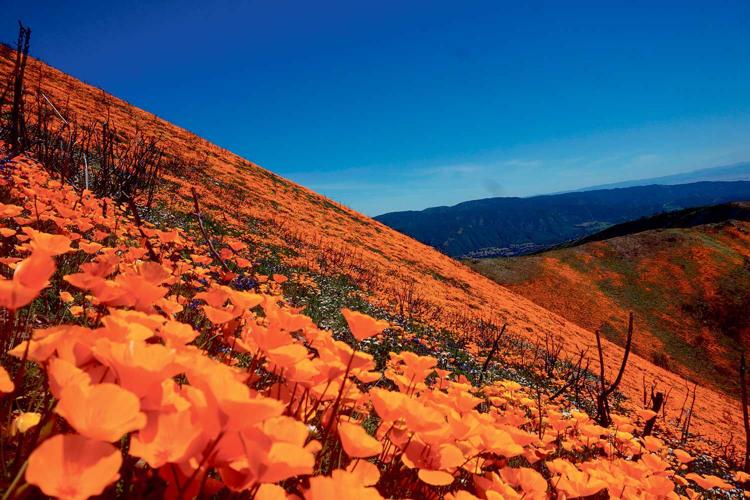


Poppies at the end of Chris Reed's slideshow documenting the Soberanes Fire.
The journey to the only observatory in Monterey County is a bumpy one. Located in the Santa Lucia Mountains, the path to the Oliver Observing Station begins at Tassajara Road in Carmel Valley and ends 5,000 feet higher on Chews Ridge, where the air is fragrant with ponderosa pines and Big Sur appears as layers of mountains to the west.
The observatory’s design is more humble than its landscape. There’s a single wooden fire lookout tower that looks like it could make for a sweet tree house. Then there’s the observatory itself: two towers at either end of a one-story building. The taller and wider of the two towers houses the observing station’s 36-inch telescope.
The station is run by Monterey Institute for Research in Astronomy, which was founded in 1972 by a group of scientists who wanted a place for long-term research projects.
As current MIRA astronomer Arthur Babcock puts it, MIRA was founded as the glory days of space exploration were winding down, by scientists who didn’t want to be tied by the demanding cycle of academia, which demanded consistent and periodic results. “[The MIRA scientists] didn’t want to be caught up in the publish or perish cycle,” Babcock says. “Their mission was to do research and to educate.”
Research and educate they did. Hundreds came together in Carmel to view the Comet Kohoutek in the winter of 1973. The group built a temporary viewing station at a Cachagua home in 1978, and that year took their first direct image photographs, or photos taken of the night sky without any alteration. In 1982, MIRA researchers discovered an area in the Southern Hemisphere where new stars were forming. Two years later, in 1984, MIRA dedicated its permanent observing station on top of Chews Ridge.
The location was perfect. The mountains blocked urban light from Greenfield to the east, making for pitch-black conditions – ideal for stargazing. The low humidity, beyond the reach of the coastal marine layer, increases clarity.

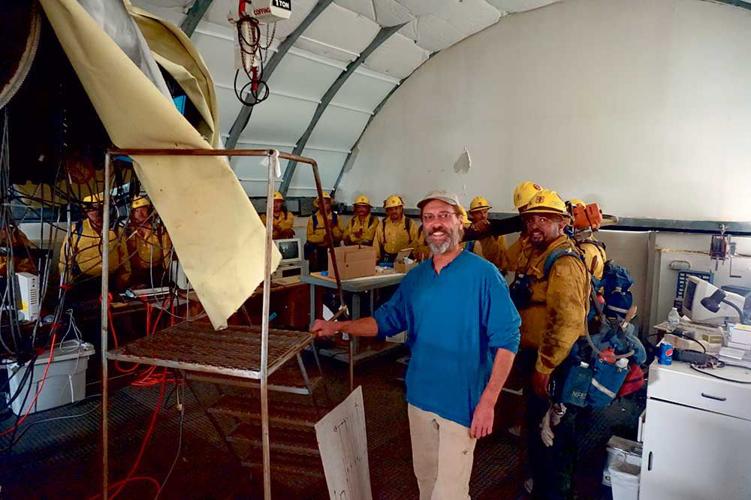
Chris Reed gave firefighters tours of the observatory
It also turned out to be the perfect viewing point to witness the entire lifecycle of the 2016 Soberanes Fire for station caretaker Chris Reed, who became stranded at the observatory as the fire raged.
Reed took a relaxed approach from his mountaintop perch. “I knew exactly when and where it was going because I had a 360-degree view,” he says.
It helped that he’s seen this all before as a firefighter. Reed was a hotshot, trained to deal with wildfires, in the 1980s. His biggest fire was a one-month stand-off with the Wheeler Fire that consumed more than 89,000 acres near Ojai in 1985. “I understood the nature of the beast,” Reed says, reflecting on the Soberanes Fire a year later.
So when 1,000 or so firefighters set up camp at the observatory last summer, Reed knew firsthand their work was hard. He did everything he could do to help relieve them. He joked with them, gave tours of the observatory, passed out 386 bottles of Coke before running out.
The firefighters returned the favor. They’d share food and restock the observatory with bottled water and Gatorade, and someone anonymously sent Reed a package of bacon. “Everyone was as grateful as they were hardworking,” Reed says. “Even the port-a-potty guy would come at the same time, every day.”
Besides food resupply and delivery of fire wrap for the wooden lookout tower, the observatory is relatively self-sufficient: Solar panels charge up to six generators and 86 batteries, which power the place. A 16,000-gallon-tank collects rainwater, doing double duty by also helping to stabilize the telescope. “We’re running a completely off-the-grid operation here,” Reed says.
A year after the fire, Reed is back to spending most of his time in the company of Bandit, his small blind mutt. In his apartment, which is located in the smaller of the observatory towers and is decorated with Evel Knievel memorabilia as well as with his old forest ranger gear, Reed clicks through his 17,000-plus photos and videos of the Soberanes Fire. Some show burning root-bulbs visible on mountain peaks miles away, some are candid photos of hotshots living and working in camp.
It’s a contrast to what the ridge looks like now: clear skies, green regrowth, and no one in sight. The final photos show the final phase of the fire: a golden blanket of poppies overtaking bits and pieces of charred brush. Even Reed, who’s seen a lot, from walls of fire to massive night skies, says, “I had never seen anything like it.”
(0) comments
Welcome to the discussion.
Log In
Keep it Clean. Please avoid obscene, vulgar, lewd, racist or sexually-oriented language.
PLEASE TURN OFF YOUR CAPS LOCK.
Don't Threaten. Threats of harming another person will not be tolerated.
Be Truthful. Don't knowingly lie about anyone or anything.
Be Nice. No racism, sexism or any sort of -ism that is degrading to another person.
Be Proactive. Use the 'Report' link on each comment to let us know of abusive posts.
Share with Us. We'd love to hear eyewitness accounts, the history behind an article.