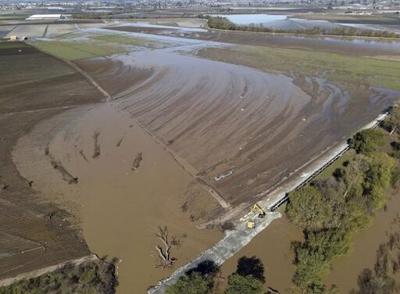

David Schmalz here, thinking about the residents of Pajaro and how much they’ve endured in the past few weeks after the Pajaro River levee breached on Saturday, March 11, inundating much of the town of 2,900 residents with floodwaters.
Only on Thursday, March 23 were residents finally allowed to return home to assess the damage, start planning repairs and begin the process of returning to the lives they had before the flooding occurred.
As part of this week’s cover story, my colleague Celia Jiménez did inspiring, boots-on-the-ground reporting on the human impacts of the flood on Pajaro residents, some of whom are considering whether or not to move elsewhere in California, or perhaps another state altogether. One woman Jiménez interviewed, a fieldworker, wondered: Will there be any strawberries for her to pick this spring? The portrait Jiménez paints is one of a community that, while resilient, is also exhausted, sad, even angry. My heart broke for them while reading her story, which I hope you’ll check out—it’s worth every second of your time.
In my piece for this week’s cover story package, I set out to answer a seemingly simple question: Why didn’t the restoration of the Pajaro River levee, which Congress authorized in 1966, ever happen?
Trying to answer that question required diving deep into Army Corps of Engineers documents (I don’t recommend it), and talking to local officials who’ve been actively working in recent years to move the project over the finish line.
For someone who primarily reports on projects led by a local or state agency, it was a crash course in the sausage-making process of the Army Corps. Some problematic parts of that process are finally starting to change, as I found out, but the gears move slowly.
There’s a lot more that I uncovered, and if you’re curious about the answer to the question I posed, I encourage you to pick up a paper or read the story online here. I also encourage you to keep the residents of Pajaro in your thoughts, if not actions—when disasters wane, there’s a tendency to forget the victims as time passes. And that, at least in part, is why this disaster happened.

(0) comments
Welcome to the discussion.
Log In
Keep it Clean. Please avoid obscene, vulgar, lewd, racist or sexually-oriented language.
PLEASE TURN OFF YOUR CAPS LOCK.
Don't Threaten. Threats of harming another person will not be tolerated.
Be Truthful. Don't knowingly lie about anyone or anything.
Be Nice. No racism, sexism or any sort of -ism that is degrading to another person.
Be Proactive. Use the 'Report' link on each comment to let us know of abusive posts.
Share with Us. We'd love to hear eyewitness accounts, the history behind an article.