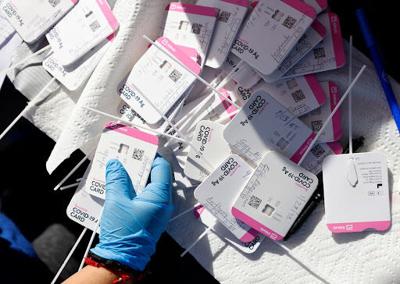

Sara Rubin here, sharing your frustration about those long lines to get tested for Covid-19. We’re nearly two years into a pandemic and we have the technological capability to conduct rapid antigen tests—less accurate than their slower-moving polymerase chain reaction (PCR) tests, but more useful in getting immediate results—and yet test companies are literally running out of supplies.
I wrote in the Jan. 13 issue of the Weekly about my own frustrations with getting tested, and waiting six-and-a-half days for the results of a PCR test. By the time my result came back negative, I’d already exceeded the CDC’s five-day isolation guidance—too late to be useful.
Rapid tests are what we need more of, if we’re going to meaningfully slow the spread of the virus these days. But rapid tests are hard for providers to get. Lightspeed Testing is a local company launched last year by two local ER doctors, Sameer Bakhda and Michelle Kalinski, who both work at CHOMP, and Bakhda’s wife, Kristin Bakhda, a nurse/midwife at Kaiser in San Jose. They order BinaxNOW tests from Abbott Laboratories, which has a corner on the U.S. market for rapid tests.
Last week, they literally ran out of tests, and they don’t know when they might get more. “We put in an order with Abbott in December for more tests,” Sameer says. “It’s now mid-January, and they say we might get it to you by the end of February.”
This comes right at the time we need more tests than ever, and what we need are rapid tests. Bakhda says PCR tests, which detect even small amounts of the Covid virus, are best used in hospital settings to determine whether a patient has Covid, but when it comes to making a meaningful impact in slowing the spread of the virus, what we need more of is rapid tests. Light Speed has been testing at locations like the Monterey Bay Aquarium—and turning around results in 20 minutes or less, on a timeline that makes a tangible difference to whether a person enters the Aquarium or not, infecting others or not.
Yet the insistence for so long, from the FDA on down, that PCR tests are superior has influenced most of us. Bakhda says he hears from patients who got a positive antigen test, and want to follow up with a PCR test to confirm their result is real. “I can hear them sniffling on the phone,” Bakhda says. “And I say, I'm sorry to tell you, but you don't need a PCR—you need a pulse oximeter, chicken soup and tylenol.”
The good news is that even with one company out of stock, others are conducting lots of rapid tests, and the backlogged supply chain is having some productive moments. The Monterey County Health Department this week received 65,000 additional rapid tests from the California Department of Public Health (they’re already earmarked for destinations like nursing homes, the county jail and preschools). The VIDA Project, the county-funded initiative run by a group of nonprofit partners, has regular rapid testing sites.
In the first 10 days of January, VIDA tested 3,160 people—56 percent more than they tested in the entire month of December. Of those early-January tests, 24 percent were positive, a relatively huge proportion.
It’s beyond frustrating that we’re running out of tests at this stage of the pandemic. Ultimately, I blame the FDA; they haven’t made it easy for new rapid testing companies to get into the game. (I recommend reading this ProPublica story on why Abbott accounts for 75 percent of retail sales in the U.S., and other companies have not gotten approval—in short, it’s an indefensible bureaucratic tangle.)
Meanwhile startups like Lightspeed, which aimed to help do a simple thing at a time that no one else seemed capable of doing it—ordering, administering and processing rapid tests—are struggling financially to make their model work.
The three partners aren’t trying to get rich, but now they’re moving on to a new layer of frustration—trying to get reimbursed by insurance companies for the cost of the tests, which are free to all patients, with or without insurance. They just got a check for $4.04 from Blue Cross for an insured patient. “That doesn’t even cover the cost of the test,” Bakhda says. “I mean, come on.”
That sums up how I feel, too. But meanwhile, please get tested—rapid testing sites are a great option, and the lines move quickly. Check weekly for the full calendar of testing sites and hours at the Covid Collaborative website. Share it, and encourage the people you love to also get tested. And do what you can to stay healthy out there.
Read the full newsletter here.

(0) comments
Welcome to the discussion.
Log In
Keep it Clean. Please avoid obscene, vulgar, lewd, racist or sexually-oriented language.
PLEASE TURN OFF YOUR CAPS LOCK.
Don't Threaten. Threats of harming another person will not be tolerated.
Be Truthful. Don't knowingly lie about anyone or anything.
Be Nice. No racism, sexism or any sort of -ism that is degrading to another person.
Be Proactive. Use the 'Report' link on each comment to let us know of abusive posts.
Share with Us. We'd love to hear eyewitness accounts, the history behind an article.