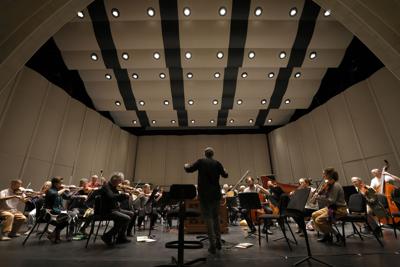

Sara Rubin here, listening to a recording of Antonio Vivaldi’s The Four Seasons, perhaps one of the most recognizable classical music pieces to modern Western ears. I’m studying up in anticipation of attending a concert on Monday night, July 15, that includes composer Max Richter’s take on The Four Seasons, titled Recomposed.
That Richter’s contemporary deconstructed interpretation of this canonical piece features into the Carmel Bach Festival is a sign the festival—which kicks off its 87th season Saturday, July 13—continues to expand its definition of classical music. Works by Johann Sebastian Bach of course feature prominently (I will also hear his “Brandenburg Concerto No. 6” on Monday night) in the programming, but the boundaries of what listeners can expect to hear keep on getting wider. And that’s a good thing, both for classical music and for listeners, even those who might feel challenged by what they hear—or don’t hear.
On Sunday night, July 14, fans might come for Beethoven’s Ninth, even more recognizable than Vivalidi’s Four Seasons. (This symphony includes “Ode To Joy.”) But before they settle into that grand, melodic work, the orchestra will perform John Cage’s 4’33”, a composition that features silence—or the sounds that fill the supposed silence of a concert hall—for a timed 4 minutes and 33 seconds.
I asked Nathan Lutz, newly appointed as executive director of the nonprofit Bach Festival, about the decision to include works like these. Although Cage’s 4’33” was composed in 1952, it continues to be controversial. "Some people who are familiar with the piece think it's extraordinarily risky and the audience will be offended by it," Lutz says. “But it is a good opportunity to have a debate. I don't see it as a liability."
Neither do I. While it’s a little bit on the edge for a festival named after J.S. Bach, it invites listeners—both those who know and like the baroque mainstays and those interested in something more experimental—into the same space. Finding that balance of old favorites and boundary-pushing music is no easy feat, but I am glad to see a new generation of festival leadership (Artistic Director Grete Pederson is now in her second season) embracing more of the latter.
Lutz has been reading about French music in the 19th century (“super geeky,” he acknowledges) and learning that contemporaries of organist and composer Albert Renaud found his music that to our modern ears sounds quite tame to be “disgusting.”
“The same debate is happening through the entire history of this art form,” Lutz says. "We call ourselves the Carmel Bach Festival. What is the duty to present Bach? It's not only a baroque festival.”
Melding boundary-pushing modern works with Bach and other classical greats sounds to me like an excellent way to advance the debate onstage, perhaps most explicitly in the John Cage/Ludwig van Beethoven pairing. "I think doing [4’33”] right before Beethoven's Ninth is just a beautiful moment to have that moment of calm, before this monumental piece begins,” Lutz says. “I am excited for the conversations we'll have once it's being performed."
So am I. If you tune in to this year’s Bach Fest (or don’t), I’d love to hear from you about your experience. What makes classical music compelling for you?
(0) comments
Welcome to the discussion.
Log In
Keep it Clean. Please avoid obscene, vulgar, lewd, racist or sexually-oriented language.
PLEASE TURN OFF YOUR CAPS LOCK.
Don't Threaten. Threats of harming another person will not be tolerated.
Be Truthful. Don't knowingly lie about anyone or anything.
Be Nice. No racism, sexism or any sort of -ism that is degrading to another person.
Be Proactive. Use the 'Report' link on each comment to let us know of abusive posts.
Share with Us. We'd love to hear eyewitness accounts, the history behind an article.