
Rey Mashayekhi here, thinking about that iconic yet complicated symbol of the American West: the cowboy hat.
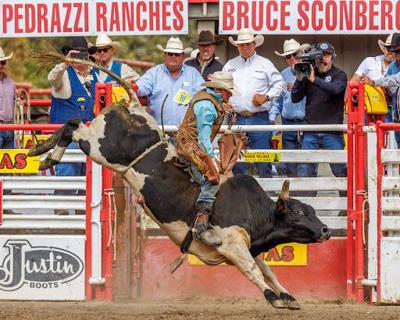
It’s Big Week in Salinas, which means thousands of people will bask in the time-honored traditions of the California Rodeo Salinas. Yes, there will be plenty of bull and bronc riding, roping and wrestling, but also lots of food, music and related non-rodeo events. (For more on all that, see this week’s cover story, on newsstands tomorrow.)
It’ll also be an opportunity for the folks in attendance to live vicariously through the occasion and pay homage to the past through their wardrobes: cowboy boots, bolo ties, big belt buckles and, of course, cowboy hats.
Wide-brimmed hats didn’t originate in America, but they certainly became synonymous with the North American cowboy and arguably America itself—thanks in no small part to Hollywood and its Westerns, and the impact those mid-20th century films had around the world. While the headwear served a very practical purpose in the Old West—providing cowboys and vaqueros with protection from the sun while out on the ranch—they swiftly became sartorially ubiquitous in the late-19th and early-20th centuries, propelled by John B. Stetson and his eponymous hat brand.
And while the cowboy hat is a symbol of freedom and rugged individualism to many, it can also mean something very different to others. Anyone who’s seen a John Wayne Western or played “Cowboys and Indians” growing up can understand that the guys wearing the cowboy hats—almost exclusively portrayed as white in popular culture—have always been considered the “good guys,” while the other side—the “savages” with darker complexions—were usually deemed the enemy, to be chased and vanquished.
The actual history of the American West was only more brutal and oppressive toward Native Americans and other people of color, who were subjugated to the rule and prejudices of white settlers as Manifest Destiny became a reality. While the history of the American cowboy is by no means an exclusively white one, the cowboy hat itself eventually became a signifier of that white-dominated power structure and the authority it held.
Speaking of authority, cowboy hats also became synonymous with lawmen in tales of the Old West—an association that continues to this day, as evidenced by the uniforms donned by sheriff’s departments across the country. That opens up another dimension to the hat’s significance as far as societal power structures are concerned.
It is a dynamic not lost on Monterey County’s own sheriff, Tina Nieto. When I met Nieto earlier this year for a “Face to Face” interview feature that ran in the Weekly in March, she clearly fancied the look that came with her newly acquired position. “How do you think I look in a cowboy hat? I have four now,” she said, nodding to the one that hung on a coat rack near her desk.
But Nieto—the first person of color, first woman, and first openly gay person to hold her position in Monterey County—acknowledged that not everyone in her constituency looks upon that hat with admiration. “There’s some members of our community who see the cowboy hat as oppressive, and I don’t wear the cowboy hat around those communities,” she said, noting that she opts for a baseball cap on such occasions.
While describing the cowboy hat as “a proud part of our tradition” at the Sheriff’s Office, Nieto added that she was making an effort, both inside and outside of her department, to ascribe to it “a new narrative”—one rooted in respect and dignity between authorities and the people they are meant to serve.
“I tell my people that we need to make it so that every community doesn’t see that hat as oppressive,” Nieto said. “Let’s create a new story, a new narrative—so when they see it they’re like, ‘Yeah, the sheriff’s here to help, not hurt me.”

(1) comment
Rodeo is condemned by nearly EVERY animal welfare organization in North America due to its inherent cruelty. Rodeo has almost NOTHING to do with ranching. For most of the animals, the rodeo arena is merely a detour en route to the slaughterhouse. Real working ranch hands never routinely rode bulls, or rode bareback, or wrestled steers, or barrel raced, or practiced calf roping (terrified BABIES!) as a timed event. Nor did they put irritating flank straps on the horses and bulls or work them over in the holding chutes with painful "hotshots," kicks and slaps. Some "sport"! Indeed, rodeo is not a true "sport" at all. Rather, it's a bogus, macho exercise in DOMINATION. It needs to end.
And the media needs to stop promoting this blatant cruelty. I was present at the 1995 California Rodeo/Salinas when FIVE animals suffered and died, all in the name of "entertainment." Only in the aftermath of the mayhem did the PRCA adopt a rule requiring on-site veterinarians at all their events. The great majority of the estimated 5,000-10,000 U.S. rodeos don't provide even this basic care, and animal injuries and deaths are commonplace. Even Cesar Chavez was an outspoken critic; ditto Pope Francis.
The United Kingdom (England, Scotland, Wales) outlawed rodeos back in 1934, followed by Germany and the Netherlands. Can the U.S. be far behind? Rodeo has had its brutal day and now--like those Confederate statues--belongs in the Dustbin of History, R.I.P. BOYCOTT ALL RODEOS, THEIR ADVERTISERS & SPONSORS. FOLLOW THE MONEY.
Welcome to the discussion.
Log In
Keep it Clean. Please avoid obscene, vulgar, lewd, racist or sexually-oriented language.
PLEASE TURN OFF YOUR CAPS LOCK.
Don't Threaten. Threats of harming another person will not be tolerated.
Be Truthful. Don't knowingly lie about anyone or anything.
Be Nice. No racism, sexism or any sort of -ism that is degrading to another person.
Be Proactive. Use the 'Report' link on each comment to let us know of abusive posts.
Share with Us. We'd love to hear eyewitness accounts, the history behind an article.