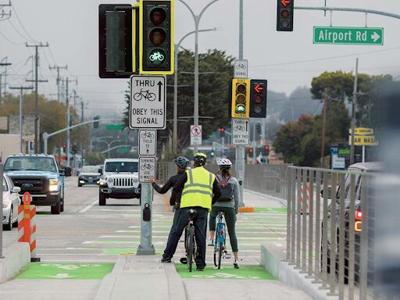

Sara Rubin here, getting ready to zoom down the street on my new e-bike. I’m still a fan of my acoustic, non-electric bike, but on some days, my reporting calendar takes me too far afield to commit to riding a bike to work. On many of those days, an electric bike is perfect; I can get around faster, and without breaking a sweat. Hills are rendered irrelevant.
Getting between the Seaside headquarters of the Monterey County Weekly and Monterey County Superior Court in Monterey, up a steep climb off Aguajito Road, is one such ride. My route there often takes me down North Fremont Street.
Ever since a protected bike lane down the middle of the street opened in 2019, I’ve marveled at it for a few reasons. One, it’s a beautiful piece of bicycling infrastructure. Two, it’s a shockingly useless piece of bicycling infrastructure. Me and other cyclists can be seen biking on the right hand side of the street, risking the cars zooming by on our left and the parked cars on our right, because that’s the normal way to get around on a bike, and because getting too and from the fancy bike lane requires crossing the street, which requires waiting for a crosswalk signal, and it’s kind of a pain.
But when you upgrade from an acoustic bike to an electric bike, the entire calculus changes. I can easily travel at the speed of cars. The traffic lights are synced up, so I don’t have to stop. And I can hit the throttle to get to and from the bike path and the side of the road quickly and safely.
The experience of cruising down the Bike Lane to Nowhere prompted me to ask Marissa Garcia, an engineering assistant in the City of Monterey’s Public Works Department, for an update. When is this thing going to connect to something, making it more useful and inviting, especially for riders on acoustic bicycles?
I’ve written before about the North Fremont Gap project on the side near Safeway in Del Rey Oaks, on the north end of the project. That’s delayed—the City applied for two grants, unsuccessfully. (The latest estimate is $2.4 million for construction.)
Now they’ll wait for the adjacent FORTAG project to proceed first, hoping that helps provide context for a greater pedestrian/bike path connectivity concept. “When there’s more construction and FORTAG is actually through there, I think our applications will become stronger,” Garcia says. “[Grant reviewers] don’t understand how much connectivity we are going to get out of it.”
That’s 0-for-2 so far on the north side.
On the south side of the bike trail, where it comes to an abrupt end leaving cyclists off in the middle of four-lane Fremont Street at Casa Verde, Garcia and team are working on a plan. They call it the Mark Thomas Bike Lane Project, and it would be a striped bike lane that connects from the protected infrastructure on Fremont via Casa Verde to Fairgrounds Way, then goes down past the Fairgrounds to Sloat Avenue, and past the Naval Postgraduate School, eventually meeting up with the existing Rec Trail.
The Mark Thomas project hasn’t even quite entered phase one, which is the planning stage, but Garcia is hopeful about getting there. The project was ranked third by the city’s Neighborhood and Community Improvement Program for 2023, earning 120 votes. (It tied with an eight-court pickleball court at Ryan Ranch.)
The NCIP Committee will formalize its recommendations to Monterey City Council at a meeting at 6pm this Thursday, Aug. 10; council is then set to vote on Sept. 19 on which projects to fund. If the planning gets funded, Garcia says formal plans can ensue; once a project is “shovel-ready,” it’s easier to win grants and get construction funding.
I hope the gaps on both sides get synced up. The Bike Lane to Nowhere will certainly serve more people in a more meaningful way if it connects at both ends, becoming a bike lane to somewhere.

(3) comments
As a person who must dress for work in a way that makes commuting on a bicycle to work impractical, I would like to share the opinion of a car driver who daily drives past the bike lane to nowhere on Freemont. I personally do not find it attractive infrastructure. It looks too industrial and like it should be a railway. It narrows the roads so badly that they have become dangerous for cars, and forces a lot of u-turns at signals. The bike only signals are confusing for car drivers not used to them, and I have seen car drivers mistake them for their signals. Cars on both sides of Freemont now drive near the line dividing the two lanes, and are constantly nearing collision with each other and the bike path railing. What bothers me the most is that I almost never see anyone on this extremely expensive bike path. The City of Monterey is constantly complaining about not having money, and yet they spent millions of dollars on a bike path that is not utilized or well maintained (weeds growing in the cement and the railing is bent from how often it is hit). I personally find it ugly and dangerous, and only clogs up an already busy road even more. If the idea was to build it and they will come, that clearly has not happened. Spending more money on this project while raising taxes because the city is broke does not make sense (refer to the resolutions putting Measure Y on the ballot in 2020, which states, “WHEREAS, in October 2019, the City of Monterey declared a fiscal emergency.”). The City of Monterey should get its budget in order before taking on expensive, frivolous projects that burden far more of its citizens than it serves. I too would like to see fewer cars on the streets and more bikes, but based upon my daily commute on Freemont, this bike path has not accomplished anything but making Freemont a much more dangerous and slower road to drive, without providing an alternative route for cars. All roads from Monterey to Seaside were badly congested before, and this bike path only makes the situation worse.
The point of this project is that some folks were able to justify their employment by "doing something" even if it achieves little. That, in turn, created something which will require more projects that will justify their future employment. The bike lane to nowhere served a purpose. It just wasn't to the public's benefit.
Important point to know before criticizing the project: the bulk of the money went toward replacing the old traffic signals, which were at the end of their life span and ready to fail. It was a smart and resourceful move by City officials to use the grant money vs. City funds to replace them.
Welcome to the discussion.
Log In
Keep it Clean. Please avoid obscene, vulgar, lewd, racist or sexually-oriented language.
PLEASE TURN OFF YOUR CAPS LOCK.
Don't Threaten. Threats of harming another person will not be tolerated.
Be Truthful. Don't knowingly lie about anyone or anything.
Be Nice. No racism, sexism or any sort of -ism that is degrading to another person.
Be Proactive. Use the 'Report' link on each comment to let us know of abusive posts.
Share with Us. We'd love to hear eyewitness accounts, the history behind an article.