
Sara Rubin here, grateful for public access to California’s coast—and recalling that the idea that California’s coast should be a public resource was not always a given. Amid concerns that private development would cut off public access, citizen-led Proposition 20 appeared on Californians’ 1972 ballots. Then-State Sen. Jim Mills led a bicycle tour down the coast, from San Francisco to San Diego, to rally support.
“It is the policy of the state to preserve, protect, and where possible, restore the resources of the coastal zone for the enjoyment of the current and succeeding generations,” the initiative stated.
It passed, creating the California Coastal Commission, later codified by the State Legislature with the Coastal Act of 1976. It would be the job of the Coastal Commission to enforce its principles.
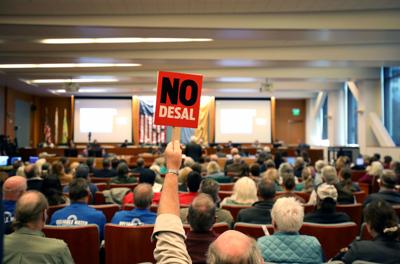
In the half-century since, the Coastal Commission has come to wield great influence, with decision-making authority over a region larger than Rhode Island, spanning 15 counties. The Coastal Zone, over which the commission has jurisdiction, includes a significant portion of Monterey County. In recent memory, the commission has considered Cal Am’s desalination plant in Marina; beach fire rules in Carmel; affordability deed restrictions for the Moro Cojo development in Castroville; and the American Tin Cannery hotel project in Pacific Grove, just to name a few local topics.
The agency is governed by 12 commissioners, with four each appointed by the governor, the Senate Rules Committee and the Speaker of the Assembly. And Monterey County leaders are eyeing a vacancy.
The Central Coast region—comprising Monterey, Santa Cruz and San Mateo counties—has not had a Monterey County representative since 2009 when Dave Potter, now mayor of Carmel, was ousted. He was succeeded by Mark Stone of Scotts Valley (a Santa Cruz county supervisor at the time, later an assemblymember), then Carole Groom, who termed out in 2022 after three terms as a San Mateo county supervisor. Monterey County held the powerful seat for 40 years until losing it for the past 14; now, there is an opportunity to get it back.
Assembly Speaker Anthony Rendon sent letters on Jan. 17 requesting nominations for the appointment. Each of the three counties has 45 days to submit nominations, by March 3. Rendon then has 30 days to review those nominations and either appoint someone, or ask the counties to send more names.
The timing might seem obnoxiously bureaucratic, but it matters not just because it is spelled out in statute. It matters in that Rendon is set to hand the speakership to Assemblymember Robert Rivas, D-Hollister, on June 30. That makes Rendon and Rivas political rivals within the Democratic Party. While local nominees would stand a great chance to get Rivas’ blessing, might Rendon pass over qualified Monterey County nominees, just because of their de facto affiliation with Rivas?
That remains to be seen. First, each of the three counties’ boards of supervisors and city selection committees—a group of mayors from each city within the county—are expected to nominate at least one supervisor and at least one city councilperson or mayor. There is not a limit, which means two Monterey County supervisors who are interested could find themselves on the list of nominees.
Those are Chris Lopez and Mary Adams. While Lopez’s District 3 is outside of the coastal zone, he sees that as an asset: “I believe a diverse body of members makes organizations stronger, especially when it comes to protecting our coastlines and guaranteeing access for all residents.” (The Coastal Commission’s purview includes protecting public access for all, not just coastal residents.)
Adams is Potter’s successor to the coastal District 5, which she says has more coastal land than any other supervisorial district in California. “I believe the Coastal Commission is the most effective commission we have as far as protecting, and being the watchdog,” Adams says. “The Coastal Commission really has the opportunity to forge the future of our county.”
Monterey County’s 12 mayors will meet at noon on Friday, March 3, in Pacific Grove to consider nominations on behalf of the City Selection Committee. (Potter is not interested in being reappointed—“No, definitely not,” he says.) The county Board of Supervisors is likely to consider nominations when they meet on Tuesday, Feb. 28, to meet the Speaker’s deadline.
Who is Rendon looking for, geographically or politically? I don’t know. But spokesperson Katie Talbot writes, “The Speaker is looking with particular interest at candidates with a strong environmental record, who support coastal preservation, restoration and access for all Californians.”
Whether or not it’s a Monterey County representative entrusted with that mission remains to be seen.
(1) comment
This is a good insightful article into the process of appointing a coastal commissioner. I for one appreciate the background information which puts it in clear perspective. Whoever gets the commissioner slot will have a big responsibility to protect our beautiful coastline from ecological and environmental catastrophes. That's a tall order and shouldn't be taken lightly.
Welcome to the discussion.
Log In
Keep it Clean. Please avoid obscene, vulgar, lewd, racist or sexually-oriented language.
PLEASE TURN OFF YOUR CAPS LOCK.
Don't Threaten. Threats of harming another person will not be tolerated.
Be Truthful. Don't knowingly lie about anyone or anything.
Be Nice. No racism, sexism or any sort of -ism that is degrading to another person.
Be Proactive. Use the 'Report' link on each comment to let us know of abusive posts.
Share with Us. We'd love to hear eyewitness accounts, the history behind an article.