
Erik Chalhoub here, thinking about how interconnected the tri-county region is, not just on an economic level, but on a personal level for many of us.
I grew up in Santa Cruz County and attended schools and college there. I moved to Monterey County 20 years ago, and worked in San Benito County for a spell. I spend most of my free time in these areas, as well as Santa Clara County, spending money and visiting the various sites that make each county unique.
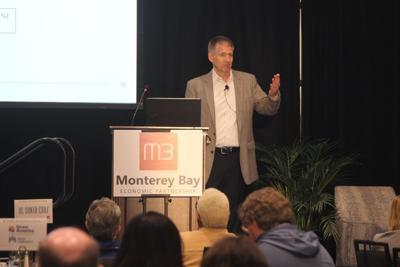
How interdependent each county is on each other was one of the many topics discussed during the Monterey Bay Economic Partnership’s 2024 Economic Outlook on Friday, May 3. Held at the Embassy Suites in Seaside, the half-day conference drew officials from many jurisdictions in the tri-county area, as well as organizations that work in the region.
Three county administrative officers touched on climate change during a panel discussion—Santa Cruz County’s Carlos Palacios mentioned the region has suffered seven federally declared natural disasters in the past six years, crippling infrastructure and forcing jurisdictions to tighten up their belts while they endlessly wait for help from the overwhelmed Federal Emergency Management Agency.
Monterey County Administrative Officer Sonia De La Rosa pointed to the 2023 flood in Pajaro, where the more than 3,000 people who evacuated dispersed to other counties, especially just a stone’s throw away in Watsonville. But reaching out to them to provide information on recovery resources proved difficult without working with other county agencies and organizations, she said.
In a literal sense, it’s the infrastructure that connects the counties. All counties, however, struggle to keep up with the rising costs of maintaining those roads. San Benito County Administrative Officer Ray Espinosa—with his county only having two, two-lane thoroughfares (Highways 156 and 25) to get in and out of it—said the region needs to join together to advocate for more state and federal funding toward infrastructure. It’s a power-in-numbers approach that was a common thread throughout the conference.
Jon Haveman of Marin Economic Consulting painted a positive picture of the region’s current economy during his keynote speech, although many issues are going to come to a head in the near and far future.
A recession is not on the horizon, he advised. Employment recovery from the Covid-19 pandemic has been relatively slow, but Monterey County’s employment numbers are nearly back to 2019 levels, and is better off than the “sluggish” growth seen in Santa Cruz and San Benito counties, he said.
The region’s population is aging—the only age group to see an increase over the past decade is 65 and over—and will require more people to migrate here to grow the local economy, Haveman noted. Monterey County’s population has increased by 5.4 percent since 2010, while San Benito County stands at 19.1 percent and Santa Cruz County 0.1 percent.
Monterey County is not in a bubble—we rely on our neighbors in more ways than we realize. What do you think ties this region together?

(0) comments
Welcome to the discussion.
Log In
Keep it Clean. Please avoid obscene, vulgar, lewd, racist or sexually-oriented language.
PLEASE TURN OFF YOUR CAPS LOCK.
Don't Threaten. Threats of harming another person will not be tolerated.
Be Truthful. Don't knowingly lie about anyone or anything.
Be Nice. No racism, sexism or any sort of -ism that is degrading to another person.
Be Proactive. Use the 'Report' link on each comment to let us know of abusive posts.
Share with Us. We'd love to hear eyewitness accounts, the history behind an article.