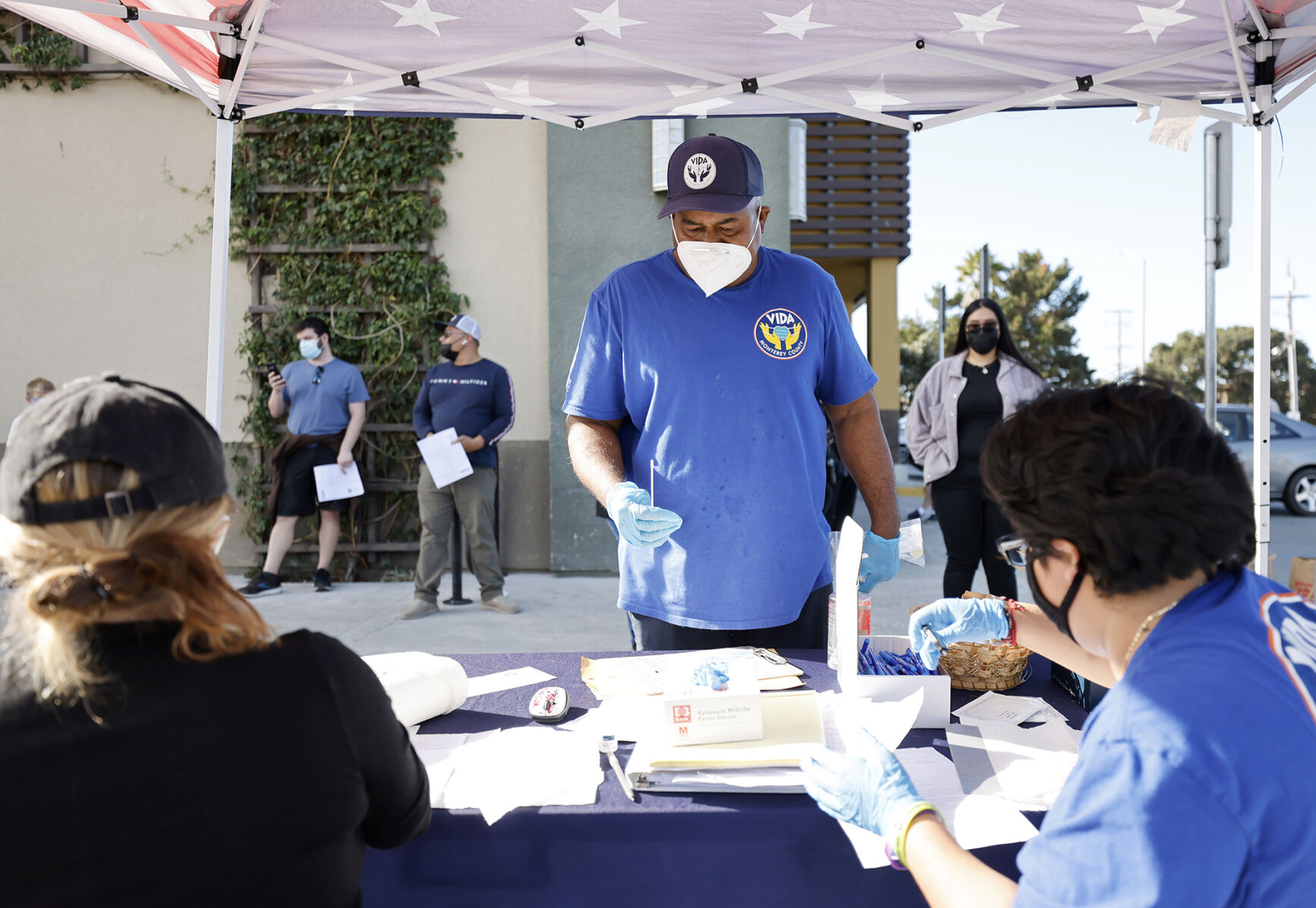

Celia Jiménez here, thinking about how it can matter when the person helping you is someone who looks like you, is from your same neighborhood or speaks the same language as you do.
Familiarity is part of the essences of the VIDA Project, a countywide program designed to help vulnerable residents in Monterey County navigate Covid-19 resources. In VIDA, your relative, your colleague, or your neighbor is the one helping you to get the resources you need to get protected and protect others (through things like signing up for vaccination appointments or getting rapid tests) as well as sharing information about resources you are eligible for (like rent and utilities assistance).
Its tremendous success comes from the workers’ wisdom on how to approach their own community members, including speaking different languages: English, Spanish and Mexican Indigenous languages. “I have no idea what any of us would do without it, especially with the world pandemic and Covid-19 affecting so many families,” says Cecilia Rodriguez, a VIDA coordinador.
“It's not just a job, you know? They're saving lives,” says Michael Castro, community initiatives manager at the Community Foundation for Monterey County, the nonprofit that administers the program.
VIDA started back in January of 2021 with $4.9 million from county funds. They hired over 100 workers in partnership with 10 local organizations including Center for Community Advocacy, Mujeres en Acción and CHISPA. In May of 2021, VIDA was extended to September; later on, it downsized to 50 workers to provide services until March 31, 2022.
But even if we get past pandemic crisis mode, the need for community health workers remains, and VIDA will continue at a smaller scale for the next two years. That’s thanks to a $3.9 million grant from the U.S. Department of Health and Human Services. Starting in April, VIDA will downsize to 20-25 workers, whose focus will be on health literacy.
Krista Hanni, program manager for the Monterey County Health Department, says VIDA will continue to provide accurate and culturally accessible information across the county, and community health workers will continue to be a bridge between residents and health services. Hanni says they will take the challenges people face during the pandemic, learn from them and use them to expand access to care and improve the local healthcare systems. Hanni adds that California is considering reimbursing community health workers through MediCal—a model that other states such as Rhode Island, Minnesota, South Dakota, Oregon, and Indiana have implemented.
If there is something VIDA has demonstrated, beyond all the work they have done providing Covid-19 outreach, it’s that already-trusted people are in a position to build more trust in their communities. That’s a model to emulate.
Read the full newsletter here.

(0) comments
Welcome to the discussion.
Log In
Keep it Clean. Please avoid obscene, vulgar, lewd, racist or sexually-oriented language.
PLEASE TURN OFF YOUR CAPS LOCK.
Don't Threaten. Threats of harming another person will not be tolerated.
Be Truthful. Don't knowingly lie about anyone or anything.
Be Nice. No racism, sexism or any sort of -ism that is degrading to another person.
Be Proactive. Use the 'Report' link on each comment to let us know of abusive posts.
Share with Us. We'd love to hear eyewitness accounts, the history behind an article.