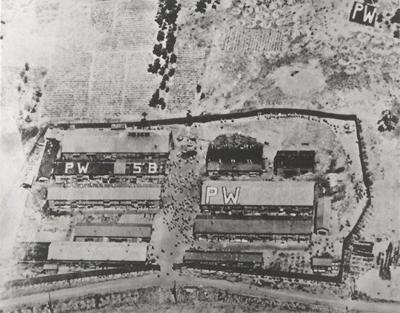

Dave Faries here, dusting off my master’s thesis in recognition of today’s anniversary of the end of the Second World War (the official documents would be signed Sept. 2). It’s an appropriate occasion, as it was a year ago U.S. forces departed Afghanistan. The end of a conflict brings different emotions. This is just one tale.
My research was groundbreaking only in the sense that, at the time, mentions of a small unit known as the North China Marines were quite rare. The thesis is titled Home Is My Only Destination: William Harold Thomas, North China Marine, 1939-1945 and has never been published.
The North China Marines consisted of less than 300 Marines detailed to guard the U.S. legation in what we now know as Beijing, at the time called Peking. The city was already occupied by Japan in 1939, when Thomas arrived following boot camp. The day Japan bombed Pearl Harbor—Dec. 8, 1941 across the dateline—the Marines were captured and sent to prisoner of war camps in China and then Japan.
Thomas and the others who survived spent the entire war in often brutal captivity. In my subject’s case, he was being held in Niigata, Japan in 1945.
I present an excerpt below, cut down in places:
News that war was finally over first came to Niigata’s prisoners on leaflets dropped by the now ubiquitous B-29s. It was a sharp, clear morning, August 15.
Later that morning Thomas heard rumors of Emperor Hirohito’s radio broadcast the previous day during which he informed his people the war could no longer be carried on. Evidence continued to mount: the prisoners were not called to work; Japanese authorities could be seen packing or frantically destroying papers; guards disappeared from the gates.
On August 20 word of Japan’s surrender officially reached the camp. “That maliciously lingering doubt has been eradicated,” Thomas jotted in a diary begun that day. His existence was still marginal. He weighed a mere 112 pounds—a skeleton, really, with taught skin and protruding joints. The others staggered around in the same condition.
“25 Aug. 45—About 0900 navy Grummans (12 in no.)—F4Us & F6F’s came over & gave us a show. One pilot dropped a pack of ‘luckies.’ Maybe the big ones will come later. The most exalted state of emotions I have ever endured…completely enveloped me during their stay. I can assure anybody that tears of happiness are very possible.”
Another dozen navy planes swung low over camp the next morning, waggling their wings and dropping a shower of cigarettes, rations, chocolates and a note which read “hang on men it won’t be long now.” Evening brought a flight of TBF torpedo bombers winging over camp, spilling more rations, as well as reading material—magazines and newspapers from the States. “Never have I seen POW’s so happy,” Thomas noted.
The big planes came within two days, dropping tons of food, medicine and clothing. “No more RICE,” Thomas wrote with obvious exuberance. Deprived for so long, the recipients tended to overindulge, like children on Halloween or Christmas. It didn’t take much. “I ate two candy bars from the Red Cross,” recalled Irving Akers, “and got sick as a mule.”
At the time of Japan’s capitulation, only 42 camps were known to exist in the home islands, Formosa and Manchuria. One condition imposed on Japan in the surrender agreement was that their government turn over to American military authorities a complete list of prisoners and prison camps. The first such list was delivered on August 27, registering 73 camps—and this was by no means a complete account. Halsey’s reconnaissance flights discovered 57 more. Red Cross delegates, working diligently, compiled a tally of prisoners 7,000 names longer than any previous list.
The Third Fleet faced enormous logistical difficulties, not only in locating camps. The exercise of feeding, tabulating and transporting the men could easily stretch any task force thin. Commander Harold Stassen, now remembered for a series of futile postwar presidential campaigns, led Third Fleet’s liberation parties and took up his assignment with vigor. He flew to Niigata and arranged for transportation of prisoners from there to Yokohama.
“Mom, here I come,” Thomas wrote when orders to depart Niigata arrived.
On the morning of September 5, 1945, Thomas found himself once again in uniform under an American flag. It was a moment of indescribable relief. Like all other Recovered Allied Military Personnel (or RAMP, their official designation in a military fond of acronyms), Thomas was hurried through a clearing process which included a bath, a perfunctory medical exam and a clean issue of clothing. And they were fed.
The telegram arrived the morning of September 7. Waiting for the news was just about the only thing anyone in the Thomas family managed to accomplish since the war ended. They had no idea if Harold was even alive.
So on that morning, his father and mother stood at the door, unable to open the Western Union envelope, afraid of the words it might contain. Elizabeth remembers that her older brother Bob, home from duty at an air base in Florida, finally took the envelope and tore at its seal. For a moment, three and a half years of worry, of waiting, of memories held them breathless. Then Bob burst out: “They’ve found him! He’s coming home!”
The telegram read: “Pleased to inform you of the liberation from Japanese custody of your son Corporal William Harold Thomas USMC. He embarked on board an American ship on 5 September 1945. Further details will be furnished you promptly.”
For 45 months, 1,357 days, Thomas had watched life ebb and almost fade from view. Now he was on his way home. The Ozark steamed into Guam where its jubilant passengers went through a day of medical exams. A snack bar remained open for former prisoners 24 hours per day and doctors encouraged the men to eat as often as possible, but not to overeat.
That day on Guam, September 13, Thomas again wrote home:
“Here it is, your first uncensored letter in over 3 ½ years. As I am sure you know, we POWs have been liberated. I know that Webster’s definition of ‘liberation’ is inadequate—he was never a POW.
“I arrived at Guam yesterday…Leave here in a few hours for another step nearer you. Considering everything I’m in excellent health. This service chow is putting weight on fast.
“How is everyone there? Fine I hope. We will have many pleasant hours in the very near future—together. There are so many things to ask & tell that I won’t even start in this letter. My feelings can’t be shown on paper.
“Tell friends I will see them soon. Home is my only destination.”

(0) comments
Welcome to the discussion.
Log In
Keep it Clean. Please avoid obscene, vulgar, lewd, racist or sexually-oriented language.
PLEASE TURN OFF YOUR CAPS LOCK.
Don't Threaten. Threats of harming another person will not be tolerated.
Be Truthful. Don't knowingly lie about anyone or anything.
Be Nice. No racism, sexism or any sort of -ism that is degrading to another person.
Be Proactive. Use the 'Report' link on each comment to let us know of abusive posts.
Share with Us. We'd love to hear eyewitness accounts, the history behind an article.