
David Schmalz here, thinking about natural disasters. That phrase has now become a loaded term, because the so-called “natural” disasters we’re experiencing are often exacerbated, and made more frequent, by humans burning fossil fuels.
I suppose one could argue that humans are in fact animals that evolved on Earth among other animals, and that anything we do is “natural.” But it’s also true that historical weather patterns don’t have much predictive value for the future we are hurtling into—they are more just data points that reflect how much different the world is becoming.
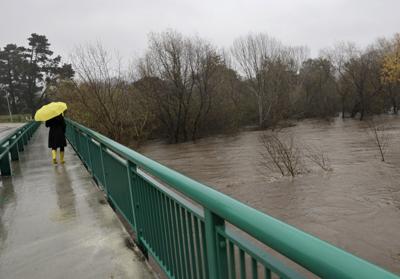
And the reason this is all on my mind is because the Central Coast, and much of California, got battered by a series of atmospheric rivers over the turn of the new year, where it seemed like it didn’t stop raining for two weeks straight. And when that happens, communities flood, roads get closed and various pieces of our infrastructure are often damaged.
Tomorrow, Jan. 31, the Monterey County Board of Supervisors will consider approving a $7 million advance funding agreement with the Monterey County Water Resources Agency to make emergency repairs on its infrastructure that was damaged in the recent storms. (That money, if approved, is expected to be reimbursed by the Federal Emergency Management Agency, but not in the current fiscal year.)
The estimated costs of the emergency repairs, which MCWRA staff recommends doing this winter, are $3.5 million to repair damage to the Lake Nacimiento spillway plunge pool, $1.5 million for damage to the levee on the Pajaro River and $2 million for repairs on the Salinas Lagoon road and slide gate.
But that doesn’t even cover all of the damage—preliminary estimates by MCWRA put the total tally of damage to its infrastructure at $16 million. Which is where I think there needs to be robust public debate: Currently, Monterey County is not climate resilient. To what extent should our local government agencies be funding efforts to change that?
Nonprofit Big Sur Land Trust is spearheading the Carmel River FREE project to mitigate flooding in the lower Carmel River. The organization is also restoring a historical wetland in the center of Salinas for that same purpose, albeit on a smaller scale, for now.
But why should those laudable projects fall on a nonprofit? Are we just going to keep waiting for disasters to strike and then put out a hand to FEMA for reimbursement? And on the Monterey Peninsula, there are power lines everywhere in a forest that, increasingly, is a tinderbox—does that not seem like a serious problem that we should be devoting energy, and money, to solve?
Climate change is a slow-moving train wreck, and no disaster should take us by surprise. That said, are we going to strap on our seatbelts or not?
(1) comment
The likely culprit for climate change are the surreptitious F-gas releases (fluorinated hydrocarbons), not the CO2 releases. This is not a popular idea, but needs to be addressed.
Welcome to the discussion.
Log In
Keep it Clean. Please avoid obscene, vulgar, lewd, racist or sexually-oriented language.
PLEASE TURN OFF YOUR CAPS LOCK.
Don't Threaten. Threats of harming another person will not be tolerated.
Be Truthful. Don't knowingly lie about anyone or anything.
Be Nice. No racism, sexism or any sort of -ism that is degrading to another person.
Be Proactive. Use the 'Report' link on each comment to let us know of abusive posts.
Share with Us. We'd love to hear eyewitness accounts, the history behind an article.