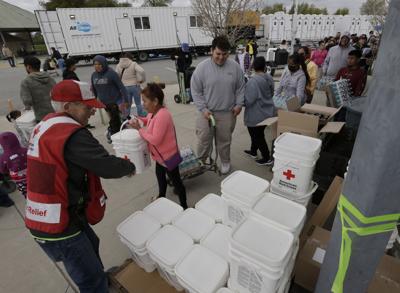

David Schmalz here, thinking about the residents of Pajaro and grateful that President Joe Biden finally issued a formal declaration of disaster for the area, which will free up federal resources to help residents on what could be a tough road toward recovery.
I’ve also been thinking how unlucky Pajaro residents are that this winter of deluge happened before the long-planned Army Corps of Engineers levee restoration project was completed—it’s projected to begin in 2025. But another part of my brain also recognizes that the current protection levels of the Pajaro River levee only guard against a 15.4-year flood event, meaning there’s a 6.5-percent chance it could occur in any given year. And considering that it last breached in 1998, the fact that it took 25 years for it to happen again actually seems lucky.
I wrote a story a few weeks ago trying to answer the question of why the levee restoration—which Congress authorized in 1966—has taken so long. In it, I focused on the federal side.
What I didn’t have time to get into was the work that went into funding the project from the state side: The project is estimated to cost around $434 million, but will likely rise above $500 million, and 35 percent of that will come from the state. That’s not normal—usually, the state’s portion (of the 35 percent) must be funded by at least 30 percent from local sources. That is not the case with the Pajaro River levee project, where the state is paying the full 35 percent. Much of that is because of the efforts of State Sen. John Laird, D-Santa Cruz, who’s been working to get the project moving for years, and who co-authored a bill to guarantee the funding in 2021—which, he says, “passed rather overwhelmingly.”
One concern Laird says he heard from fellow lawmakers while bringing the bill through the legislature was that the bill would create a precedent for other communities, so he amended it to clarify “that it wouldn’t open the door for other communities if they weren’t in the same situation as Pajaro.” And that situation, for decades now, has been one of a low-income community in a state of constant peril.
So far as Laird knows, it’s the only time the state has agreed to pay 100 percent of the 35-percent match for a project. Over the course of the past several years, he’s met with scores of officials, both elected and government staff, trying to push the project across the finish line, but it was too late—the gears of bureaucracy grind too slow.
“It's just so heartbreaking we didn’t make it to this project,” Laird says, adding, “the narrative has been that Pajaro has been ignored because it’s disadvantaged, but being disadvantaged helped the project get off the dime and fully funded.”
There are a lot of hypotheticals and what-ifs that can be applied to the recent levee breach—perhaps courses of action that would have prevented it—and while it’s important to make those assessments, it’s also important to recognize that there may not be a “bad guy” in this story, per se. There are a number of people, powerful or not, doing their level best.
Their efforts may not have staved off this recent flood, but hopefully they will help protect the town against the next.
(0) comments
Welcome to the discussion.
Log In
Keep it Clean. Please avoid obscene, vulgar, lewd, racist or sexually-oriented language.
PLEASE TURN OFF YOUR CAPS LOCK.
Don't Threaten. Threats of harming another person will not be tolerated.
Be Truthful. Don't knowingly lie about anyone or anything.
Be Nice. No racism, sexism or any sort of -ism that is degrading to another person.
Be Proactive. Use the 'Report' link on each comment to let us know of abusive posts.
Share with Us. We'd love to hear eyewitness accounts, the history behind an article.