
Sara Rubin here, thinking about how thousands of years before Monterey County as a jurisdiction even existed as an idea, it was inhabited by thousands of Indigenous people who called this place home. Numerous villages all over the region were populated by what came to be known as tribelets—different but related tribes living in different communities, speaking different languages, and interacting with each other.
That diversity of people got squashed together into the idea of the Coastanoan people, a Spanish word for Indigenous people in a large area from San Francisco to southern Monterey County, inland and on the coast, despite distinct cultures.
The colonial renaming of a people was just one step in a path toward erasure, however—there was of course rampant violence and forced missionization. There was the deliberate destruction of a culture and a way of life. Some Indigenous people retreated deep into the rugged Santa Lucia Mountains to attempt to escape Spanish missionaries, who pursued them there.
The Indigenous Esselen people were never eliminated entirely, despite the violence and suffering they endured. But that did not stop white anthropologist who visited in 1902 from declaring the Esselen “extinct.” In 1925, Alfred Kroeber wrote: “The Costanoan group is extinct so far as all practical purposes are concerned.”
It was just one of many ironic blows against a publicly recognizable Esselen presence in modern California. Kroeber was in pursuit of an academic idea of what Indigenous life looked like at the time European colonizers first encountered Indigenous people—a way of life that of course no longer existed, precisely because the colonizers had long since made that impossible. He was looking for “the noble savage” from a long-gone era.
A series of government failures continued throughout the 20th century when it came to recognizing the Esselen. There was a 1927 determination by a government bureaucrat that Monterey County’s Indigenous community required no land. There were treaties that were never signed by the government side, then never honored.
And eventually, the Office of Federal Acknowledgement within the U.S. Bureau of Indian Affairs would consider all of this in determining whether the Esselen should be federally recognized as a tribe—was there evidence of continuity of culture and genealogy? The irony: It’s hard to prove continuity to the government, when the same government has made it all but impossible to even exist.
This journey is included in this week’s cover story. It’s just a part of a long and winding history, which lends itself to book length—indeed, there are several books written about it. But I am most interested in the present, because finally, 250 years after the first missionaries arrived, there is tangible progress for treating Indigenous people of this area with the dignity and respect they deserve.
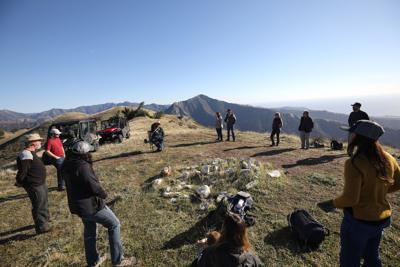
That comes in the form of land in a place once known as Sargenta-Ruc, then called Adler Ranch and Rancho Aguila, and settled in 1875 by Charles Bixby. It is 1,119 acres of beautiful Big Sur country with views of sacred sites—the notch of Ventana Double Cone known as the “window” through which souls are believed to have traveled, and Pico Blanco, where the creation myth took place.
The story of how the Esselen Tribe of Monterey County, a nonprofit that is not federally recognized by the U.S. Bureau of Indian Affairs, came to acquire this land—an extraordinary act of rematriation of land to people from whom it was stolen—is detailed in this week’s cover. I think it’s a deeply inspiring tale of how different organizations including tribal groups, nonprofits, government agencies and real estate brokers can help make good things happen.
Jana Nason is the tribal administrator for the Esselen Tribe. “We are able to bring a lot of tribal members back in and include them and welcome them back,” she says. “It really represents us exercising our tribal sovereignty, and as a tribe, being able to protect our cultural heritage and the natural resources of the world.”
The journey is far from over. The Esselen Tribe is in the interview stage of a process in its bid to acquire the Pico Blanco Boy Scout camp next door, hoping to provide space to better support visitors. And another tribal organization, Ohlone/Costanoan-Esselen Nation, is still actively in pursuit of both land and federal recognition.
Nason points to the difference also between giving land back versus a tribe buying it. But both mechanisms are part of a growing land back movement worldwide, and both represent a return of stolen lands—it’s a form of reparations. “I think it is a significant turning point. There is a reawakening of tribal citizens to exercise their indigenous sovereignty,” Nason says.
I was honored to visit the land twice while reporting this story, and I watched as tribal members were moved to tears to set their feet on a place their ancestors called home. It reminded me of a feeling I have had visiting sacred archeological sites across the globe, where my ancestors once lived—there is a connectedness that transcends anything we can put into words.
“People now are able to return and experience that deep connection,” Nason says. “I’ve seen it just be transformative for people. For me, it has changed me.”
This one acquisition has changed the story of the Esselen people in Monterey County. And in the future, there may be more.

(0) comments
Welcome to the discussion.
Log In
Keep it Clean. Please avoid obscene, vulgar, lewd, racist or sexually-oriented language.
PLEASE TURN OFF YOUR CAPS LOCK.
Don't Threaten. Threats of harming another person will not be tolerated.
Be Truthful. Don't knowingly lie about anyone or anything.
Be Nice. No racism, sexism or any sort of -ism that is degrading to another person.
Be Proactive. Use the 'Report' link on each comment to let us know of abusive posts.
Share with Us. We'd love to hear eyewitness accounts, the history behind an article.