
Rey Mashayekhi here, thinking about the tradeoffs that we, as a society, make between safety and commerce. I’m not breaking any news here; it’s simply a fact of life in our economic system, and especially when you’re as reliant as Monterey County is on an industry like agriculture.
To be clear, Monterey County’s $4 billion agriculture sector puts food on the plates of many—from the local workforce that it employs to the Americans across the country that it feeds. That’s why we put up, more or less, with an industry that uses cancer-causing pesticides banned in 34 countries on fields within reaching distance of elementary schools.
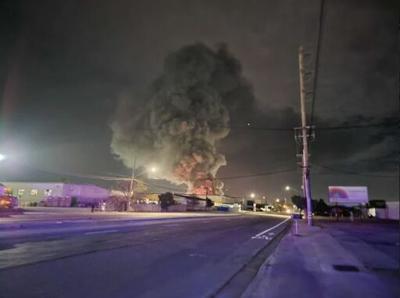
Since launching 28 years ago, Salinas-based Taylor Farms has grown into a local ag powerhouse that employs thousands of people and contributes immensely to the region’s economy. Yet that same tradeoff was felt in alarming fashion 13 months ago, when Taylor Farms’ Abbott Street food processing facility in Salinas caught fire—triggering a massive response amid fears of a potentially devastating explosion.
Like many food processing facilities, the Abbott Street location housed plenty of ammonia for refrigeration purposes. Ammonia is also highly flammable, and one only has to recall the August 2020 explosion in Beirut, Lebanon, fueled by ammonium nitrate, to recognize the chemical’s destructive properties under the wrong circumstances.
That’s why the Salinas Fire Department and other local authorities quickly sprang into action on the evening of April 13, 2022, issuing both evacuation and shelter-in-place orders for the surrounding area. Most of the 225,000-square-foot structure burned down, with only limited ammonia releases into the atmosphere. There was no explosion, no injuries and no deaths. “It was a big deal and had a lot of potential that, fortunately, did not materialize,” Salinas Fire Chief Sam Klemek tells me.
Last month, nearly a year after the fire, Taylor Farms announced that the Abbott Street facility would be reopening by the end of April—and I was curious what’s been done in the year since to ensure that such an incident does not happen again. Taylor Farms insists that it worked closely with local fire authorities and the city of Salinas on the rebuild: “We took this as an opportunity to make improvements…[We] eliminated all wood structures, as well as designed an even more secure ammonia safety system,” a spokesperson says, describing the fire as “a big educational moment for everyone involved.”
Klemek tells me that the ammonia safety system at the old facility actually worked as intended, preventing a cataclysmic scenario. “It’s a necessary evil [and] an industry standard,” he says of the use of ammonia at the processing facility. “We’re keenly aware of the dangers of it, and the taste in everybody’s mouth about it.”
Where there was significant room for improvement was the building structure itself. The cause of the fire was “hotwork,” a.k.a. welding, that was taking place at the facility at the time of the incident, which apparently ignited flammable insulation inside the walls of the structure—eventually sending the whole thing up in smoke. Klemek notes that while Salinas’ building fire code is updated every three years, the part of the structure where the fire originated dated back to the 1990s, leaving it more prone to such a hazard.
The new, rebuilt Abbott Street facility was constructed up to code, making such an incident significantly less likely, according to Klemek. He also said Taylor Farms was “amenable to making improvements” to the on-site water systems, allowing firefighters to more easily access hydrants.
“We feel that we were very lucky in many respects,” Klemek says, reflecting on the fire. “But all of the features of the building and the safety systems in place—they did their job. I would attest it kept a major disaster from occurring.”
Still, even the best-laid plans and systems can go awry—all it takes is a little bad luck. While it’s encouraging that Taylor Farms—as well as local authorities—took measures to prevent such a disaster from ever again befalling the surrounding Salinas community, the fire is a reminder of the risks inherent to the agro-industrial way of life around these parts.
(0) comments
Welcome to the discussion.
Log In
Keep it Clean. Please avoid obscene, vulgar, lewd, racist or sexually-oriented language.
PLEASE TURN OFF YOUR CAPS LOCK.
Don't Threaten. Threats of harming another person will not be tolerated.
Be Truthful. Don't knowingly lie about anyone or anything.
Be Nice. No racism, sexism or any sort of -ism that is degrading to another person.
Be Proactive. Use the 'Report' link on each comment to let us know of abusive posts.
Share with Us. We'd love to hear eyewitness accounts, the history behind an article.