
Sara Rubin here, thinking about the power of symbolism. Sometimes it’s explicit and impossible not to see. Other times it’s more subtle—it might require a viewer to know an obscure reference to get it, or maybe a high school English teacher to help tease it out of a novel.
To Salinas police officers, symbols representing gang affiliations look pretty obvious, although to you or me they might not be. Sweatshirts and hats that in another context might be innocuous come to signify something very particular to those in the know. Specifically, I am thinking about the use of the letter “m” as it references Salinas East Market, or SEM.
Salinas Police Cmdr. Brian Johnson explains that officers see this a lot—a Florida Marlins hat or a Milwaukee Brewers shirt. Officers are trained to see sports fan merch and recognize something else, and ask questions. A cop might ask someone about their favorite player on the Marlins, or even what sport they play, and get an answer they suspected: The wearer has no clue and isn’t a Marlins (or fill-in-the-blank) fan, but is wearing a symbol of their gang affiliation. “In general, gang paraphernalia can be anything the gangs use to symbolize their gangs,” Johnson says.
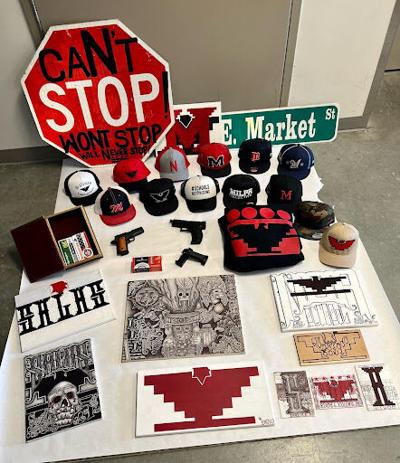
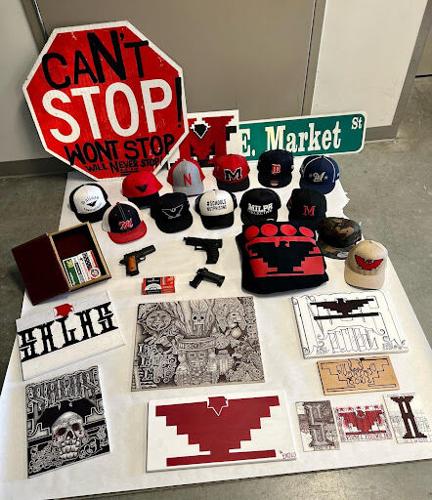
That’s part of the context that explains why Salinas police published a photo on Dec. 21 of evidence seized while serving a search warrant, showing two guns and a dozen ballcaps, alongside artwork and decor with an emphasis on the letter “m” and the color red.
“We would like to offer up two more quick PSAs,” SPD wrote in a social media post with the evidence photo. “1. For the gang members of Salinas you cannot hide from [the Violence Suppression Task Force] in a different county (San Benito).
“2. For any parents out there looking for signs that your kid is hanging out with the wrong group of people; take a look at this photo. It is a good example of some Norteño gang indicia that we commonly see.”
The second part of that PSA landed harshly for some, including organizers at the nonprofit MILPA, which advocates for criminal justice reform and, in many cases, is an antagonist of the police. Besides sports team hats, the evidence display includes a hat that simply reads “MILPA Collective” and one that reads “#SchoolsNotPrisons,” a message that MILPA has organized people around. The display also includes images with the UFW symbol, an eagle inspired by Aztec imagery, with a red background to symbolize the blood spilled by generations of toiling farmworkers.
“It feels like a direct attack,” says Cesar Lara, policy director at MILPA. “It’s one thing to just put it out there. It’s another to say, ‘parents, beware, if your kid is wearing this they might be in gangs.’”
MILPA issued a press release condemning SPD for what they call defamation and slander of the organization’s activities.
Part of what stings about this heap of evidence in particular is that it was seized from Israel Villa, formerly of Salinas and formerly MILPA’s policy coordinator. Villa is now living in Hollister and SPD served a search warrant, and say they discovered a loaded unregistered handgun in his waistband, another unregistered loaded handgun and ammunition at home, and “plenty of gang indicia.” Villa is a convicted felon and was arrested on gun charges.
Villa is now three years gone from MILPA, after concerns surfaced about whether he remained involved in gang activity—and was leveraging MILPA’s leadership role to strengthen Nuestra Familia’s presence—despite claims to the contrary.
To Lara, SPD’s post seemed intentionally crafted to poke at the antagonism inherent between law enforcement and the advocacy group calling for #SchoolsNotPrisons, but also crafted to cast doubt on MILPA’s integrity.
There is nothing about a MILPA hat, or a UFW flag, or a Florida Marlins hat that necessarily shows a gang affiliation. Who I think we should blame for appropriating these otherwise innocuous symbols and giving them sinister tones is the gang members and leaders themselves, who have taken activist symbols and sports team logos and imbued them with suspicion.
And that suspicion inevitably trickles into families, even in households where kids might be getting involved and finding their voice as activists. Even if we don’t agree with their agenda, that’s the kind of involvement we should all support for all kids.
(0) comments
Welcome to the discussion.
Log In
Keep it Clean. Please avoid obscene, vulgar, lewd, racist or sexually-oriented language.
PLEASE TURN OFF YOUR CAPS LOCK.
Don't Threaten. Threats of harming another person will not be tolerated.
Be Truthful. Don't knowingly lie about anyone or anything.
Be Nice. No racism, sexism or any sort of -ism that is degrading to another person.
Be Proactive. Use the 'Report' link on each comment to let us know of abusive posts.
Share with Us. We'd love to hear eyewitness accounts, the history behind an article.