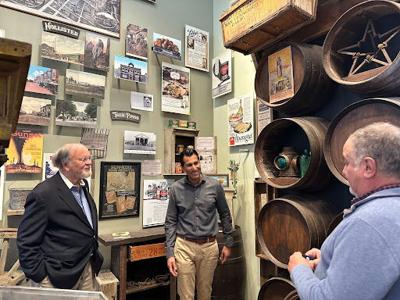

It wasn’t precisely a homecoming for Speaker of the Assembly Robert Rivas, D-Hollister, this morning, but for a few brief moments he was home. Pam Marino here to share about Rivas’ visit to the California Welcome Center in Salinas, and how it could prove valuable to the future of the Salinas Valley’s economy.
Rivas had been invited to the center located inside the historic Southern Pacific Freight Depot to meet with Craig Kaufman, founder and executive director of the Salinas Valley Tourism and Visitors Bureau, and the bureau’s board of directors, including former member of the California Assembly and U.S. House of Representatives Sam Farr. Kaufman led Rivas on a brief tour around the exhibits chronicling the history of the Salinas Valley and surrounding region, and then shared the bureau’s vision for increasing tourism—and tax revenues—in the valley.
That vision is what’s called the Valleys of Anza, leveraging the Juan Bautista de Anza National Historic Trail that runs through the Salinas Valley in Monterey County and the San Juan Valley in neighboring San Benito County and entice tourists to veer off the beaten path to the coast—if only for a day—to discover the treasures that lie inland. The tax money generated through overnight stays in hotels and other lodgings could then be used to add affordable housing to the valleys.
“We need to think about the totality of the region and get people off the coast,” Farr said of the current state of tourism, which is almost all focused on Monterey Bay and the Pacific Ocean. The hotels on the Monterey Peninsula, Farr said, will get an extra night and still make money. “We need to invest some money into getting the whole [visitor] experience of the three counties inland.”
Kaufman has been leading the charge on this plan for a few years, and attracted some impressive partners like the U.C. Berkeley College of Environmental Design. As part of this partnership, the school sent students to the Salinas Valley to do research and develop ideas on how to use the rich history and culture of the region, along with present-day attractions like Pinnacles National Park and the River Road Wine Trail, to increase tourism. More recently the National Parks Foundation awarded the bureau $50,000 toward further developing the plan.
This morning, Kaufman and the board had the ear of one of the most powerful politicians in California.
At one point, Rivas asked how the center and the bureau’s efforts were being funded. Two ways, Kaufman said. Operations are funded by money collected through the Monterey County Tourism Improvement District from hotel stays. The exhibits inside the center were paid for through the board’s fundraising efforts.
“So no state support?” Rivas asked. “Not yet,” a woman chimed in, to much laughter. It was not lost on anyone in the room that Rivas has the influence in Sacramento to direct money their way.
As for the Valleys of Anza plan, Rivas immediately grasped the concept, connecting it to how others in the state have successfully developed agritourism attractions and thinking ahead to how to spread the word.
“You know who we should show this to—Adam Schiff,” Rivas said, referring to the Democratic congressman from Burbank who also happens to be running for U.S. Senate. Schiff is going to be in the area in the next couple of weeks, Rivas said, along with members of the state Legislature.
Part of the exhibit at the Welcome Center is a display all about the San Juan Valley, which includes the town of Tres Pinos, where Rivas grew up in farmworker housing with his family. Rivas lingered at the display, looking fondly at the photos, including a historical photo of the Paicines General Store. “I grew up a half-mile from that store,” Rivas said.
It’s Rivas’ rural background that allows him to understand the needs of the state’s agricultural regions, and it showed this morning in Salinas. It could mean everything to the region’s economic future, including the future of tourism in the Salinas Valley.
By the way, if you’ve never been to the California Welcome Center, I recommend a visit. The current “Postcards, Passengers and Produce” exhibit detailing how the Southern Pacific Railroad contributed to creating the Salad Bowl of the World is interesting and informative, and you’ll come away with a better understanding of not just the Salinas Valley but the entire county and surrounding region—the place that we call home.
(0) comments
Welcome to the discussion.
Log In
Keep it Clean. Please avoid obscene, vulgar, lewd, racist or sexually-oriented language.
PLEASE TURN OFF YOUR CAPS LOCK.
Don't Threaten. Threats of harming another person will not be tolerated.
Be Truthful. Don't knowingly lie about anyone or anything.
Be Nice. No racism, sexism or any sort of -ism that is degrading to another person.
Be Proactive. Use the 'Report' link on each comment to let us know of abusive posts.
Share with Us. We'd love to hear eyewitness accounts, the history behind an article.