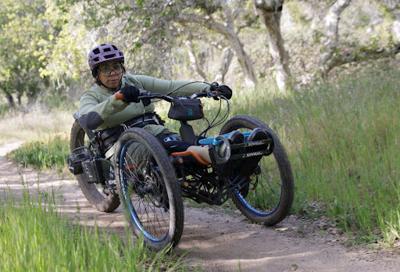

Sara Rubin here, hopping on my bike to head to Sea Otter Classic at Laguna Seca. This four-day festival is the largest bicycle gathering in the world. It draws some 1,000 vendors to an expo showing off the latest in everything from bikes and tires and seats, to helmets and jerseys and bike gloves, to energy drinks and kinesiology tape. It draws 6,000 athletes participating in a diversity of races, from downhill courses to the 65-mile Life Time Grand Prix. And it draws a lot of regular people—about 74,000 of them—who, like me, might be just people who like to ride bikes.
I’m not sure that I qualify as a “cyclist.” While I do have a pair of hot pink biking gloves that I love, I don’t have clip-in pedals or bike shoes; I don’t have dedicated bike clothing (although in general, I am a big proponent of spandex). I have a good bike and the most basic level of maintenance ability (how to change a tube and grease a chain). I am not a fast biker or an ambitious biker, and I regularly get passed on the Rec Trail by faster bikers on fancier bikes.
While Sea Otter Classic of course is for people who unambiguously identify themselves as bicyclists, I am especially interested in how this festival is taking a different approach this year in explicitly inviting in those of us who might not think of ourselves that way.
“Everybody that rides a bike is a cyclist,” mountain biker Annijke Wade tells me. “There is no one way to ride, no one way to show up. You don’t need to wear anything in particular—you should wear a helmet—but you don’t need particular shoes, or a fancy backpack. Just get out there and use a bike.”
I spoke to Wade for the cover story in this week’s issue of the Weekly about how she is part of a growing community advocating to expand the definition of cyclist. Specifically, Wade and others are working to include people of color, women and athletes with disabilities (Wade is all three). They are working to include people who are fat, people who are poor and can’t afford nice bikes, people who identify as LGBTQ+, people who bike for fun and people who bike for transportation.
There are, of course, barriers to bicycling—starting with the cost of a bike and the costs of maintaining a bike. Lots of groups are working to help alleviate those costs for people who come from marginalized backgrounds. (Those include local efforts like those by nonprofit Greenfield Community Science Workshop, which leads workshops for kids to learn how to repair bikes.)
Wade, who lives in Seaside and mountain bikes regularly on Fort Ord National Monument, is one of several bikers at the forefront of a movement in biking, and the outdoor recreation world more generally: claiming space for people who have been excluded as mostly white, mostly able-bodied people define who an athlete is. Increasingly, they are succeeding in getting people to redefine who gets to call themselves a hiker, a runner, a surfer or a biker—the list goes on.
Wade will join several others in leading a discussion about diversity in the sport, followed by a 12-mile community bike ride that is open to all—whoever you are, and whether or not you define yourself as a biker.
I’ll see you on the bike path.
(0) comments
Welcome to the discussion.
Log In
Keep it Clean. Please avoid obscene, vulgar, lewd, racist or sexually-oriented language.
PLEASE TURN OFF YOUR CAPS LOCK.
Don't Threaten. Threats of harming another person will not be tolerated.
Be Truthful. Don't knowingly lie about anyone or anything.
Be Nice. No racism, sexism or any sort of -ism that is degrading to another person.
Be Proactive. Use the 'Report' link on each comment to let us know of abusive posts.
Share with Us. We'd love to hear eyewitness accounts, the history behind an article.