
Celia Jiménez here, thinking about how compromise is a great baseline to start a dialogue between opposing parties.
Yesterday, Oct. 18, Salinas City Council decided to keep an inclusionary housing exemption in place for adaptive-reuse building projects only and remove it for new construction. This decision was a compromise that the council hopes will continue to incentivize developers who want to remodel buildings in downtown, and also create more opportunity for lower-income residents to live in the area.
“I know what it's like to live in affordable housing and to be discussed in a way that makes you disposable,” said an emotional City Councilmember Anthony Rocha. (Rocha was the one who pushed for reviewing this exemption, five years after it was first introduced.) “We are not dispensable. We should be treated as a priority because this is our community.”
The plan as approved is a compromise: No requirement for existing buildings (which are more costly for developers) and reinstate the requirement of inclusionary units in new construction.
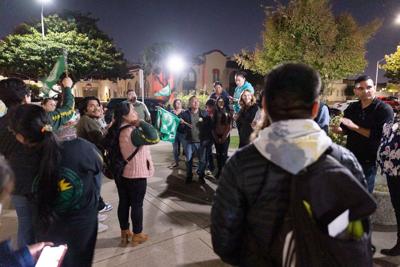
When Rocha’s motion passed, residents inside council chambers responded with cheers and applause, then moved outside to celebrate this win. Over 100 people showed up. Many wore green and held Center for Community Advocacy flags. People spoke in English, Mixteco and Spanish. Most supported removing the inclusionary housing exception in its entirety. Jesus Estrada, an organizer with CCA, says if inclusionary housing was constructed downtown, he would apply to live there.
For over two hours—half of yesterday’s council meeting—city staff, councilmembers and residents shared their thoughts about the inclusionary housing ordinance exemption in downtown Salinas (which, by the way, extends beyond Main Street; It’s called Central City Overlay).
“This ordinance is for the whole city, not just where it's convenient,” said Chris Barrera, Salinas 2055 LULAC president. “Oldtown belongs to all of us—the entire city, the residents of Salinas. And we all deserve an opportunity.” Barrera emphasizes that all people should have the opportunity to live in different parts of the city.
Frank Saunders, a downtown property owner, and Kevin Dayton, of the Salinas City Center Improvement Association and the Salinas Valley Chamber of Commerce, highlighted the revitalization currently underway in downtown Salinas. Saunders noted that since the city put the exception in place, only two residential projects—the Bruhn and Rabobank buildings—were remodeled in the area. (Units at the Bruhn Building are renting for $2,500-$3,500/month; in the Rabobank Building, studios are going for $1,500/month.)
Natalie Herendeen, executive director of CCA, passionately asked for creative solutions. “If they're building houses, we have housing and we have jobs. Find ways to incentivize them, not at the cost of community members and not at the cost of well-being.”
Developers have shared that without an exemption to the city’s ordinance, they wouldn’t be remodeling buildings and contributing to the Oldtown revitalization. And there’s the rub:
“If housing isn't built, there is no inclusionary housing,” noted Megan Hunter, the city’s director of community development.
Salinas’ downtown area has the highest number of affordable units in the city, and five years ago—after over two years of negotiations—developers and housing advocates came out with a plan to bring more housing to downtown: To exempt housing projects from the city’s inclusionary housing requirement, requiring that 12 to 20 percent of units are set aside for affordability criteria established by HUD.
“This is aimed at getting the market rate developers to do their fair share,” says Matt Huerta, a Salinas resident and housing advocate about the council’s decision. He thinks there is a commitment from the city to provide more affordable housing. “I think it was a very good day for all of us.” He adds that showing up to council meetings can make a difference: “Without that pressure from the community, they would not have made that decision today,” Huerta says.
Ultimately the council voted 6-1 (Steve McShane dissenting) for the compromise plan. It marks a partial win for both developers and affordable housing advocates. The city’s inclusionary housing ordinance—including the Oldtown exemption—will be reviewed again in June.
(0) comments
Welcome to the discussion.
Log In
Keep it Clean. Please avoid obscene, vulgar, lewd, racist or sexually-oriented language.
PLEASE TURN OFF YOUR CAPS LOCK.
Don't Threaten. Threats of harming another person will not be tolerated.
Be Truthful. Don't knowingly lie about anyone or anything.
Be Nice. No racism, sexism or any sort of -ism that is degrading to another person.
Be Proactive. Use the 'Report' link on each comment to let us know of abusive posts.
Share with Us. We'd love to hear eyewitness accounts, the history behind an article.