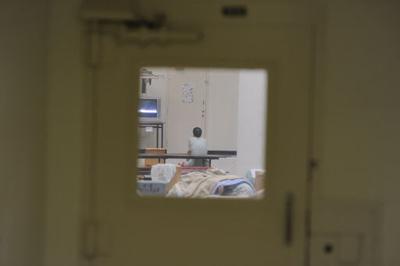

Sara Rubin here, thinking about what we still don’t know about conditions at Monterey County Jail. As you can read in a story by Rey Mashayekhi that will run in print in the July 27 issue of the Weekly, and is posted today on our website, the public is on the brink of either learning a lot—or potentially facing a court ruling that means continued secrecy of reports detailing physical health, mental health, disability access, general safety and other factors inside the jail.
This story began in 2013, when Jesse Hernandez and other people incarcerated in Monterey County Jail filed a class-action lawsuit in federal court. After two years of litigation, the County and its contractor that provides medical services in the jail agreed to settle with the plaintiffs. (That contractor was known as California Forensic Medical Group at the time; it is now called Wellpath.)
Part of that settlement agreement called for inviting neutral, third-party monitors who are experts in various fields—such as infectious disease control or psychiatric care—to visit the jail at least twice a year to ensure agreed-upon improvements were being made.
Now it’s eight years later, and the attorneys representing the plaintiffs in this case say the agreed-upon improvements are not being fulfilled. In April, they filed a motion asking a judge to find Wellpath “noncompliant with the settlement agreement.”
A hearing on that motion is scheduled for Aug. 24. Naturally, one of the factors the judge will take into account is the findings of the monitors who have been visiting the jail for years. Their reports, at least 30 of them, are filed with the court.
But they are filed under seal, meaning they are not accessible to the public. That means they are not viewable to the people incarcerated in the jail, to the press, to the general public and county taxpayers. And we at the Weekly believe these reports—likely the most meaningful, detailed accounts from a neutral third party that will ever be produced about conditions inside—should be made public.
For that reason, the Weekly has joined the legal effort to unseal these reports so we can learn in detail about what changes have and have not been implemented. Along with the First Amendment Coalition and the families of Mark Pajas Sr. and Rafael Ramirez Lara, two men who died while incarcerated in the jail, we filed a motion to become intervenors in this case, specifically on the matter of whether to unseal the monitors’ reports. We are represented by the Washington, D.C.-based nonprofit legal advocacy group Public Justice.
On Friday last week, the day after we filed our motion—which is still pending, with no determination yet on whether to grant our status as intervenors in the case—it seemed like it might all quickly become a moot point. U.S. District Court Judge Beth Labson Freeman ruled on previous arguments from the plaintiffs and the defendants about whether the monitors’ reports should be unsealed and become part of the public record—she ruled they should be. (With limited redactions to protect private information, such as the medical histories of people who have been incarcerated at the jail—as far as I can tell, nobody disputes that redactions to protect privacy are appropriate.)
But Wellpath quickly filed a notice of appeal with the Ninth Circuit Court of Appeals. With it, the company has also asked Freeman to stay her ruling, meaning it would not take effect while an appeal is pending. If the stay is granted, it seems unlikely that we will see the monitors’ reports before the judge decides on the bigger question on Aug. 24: Are the County and Wellpath doing enough to uphold their end of the settlement agreement, or not?
Without reading the third-party reports that tell us what’s really happening (or not) inside the jail, it’s hard to know. Formerly incarcerated people have stories to share of their personal experiences.
But the official message is shrouded in secrecy. Last week, I asked Monterey County Sheriff Tina Nieto how compliance is going. She told me in general that it’s going well—that prior to her tenure, it was up to one sergeant to file reports. She’s upgraded that to a group of people. “Now we have a team,” she said. “We have to look at what’s working and what’s not working, and how we get into compliance.”
When I asked her to elaborate on the part about what’s not working, I ran up against the secrecy part: “County counsel advises I don’t say. What I can say is, if we find issues, that we find best practices to improve issues.”
The more the public knows about those issues, the more the public will believe that sincere efforts are being made to protect health and safety inside a carceral facility. The more Wellpath pushes back, the more it makes me wonder: What are they trying to hide?
The Weekly will continue to cover this case in the coming weeks and months as it moves through the court system. Stay tuned for more. And if you or somebody you know has been incarcerated at Monterey County Jail and has a story to share, reach out any time.

(0) comments
Welcome to the discussion.
Log In
Keep it Clean. Please avoid obscene, vulgar, lewd, racist or sexually-oriented language.
PLEASE TURN OFF YOUR CAPS LOCK.
Don't Threaten. Threats of harming another person will not be tolerated.
Be Truthful. Don't knowingly lie about anyone or anything.
Be Nice. No racism, sexism or any sort of -ism that is degrading to another person.
Be Proactive. Use the 'Report' link on each comment to let us know of abusive posts.
Share with Us. We'd love to hear eyewitness accounts, the history behind an article.