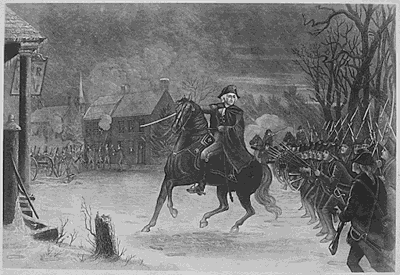

Dave Faries here, flipping through an old memoir but not finding the thing I was hoping to see.
The book was published anonymously around 1830 and later traced to the pen of one Joseph Plumb Martin, who had served in the Continental Army during the American Revolution. It is a treasure for several reasons, not the least of which is the author’s self-deprecating wit. The pages include much detail of desperate foraging for food and libations punctuated here and there by battles. Although journals and diaries survive, Martin’s is one of a very few memoirs written by private soldiers who fought the war.
Missing is any reference to the Declaration of Independence, particularly as motivation for joining the cause. However, Martin signed enlistment papers with a Connecticut temporary levy unit on July 6, 1776, which might suggest cause and effect. As he recalled the occasion, “I took up the pen, loaded it with the fatal charge, made several mimic imitations of writing my name, but took especial care not to touch the paper with the pen until an unlucky wight who was leaning over my shoulder gave my hand a stroke, which caused the pen to make a woeful scratch on the paper.”
When his term was up, Martin enlisted in the Continental Army—the regulars, commanded by General George Washington—and remained a soldier until the very end. Describing his discharge in 1783, he said “I confess, after all, that my anticipation of the happiness I should experience on such a day as this was not realized…We had lived together as a family of brothers for several years.”
John Dickenson, a delegate to the Continental Congress, opposed adoption of the Declaration of Independence. Not that he was particularly fond of British rule. To commit the fortunes of 13 colonies to such a document, he said, would be “to brave the storm on a skiff made of paper.” The delegates were often contentious and forced many changes to Thomas Jefferson’s draft. They agreed, however, on a list of grievances and a philosophy of government bold for its time.
I urge everyone to read beyond the stirring passages of this country’s founding document and study its core. Government exists to secure the rights of its citizens. More importantly, governments derive “their just powers from the consent of the governed.” It should be duly noted that the rights in question were intended for the most part to cover white male landowners. America has always been a work in progress.
To that point, Congress set a foundation for change: “That whenever any Form of Government becomes destructive of these ends, it is the Right of the People to alter or to abolish it, and to institute new Government.” Six Supreme Court justices may not see it in the Constitution, adopted in 1787 and amended—a synonym of altered—many times since, but the right to transform government in order to, say, grant women reproductive rights is enshrined in the nation’s founding document.
The concept of abolishing the existing government is often cited by those with a complaint. It’s easy to label something as “government overreach” and demand that federal power be stripped. In 1776—in the midst of revolution—Congress cautioned that “Prudence, indeed, will dictate that Governments long established should not be changed for light and transient causes.”
What follows is a list of 27 specific grievances against King George III and his rule over the colonies. Despite a slur directed toward indigenous peoples that may raise eyebrows now, each point builds to a compelling case for change, the need to form a government of the people, by the people and for the people (again, within the limits of that concept at the time).
These complaints and the spirit they inspired made that skiff of paper more resilient than Dickenson ever imagined. Martin and his comrades in the Continental Army were defeated far more often than they won. General Nathanael Greene once noted that the strategy was to “fight, get beat, rise and fight again.” While most militia units—the ones associated with the right to keep and bear arms—would scamper home (and later receive the plaudits for final victory), the Continentals received little in the way of support or pay. They bore the brunt, rag tag and bobtail.
As the war neared its end, the Pennsylvania Line of the Continental Army had enough. They determined to mutiny and ask Congress for their missing back pay. The British got wind of this and sent an emissary with a promise of compensation if they would quit the war. Instead, they seized the British representative. They would see out the war. They just wanted what was promised to them.
In March of 1783, Continental Army officers—who had also gone without pay—considered a more direct threat against Congress. A petition circulated calling for an armed move against Congress to claim back pay and pensions by force, if necessary. Washington slipped through a side door and interrupted the officers’ meeting. After condemning the plot, he opened a letter from a member of Congress indicating support for their demands.
There are slightly different accounts of what happened next when it comes to wording, but the gist is the same. Washington had shared in all of their tribulations. He knew the depth of purpose, the spirit that had carried them to the brink of victory. He paused, unable to read the letter, and then reached for a pair of reading glasses.
“Gentlemen,” he said to the group. “You will permit me to put on my spectacles, for I have not only grown gray in the service of my country, but almost blind.”
The meeting broke up with tears flowing.
Despite frustrations over an ill-functioning federal government that was born in revolution, starved of income and still in the process of becoming, these were men inspired by words on a sheet of paper to take on a storm. Little gestures could rekindle the spirit of ’76.
It was a seemingly innocuous line from the Declaration of Independence that caused me to rummage through my bookshelves for Joseph Plumb Martin’s memoir. The document signed on July 4, 1776 reminds the British people that the new nation would hold them “Enemies in War, in Peace Friends.”
Martin recalled a sweltering afternoon—so muggy he mentions the fact several times—in June of 1778 on a field outside of Monmouth Courthouse in New Jersey. The Continentals held firm and broke the British line, but the heat of battle was now a distant memory.
“They were retreating in line, although in some disorder. I singled out a man and took my aim directly between his shoulders. He was a good mark, being a broad-shouldered fellow. What became of him I know not; the fire and smoke hid him from my sight. One thing I know, that is, I took as deliberate aim at him as ever I did at any game in my life. But after all, I hope I did not kill him, although I intended to at the time.”
Here’s to the wisdom, the sweat and suffering of all who forged a new way forward then, despite their flaws and differences. Let’s keep their work in progress.

(0) comments
Welcome to the discussion.
Log In
Keep it Clean. Please avoid obscene, vulgar, lewd, racist or sexually-oriented language.
PLEASE TURN OFF YOUR CAPS LOCK.
Don't Threaten. Threats of harming another person will not be tolerated.
Be Truthful. Don't knowingly lie about anyone or anything.
Be Nice. No racism, sexism or any sort of -ism that is degrading to another person.
Be Proactive. Use the 'Report' link on each comment to let us know of abusive posts.
Share with Us. We'd love to hear eyewitness accounts, the history behind an article.