
Sara Rubin here, thinking about sharks. I’ll admit it—I think about sharks a lot. If you swim in the ocean around here, you’ve at least considered that they live here and they hunt mammals for food. Over the years that I’ve been swimming with a group called the Kelp Krawlers, I’ve spent some swims completely consumed by talking myself out of thinking about sharks. It’s a mental game as much as a physical one, swimming in conditions that can include waves, currents, cold temperatures, jellyfish, curious seals. The ocean is not a pool. It’s also for that reason that it’s so thrilling—it’s a beautiful, wild place that also includes sea grass, kelp, sea stars, fish of all sizes (my favorites are schools of silvery anchovies) and, yes, a certain amount of inherent risk.
Steve and Brita Bruemmer, fellow members of the Kelp Krawlers, had grown accustomed to managing that risk on ocean swims. (Brita’s experience is similar to mine: “Sometimes I would think: ‘I cannot think about [sharks], I have to distract myself and keep swimming.’”) The Monterey couple got into ocean swimming starting roughly 15 years ago after doing the Pacific Grove triathlon, and it was a perfect complement to running and biking. It became an even bigger part of Steve Bruemmer’s life after he retired. (In the Kelp Krawlers, he is known as “Fast Steve.”)
Then one year ago today, on June 22, 2022, he was swimming at Lovers Point when he suddenly found himself in the jaws of a great white shark. I spoke to the Bruemmers for a story in this week’s issue of the Weekly, and mostly I was wowed by Steve’s story of resilience.
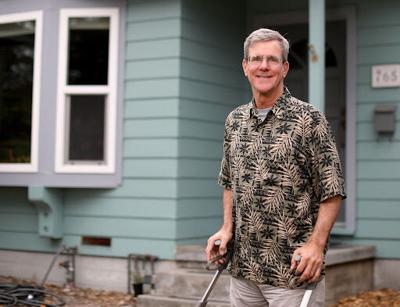
He’s at once hopeful about a continued recovery, and accepting of his physical constraints. He’s waiting on the results of a recent surgery at Stanford that may have been successful at repairing his femoral nerves. But the wait will be long, likely at least two years, until he knows if he’ll regain mobility from that operation. So in the meantime, he is accepting of his new reality—going from a very physically active person to somebody who cannot walk unassisted, without a walker. He got a new, high-end walker with pneumatic wheels that enables him to get around on uneven terrain; they installed grab bars in the bathroom so he can use the toilet; Brita put in a new walkway and patio seating area in the garden. On a recent trip with college friends that revolved mostly around golf, Bruemmer drove the golf cart—he calls it a beer cart, but don’t tell the course officials that—since he cannot play golf.
It’s been a journey in acceptance. “I need to start living my life again,” he told me.
It’s also been a journey in gratitude. Bruemmer is overcome with gratitude a year later as he reflects on everyone who enabled him to survive, from the three heroic rescuers who paddled into bloody water to the ambulance drivers to the medical team at Natividad to the blood donors (during surgeries, he received about double the amount of blood the human body contains in donations) and more.
During the hours he spent at home recovering, Bruemmer returned to the story of the Good Samaritan, and says one thing that struck him upon rereading it was that the Good Samaritan was anonymous.
“When I think of the Good Samaritans in this story, they are the taxpayers who put together this system, and the blood donors,” he says. “I’m grateful we all care for each other like that. The modern-day way to love your neighbor is to pay your taxes and call 911.”
While the Bruemmers won’t go back in the ocean—instead, they’ve taken to swimming regularly in the Monterey Peninsula College pool—they also have stayed tight with the Kelp Krawler community. A few months ago, Steve asked before a swim at Lovers Point if his presence made us nervous; while many members of the group have stopped swimming at Lovers Point (where two other shark-human encounters occurred in the past year, with a stand-up paddleboarder and a surfer) and switched to Del Monte Beach or other locations, I find something comforting about his continued presence. It’s a reminder that we can face the worst and forge ahead, one assisted step at a time.
See you in the ocean.
(0) comments
Welcome to the discussion.
Log In
Keep it Clean. Please avoid obscene, vulgar, lewd, racist or sexually-oriented language.
PLEASE TURN OFF YOUR CAPS LOCK.
Don't Threaten. Threats of harming another person will not be tolerated.
Be Truthful. Don't knowingly lie about anyone or anything.
Be Nice. No racism, sexism or any sort of -ism that is degrading to another person.
Be Proactive. Use the 'Report' link on each comment to let us know of abusive posts.
Share with Us. We'd love to hear eyewitness accounts, the history behind an article.