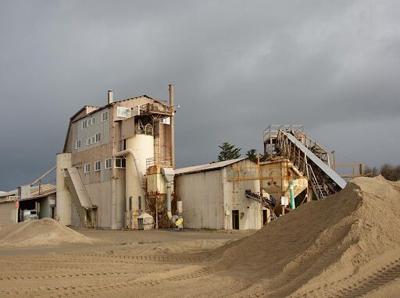

David Schmalz here, thinking about sand. That’s because, with the recent storms, the beaches along southern Monterey Bay will be seeing more of it. Monterey County officials cut a canal in the Salinas River in December as a preventative measure for flooding, allowing the river to flow freely into the bay, south of the Monterey Submarine Canyon.
Sand is something I’ve thought about often since late 2015, when I started reporting on a group of local activists lobbying to shut down the Cemex sand mine in Marina, the last coastal sand mine in the United States. The cover story I wrote about that effort was published in the Weekly on Jan. 14, 2016, almost seven years ago to the day.
In July 2017, the California Coastal Commission negotiated a consent order with Cemex to shut down mining on the property—west of Highway 1, north of Reservation Road—by Dec. 31, 2020. For those who worked to shut the mine down, including coastal engineer Ed Thornton, the local chapter of the Surfrider Foundation and citizens in Marina, it was a historic victory.
With the recent storms, those activists are finally going to start seeing the fruits of their hard work. Or rather, more precisely, the sand.
One thing I hadn’t fully appreciated as I set out to report that story is that the sand on our local beaches comes from the land—rocks eroding over time that eventually get deposited on beaches in the form of sand, often through river flow. The Salinas River is a primary source of sand for southern Monterey Bay beaches, and I can assure you, the riverbed is full of sand—in 2014 I hiked it from the county line near Camp Roberts all the way north to Spreckels, and where there wasn’t water flowing it was all sand, sand, sand.
Locals cut a channel for the river to flow out to the bay in 1910 to prevent flooding and ever since, during high river flows, sand enters the Monterey Bay and ends up in the local system. And because the man-made channel hits the bay south of the Monterey Canyon, it stays in the system as opposed to sinking into the deep sea.
But for most of the 20th century, there were also sand mines stretching from Seaside to Marina. So instead of major storms replenishing our local beaches with sand, the sand mining operations were taking that sand, and more—southern Monterey Bay had one of the highest coastal erosion rates of anywhere in the state.
Now, with the Salinas River breaching the lagoon and sand mining no longer operational, the process is finally beginning to build our local beaches back. Ultimately, this will help buttress the coastline from Marina to Monterey against climate change-induced sea level rise.
Thornton, who I caught up with last week, says the recent storms mean that “we’re getting a lot of sand back.” Still, he adds, it will take three to five years to notice the impact. As for the process moving forward, bolstered by future major storm events, the beaches will continue to grow. “The positive news is it will outweigh the sea level rise for many, many years,” Thornton says.
(1) comment
In 1967 I took a rowboat from King City to Chualar when the Salinas River was at high flood stage. It won't take long for the sand to be recharged, if the waterflow is high. Lots of fresh water going to the sea, not being captured, too.
Welcome to the discussion.
Log In
Keep it Clean. Please avoid obscene, vulgar, lewd, racist or sexually-oriented language.
PLEASE TURN OFF YOUR CAPS LOCK.
Don't Threaten. Threats of harming another person will not be tolerated.
Be Truthful. Don't knowingly lie about anyone or anything.
Be Nice. No racism, sexism or any sort of -ism that is degrading to another person.
Be Proactive. Use the 'Report' link on each comment to let us know of abusive posts.
Share with Us. We'd love to hear eyewitness accounts, the history behind an article.