
Christopher Neely here, as awake as ever to the contributions of scientists along Monterey Bay to the progress of marine biology.
The latest example of the sci-fi work being done in our backyard involves decoding the communication patterns of the world’s largest known animal, and deciphering, through those patterns, how they react to their environment and how this flexibility might contribute to their long term success in a rapidly changing ocean.
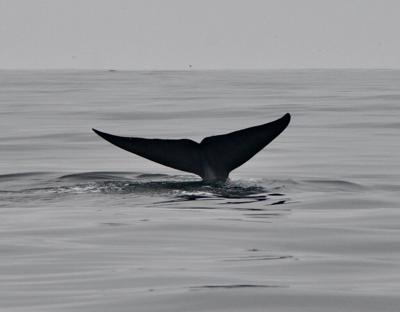
Blue whales are majestic animals. Weighing in up to 330,000 pounds and measuring 80 feet long, with an average lifespan of up to 90 years, they are the largest animal known to ever exist on Earth. However, this majesty comes with much mystery. Relatively little is known about this species, but a pair of new studies has given scientists a rare view into the life and complexities of the blue whale.
This new information begins with a crowning achievement out of the Monterey Bay Aquarium Research Institute: the hydrophone. This underwater microphone, installed in 2015, sits off the Monterey Bay at a depth of 900 feet. It is powered by a cable system, which has allowed the microphone to record sea sounds continuously for seven years. The hydrophone is unique along the coast of California, transcending the limits of batteries and memory cards.
Despite their size and clear need for as many nutrients as possible, blue whales are innately unselfish foragers according to the first study, led by David Cade, now a postdoctoral research fellow at Pacific Grove’s Hopkins Marine Station, and co-authored by MBARI biological oceanographer John Ryan and incoming MBARI postdoctoral fellow William Oestreich. With Ryan analyzing environmental variables and Oestreich analyzing speech patterns, the research team found that blue whales, which often travel in pairs or as individuals, can recognize when a patch of krill (a blue whale’s favorite meal) is especially dense. The whale will send out a call that can travel hundreds of kilometers and alerts other blue whales of the feast. According to the study, this can lead to up to 40 blue whales populating a one-kilometer radius, feeding on the krill swarm.
This is remarkable, says Oestreich, since krill populations are often patchy and spread out. Oestreich says if whales find food that is going to help them survive, then it’s intuitive that they just feed on it and move on but the study shows a propensity for inviting other blue whales to the dinner table. But it’s not as if a whale finds food, eats until full and then calls other whales to feed on the leftovers. Oestriech says there is growing evidence that a blue whale can recognize the krill is dense before it begins feeding, deciding preemptively to share.
Ryan says this means individual blue whales can be sensors for dense krill swarms, a critical attribute to ensuring the survival of the pack in a large and patchy ocean. Ryan says these feeding groups are becoming more common, which might signal the populations are recovering from decades of harm from the whaling industry.
After feeding along the Central Coast between June and September, blue whales migrate south and, by January, are typically found in Mexico and Central America, mating and breeding. However, the second study further emphasizes the ability of blue whales to adapt to their environment. Led by Oestreich and co-authored by Ryan, the study, which similarly analyzed whale sounds and environmental variables, shows blue whale populations can alter their migratory and breeding schedules by up to four months if food is especially plentiful up north.
This was especially puzzling to the researchers for two reasons. 1.) The breeding cycle for blue whales typically only lasts for four months, which makes a four-month variation significant. 2.) Research has shown blue whales are very punctual when migrating north to begin foraging. This level variation, even between consecutive years, on their southern migration shows an ability to actively prioritize feeding and decide to delay breeding, reacting in the moment to environmental factors.
This ability to make decisions based on the environment is not necessarily unique. What is unique, Oestreich says, is the ability by researchers to learn about these decisions among marine animals, which are more difficult than terrestrial animals to observe so continuously. Ryan and Oestreich say none of this is possible without MBARI’s cabled hydrophone.
Read full newsletter here.

(0) comments
Welcome to the discussion.
Log In
Keep it Clean. Please avoid obscene, vulgar, lewd, racist or sexually-oriented language.
PLEASE TURN OFF YOUR CAPS LOCK.
Don't Threaten. Threats of harming another person will not be tolerated.
Be Truthful. Don't knowingly lie about anyone or anything.
Be Nice. No racism, sexism or any sort of -ism that is degrading to another person.
Be Proactive. Use the 'Report' link on each comment to let us know of abusive posts.
Share with Us. We'd love to hear eyewitness accounts, the history behind an article.