
Celia Jiménez here, remembering the language barriers I faced when I first came to the U.S. in 2010—the feeling of isolation, and the time I spent reading lips to make sure I understood what others were saying. It’s a memory that came back during shelter-in-place orders early during Covid-19, when the ever-changing virus information we received was available primarily in English and Spanish. But there weren’t a lot of resources in Mexican Indigenous languages—including Mixteco, Triqui and Zapoteco—spoken by many Monterey County residents. (According to the census, 29 percent of people living in the county are foreign-born).
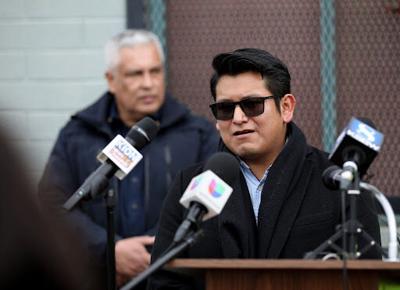
The recent winter storms, which have caused flooding in various parts of the county and displaced residents along the Pajaro, Arroyo Seco, Carmel and Salinas rivers (affecting communities, among others, in Pajaro, San Ardo, King City and Chualar), brought something new to the mix: official translation, in both Spanish and Mixteco, at a press conference outside La Casa de la Cultura in Pajaro. Mixteco is the Indigenous language spoken in the Mexican region called “La Mixteca,” which includes parts of the Mexican states of Oaxaca, Guerrero and Puebla.
It was the first time Monterey County offered a trilingual press conference in English, Spanish and Mixteco. “We hope to do more of that in the future in terms of emergency preparedness and response,” says Supervisor Luis Alejo. The county also has its first Spanish interpreter for the Office of Emergency Services, who interpreted live during a press conference yesterday about the latest flooding predictions. Alejo highlighted the county’s communications department has a Spanish speaker on staff as well. “We can't wait hours or the next day to translate something that needs to be done right away,” Alejo adds.
The Centro Binacional para el Desarrollo Indígena Oaxaqueño and the Language Access Services from Natividad Hospital (the hospital provides interpretation in several Indigenous languages) helped the county provide Mixteco interpretation in Pajaro, as well as videos in Triqui and Mixteco. Sarait Martinez, CDBIO executive director, says that over the past three years of providing interpretation services and making videos for the Indigenous community, more people have become aware of the organization and the Mexican Indigenous groups that live in the county. “We didn't have the strong presence that we have now,” Martinez says.
Many Indigenous language speakers are less likely to be able to read and write, and one language might have several variants. “It's important to target the message…because Indigenous languages are very complex,” Martinez says. “We stay away from translating any documents, but we do focus a lot on videos and audio.”
Previously, the county informally reached hundreds of Indigenous people through the VIDA Project, a countywide program designed to help vulnerable residents in Monterey County navigate Covid-19 resources. Marciana Lazaro was one of the trilingual community health workers who spoke in Mixteco and Spanish with hundreds of farmworkers. Audelia Garcia Cervantes, board president of the group Lideres Campesinas, said having Indigenous speakers help them build trust among the farmworker community.
I spoke with Maia Carroll, Monterey County communications coordinator, and Daniel González, the Spanish interpreter for the County Office of Emergency Services, about this step forward to provide information to non-English speakers. They both say the work is still in its infancy and that they are looking for feedback on how to make it better. If you are interested in providing ideas, you can email pr@co.monterey.ca.us.
(0) comments
Welcome to the discussion.
Log In
Keep it Clean. Please avoid obscene, vulgar, lewd, racist or sexually-oriented language.
PLEASE TURN OFF YOUR CAPS LOCK.
Don't Threaten. Threats of harming another person will not be tolerated.
Be Truthful. Don't knowingly lie about anyone or anything.
Be Nice. No racism, sexism or any sort of -ism that is degrading to another person.
Be Proactive. Use the 'Report' link on each comment to let us know of abusive posts.
Share with Us. We'd love to hear eyewitness accounts, the history behind an article.