
Celia Jiménez here, thinking about the legacy our ancestors left behind and how the decisions they made shaped where we are today.
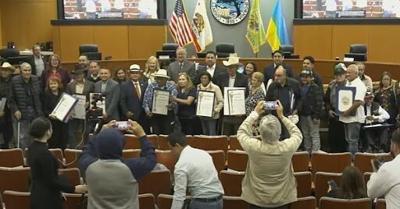
Yesterday, Sept. 12, the Monterey County Board of Supervisors adopted a resolution to recognize the first annual Bracero Workers History Recognition Week during the week of Sept. 16. The goal of the week is to celebrate the impact and contributions of Bracero Program workers, and their families, in the Salinas and Pajaro valleys.
“There is so much history that gets lost because we don’t tell our stories,” Supervisor Chris Lopez said.
Many people in the region have ties to the Bracero Program, including Supervisor Luis Alejo and Supervisor Lopez, whose grandfathers arrived in the United States through this unique labor agreement. The fathers of Sonia De La Rosa, the first Latina to serve as the county’s administrative officer, Blanca Zarazua, the Mexican honorary consul in Salinas, and former Supervisor Simon Salinas were also Braceros.
The Bracero Program was an agreement between the United States and Mexico that allowed millions of Mexican workers to legally work in the U.S. during the World War II labor shortage. It began in 1942 and lasted over 20 years.
It isn’t a coincidence that Bracero Workers History Recognition Week is celebrated during the week of Sept. 16. National Hispanic Heritage Month starts a day before, on Sept. 15. On Sept. 16, Mexico celebrates its Independence Day and Sept. 17 is the 60th anniversary of a heartbreaking crash where 32 Braceros lost their lives in Chualar.
During the ceremony, former Bracero David Saucedo Salas sang the first lines of his corrido about the Chualar tragedy. Corridos are a popular Mexican musical genre that started in the 19th century during the Mexican Revolution (Mexico’s civil war) as a way to celebrate the achievements of Mexican revolutionaries and spread news.
Bracero history recognition week isn’t just about the past. “It’s a day to celebrate the future,” Supervisor Mary Adams said, “because there has been so many seeds that people sowed that now allow for the wonderful things that are happening in our community.”
Celebrating contributions of Braceros in our community also reminds us that this is still a living history. Yesterday, we put names and faces to people who worked in this area in the 1940s, ’50s and ’60s. They are now men in their 80s and beyond—people with a wealth of stories who we can still get in touch with and learn from.

(0) comments
Welcome to the discussion.
Log In
Keep it Clean. Please avoid obscene, vulgar, lewd, racist or sexually-oriented language.
PLEASE TURN OFF YOUR CAPS LOCK.
Don't Threaten. Threats of harming another person will not be tolerated.
Be Truthful. Don't knowingly lie about anyone or anything.
Be Nice. No racism, sexism or any sort of -ism that is degrading to another person.
Be Proactive. Use the 'Report' link on each comment to let us know of abusive posts.
Share with Us. We'd love to hear eyewitness accounts, the history behind an article.