
David Schmalz here, thinking about imaginary lines—borders, essentially—that in many ways seem arbitrary but that can have a real, tangible impact on our lives.
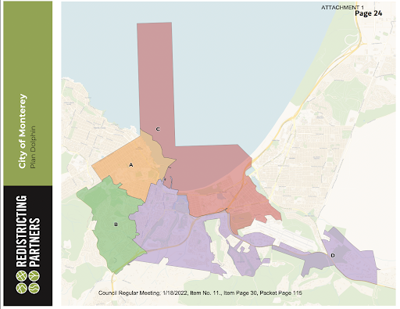
It’s on my mind because last night, the Monterey City Council adopted its draft map to transition the city from at-large City Council elections—meaning anyone living anywhere in the city can run for any open seat—to district elections, where the city is divided up into four districts with one councilmember from each.
The impetus for the transition came from a September letter Andrew Sandoval, director of the Salinas-based chapter of the League of United Latin American Citizens, or LULAC, sent to the city, which said his organization believed Monterey’s current system violates state law and threatened litigation if the city didn’t make the change.
Seeking to avoid a lawsuit, the City Council agreed. By early November, Monterey had begun outreach to residents seeking feedback about where they’d like to see the lines drawn. Out of that process came four different draft maps the city published in late December, and last night it finally came time for the City Council to choose which version they want to move forward with.
A big piece of the discussion at the meeting, both from the councilmembers and the public, was increasing representation on the Council for renters, who account for about two thirds of the city’s population. All of the current councilmembers are homeowners, and all five live in just two of the city’s 16 distinct neighborhoods.
Speaking to this, Councilmember Tyller Williamson proposed adopting the “abalone” map—all of the draft maps are named for marine creatures—because he felt it was the option that gave renters the best representation because, according to the data, most renters live near the coast, and the “abalone” plan had two districts that were consolidated near the water. The motion was seconded by Councilmember Alan Haffa.
Mayor Clyde Roberson expressed that he didn’t see there being a divide between renters and homeowners, and said the City Council seeks to represent all the residents of the city. Williamson’s motion failed in a 2-3 vote.
So the Council went back to the original motion, made by Councilmember Ed Smith, to adopt the “dolphin” map—interestingly, it was the only one of the four in the city’s report that didn’t have the word “draft” on it—which the Council adopted in a 3-2 vote with Haffa and Williamson dissenting.
The meeting then soon went off the rails as the Council discussed which two districts should be up for election in 2022. But when the dust settled, the Council, in a 3-2 vote that broke down on the same lines, ultimately went with City Manager Hans Uslar’s recommendation to choose districts A and D, which would allow both Smith and Williamson to run again in 2022 when their terms are up.
The City Council will next consider the issue Feb. 1, when they will be asked to vote on an ordinance establishing the districts and the election sequencing. That will be the last chance for changes to be made to the process, but given the way the votes broke down last night, that doesn’t seem likely.
Democracy can be messy sometimes—happening in fraught conversations and compromises. At one point in the meeting, Councilmember Dan Albert said, “This is the most uncomfortable conversation we’ve had in the last eight years”—but it’s the best system we’ve got.
Read the full newsletter here.

(0) comments
Welcome to the discussion.
Log In
Keep it Clean. Please avoid obscene, vulgar, lewd, racist or sexually-oriented language.
PLEASE TURN OFF YOUR CAPS LOCK.
Don't Threaten. Threats of harming another person will not be tolerated.
Be Truthful. Don't knowingly lie about anyone or anything.
Be Nice. No racism, sexism or any sort of -ism that is degrading to another person.
Be Proactive. Use the 'Report' link on each comment to let us know of abusive posts.
Share with Us. We'd love to hear eyewitness accounts, the history behind an article.