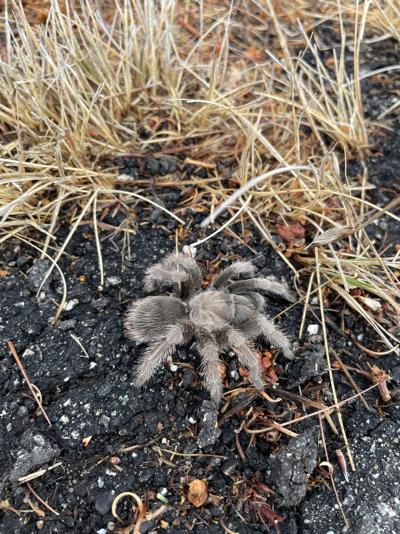

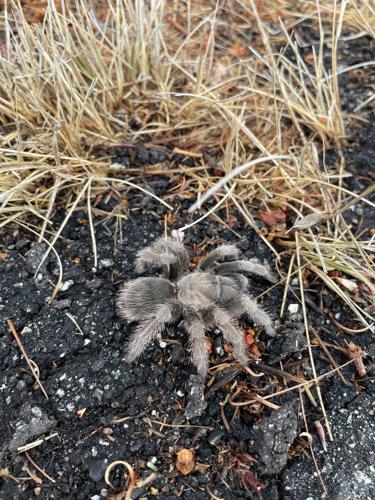
Agata Popęda here, learning about tarantulas’ love lives. And there’s a reason for it, too.
Compared to any other time of the year, it’s quite likely you will encounter a tarantula in the next few weeks. That’s because from late summer to early fall male tarantulas venture out from the underground world, confronting danger and daylight—all for a fling.
Because, and I do believe that Alix Soliman, communications and outreach coordinator for the Santa Lucia Conservancy, would agree—tarantulas are not looking for lasting love. After conducting their risky mating business—if they are lucky—they will soon return to their solitary burrows, where nobody can pity them for not hearing very well and not seeing very well, despite having as many as eight eyes!
“They are all over California,” Soliman says when asked about the origin of the species. “More in Southern California than here, but they are all over North America.” It turns out tarantulas are ultimate Americans—they originated over 100 million years ago on the supercontinent Gondwana, what is now the Americas. Since then, they have spread across the earth as tectonic plates divided—skipping only Antarctica.
From Soliman’s blog post on tarantulas, I learned that arachnophobia, a deep fear of spiders, is culturally acquired and that young children don’t mind spiders that much, before being introduced to fearing them. Tarantulas are certainly not spiders to be afraid of. Palm-sized, slow-moving and fuzzy thanks to characteristic hair, tarantulas can’t really harm a human. Soliman called them “docile creatures.” Yes, they do have venom, but it is not toxic to humans as it’s just a digestive enzyme to help the spider eat.
But let’s talk about sex and what happens when sexually mature males between the ages of eight and 10—the ones that you can spot these days on the move near desserts or grasslands—succeed.
“It’s mostly pheromones,” Soliman says, by way of explaining what force guides the semi-blind, semi-deaf male tarantula in his mating efforts. First, he finds his lady’s burrow. Then, he starts to strum rhythmically on the web at the entrance—not unlike a persistent knocking.
“If the female wishes to mate, she will drum a beat with her legs and emerge,” Sullivan wrote in the blog post. “If not, she will either stay in or come out to devour the much smaller male.”
The actual sex part seems frantic too because the male has to first put a female tarantula into a trance-like state, risking each second that she will bite him. Fascinating? Not as much as the fact that after he inserts sperm-laden “pedipipals” into the female, she can lay between 50 and 2,000 eggs.
And this is where I’ll diplomatically stop because the issue of little spiderlings, and the scandalous difference in life expectancy between a male and female tarantula, is something that you should explore on your own. Or with the help of the Santa Lucia Conservancy.
In the meantime, help a fuzzy friend out when you spot him outside the burrow by letting him go. Between coyotes and badgers, and his intimidating, prone-to-attack mate, he needs all the luck in love he can get.

(0) comments
Welcome to the discussion.
Log In
Keep it Clean. Please avoid obscene, vulgar, lewd, racist or sexually-oriented language.
PLEASE TURN OFF YOUR CAPS LOCK.
Don't Threaten. Threats of harming another person will not be tolerated.
Be Truthful. Don't knowingly lie about anyone or anything.
Be Nice. No racism, sexism or any sort of -ism that is degrading to another person.
Be Proactive. Use the 'Report' link on each comment to let us know of abusive posts.
Share with Us. We'd love to hear eyewitness accounts, the history behind an article.